



Search for AI jobs for five minutes and you’ll run into the AI engineer vs. machine learning engineer question. Two postings, nearly identical requirements, two different titles. A third one says “AI/ML engineer,” just to keep things interesting.
The mix-up makes sense. Machine learning is a branch of AI, and the two jobs share plenty of tools. But since large language models went mainstream, the day-to-day work has pulled apart. So has the pay, at least on paper.
Quick answer: A machine learning engineer builds, trains, and maintains the models. An AI engineer builds products and features on top of models, often large language models someone else trained, and makes them work reliably for real users.
Below, we compare the two roles side by side: what each one does, where they overlap, the skills and tools involved, what they pay, how demand is shifting, and how to pick the path that fits you.
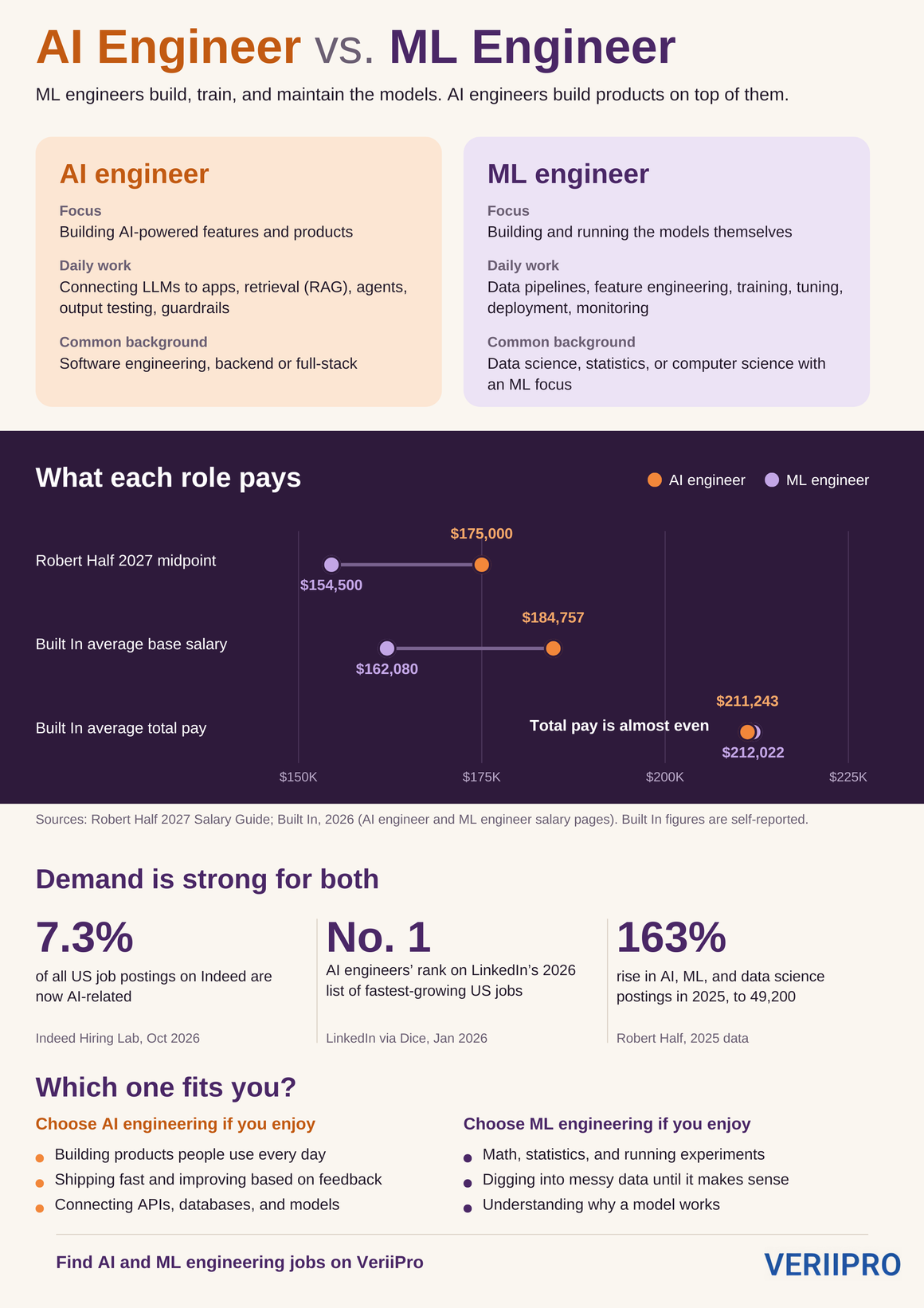
AI Engineer vs. Machine Learning Engineer at a Glance
Here’s the short version before we get into the details.
| Factor | AI Engineer | Machine Learning Engineer |
|---|---|---|
| Main focus | Building AI-powered features and products | Building and running the models themselves |
| Core question | How do we make this model useful and reliable in our product? | How do we get a model that predicts well and keeps doing it? |
| Day-to-day work | Connecting LLMs to apps, retrieval (RAG), agents, output testing, guardrails | Data pipelines, feature engineering, training, tuning, deployment, monitoring |
| Typical tools | LLM APIs, LangChain, vector databases, Python, cloud AI services | PyTorch, TensorFlow, scikit-learn, Spark, MLflow, cloud ML platforms |
| Math depth | Moderate: enough to understand how models behave | Heavy: statistics, linear algebra, optimization |
| Data work | Prepares documents and context for models | Cleans, labels, and engineers training data at scale |
| Common background | Software engineering, backend or full-stack | Data science, statistics, or computer science with an ML focus |
| Pay (Robert Half 2027 midpoint) | $175,000 | $154,500 |
| Common next step | Staff AI engineer, AI architect | Staff ML engineer, MLOps lead, ML architect |
The pay figures come from Robert Half’s 2027 Salary Guide. We’ll dig into them, and why total pay tells a different story, further down.
What Does an AI Engineer Do?
An AI engineer takes models that already exist and turns them into something people can use. That might be a support chatbot that answers from a company’s help docs, a tool that summarizes contracts, or an agent that schedules meetings by calling other software. Most of the time, the model comes from a provider’s API or an open-source release. The AI engineer’s job is everything around it.
Typical duties include:
- Building features on top of large language models (LLMs) through APIs or open-source models
- Setting up retrieval-augmented generation (RAG) so a model answers from a company’s own data, a setup we explain in our deep dive into RAG and vector databases
- Designing AI agents that call tools, APIs, and databases to finish multistep tasks
- Writing evaluations that test output quality and catch errors before users do
- Adding guardrails for safety, privacy, and made-up answers
- Keeping cost and response time under control as usage grows
Think of it as software engineering with a very powerful, slightly unpredictable part in the middle. A big piece of the job is getting that part to behave.
What Does a Machine Learning Engineer Do?
A machine learning engineer works one layer down. They take raw data, turn it into a model that makes reliable predictions, and keep that model healthy once it’s live. Fraud detection, product recommendations, demand forecasting, search ranking, and image recognition are classic ML engineering work. So is training or fine-tuning the models that AI engineers build on.
Typical duties include:
- Building data pipelines that collect, clean, and prepare training data
- Engineering features and choosing the right algorithm for the problem
- Training, tuning, and evaluating models against clear metrics
- Deploying models into production as APIs or batch jobs
- Watching for model drift and retraining when the data changes
- Building MLOps workflows for versioning, testing, and automated retraining, the kind of pipeline we walk through in Cracking the MLOps Role
A useful way to remember the difference: the ML engineer worries about whether the model is right and will stay right. The AI engineer worries about whether the feature built on it actually helps the user.
Where the Roles Overlap (and Why Titles Blur)
The overlap is real. Both roles write a lot of Python, deploy to the cloud, and care about what happens when real users show up. Both need to understand how models fail. And at smaller companies, one person often does both jobs.
Even the people who track the job market lump them together. LinkedIn’s 2026 Jobs on the Rise list ranked AI engineers, a group LinkedIn also calls machine learning engineers, as the fastest-growing role in the US, according to Dice. Robert Half’s 2026 salary data showed a single “AI/ML engineer” title. Its 2027 Salary Guide now lists AI engineer and ML engineer separately, with different pay ranges. That split says a lot about where the market is heading.
So the advice is the same one we gave in our backend engineer vs. backend developer comparison: read the job description, not just the title. Look at the verbs. “Train,” “tune,” and “feature engineering” point to ML engineering. “Integrate,” “RAG,” “agents,” and “evaluate LLM outputs” point to AI engineering.
How They Work Together: One Feature, Two Roles
Here’s how the split plays out on a real project. Say a job site wants a smart assistant that recommends jobs and answers candidates’ questions.
- The ML engineer builds the matching model. They pull past application and click data, clean it, and train a model that ranks jobs by how likely a candidate is to apply and get hired.
- The ML engineer ships it and watches it. The model goes live behind an API, with monitoring that flags when accuracy drops, for example when hiring slows in one sector and old patterns stop holding.
- The AI engineer builds the assistant. They connect an LLM to the matching model and the site’s help pages, so the assistant can answer “Which remote data jobs fit my resume?” in plain English.
- The AI engineer tests and guards it. They write evaluations for wrong or made-up answers, block questions the assistant shouldn’t touch, and cap what each conversation costs.
- Both improve it with real feedback. Clicks and complaints go back to the ML engineer for retraining and to the AI engineer for better prompts and retrieval.
Short version: the ML engineer makes the system smarter. The AI engineer makes it useful.
Skills and Tools Compared
There’s a shared foundation, then each role branches off.
Skills Both Roles Need
- Python, plus solid software habits like Git, testing, and code review
- How machine learning models work, and how they fail
- Cloud platforms such as AWS, Azure, or Google Cloud
- APIs, containers like Docker, and basic deployment
- SQL and comfort working with data
- Clear communication with product teams and non-technical colleagues
AI Engineer Skills
- Working with LLM APIs and open-source models
- RAG, embeddings, and vector databases
- Agent frameworks such as LangChain, plus tool calling
- Prompt design and structured outputs
- Evaluating and testing model outputs
- Guardrails, security, and cost control
- Backend or full-stack development, since you’re shipping product features
LinkedIn’s data lines up with this. LangChain, RAG, and PyTorch are the most common skills among AI engineers, per Dice’s summary of the list.
Machine Learning Engineer Skills
- Statistics, linear algebra, and probability
- Classic ML algorithms and deep learning
- PyTorch, TensorFlow, and scikit-learn
- Feature engineering and data preprocessing
- Large-scale data tools like Spark
- MLOps: experiment tracking, model registries, and CI/CD for models
- Model monitoring and retraining
The biggest gap is math. You can be a strong AI engineer with a working sense of how models behave. ML engineers need the theory to figure out why a model is wrong and how to fix it.
AI Engineer vs. Machine Learning Engineer Salary
Both roles pay well into six figures. Which one pays more depends on what you count.
Robert Half’s 2027 Salary Guide puts AI engineers at $154,500 to $196,750, with a midpoint of $175,000. ML engineers come in at $124,250 to $177,000, with a midpoint of $154,500. That’s a $20,500 gap at the midpoint, in favor of AI engineers.
Built In’s self-reported salary data shows the same pattern on base pay: an average of $184,757 for AI engineers vs. $162,080 for ML engineers. Then look at total pay, and the gap disappears. ML engineers report an average of $49,942 in additional cash pay, nearly double the $26,486 AI engineers report. That brings their total to $212,022, just ahead of AI engineers at $211,243.
| Pay measure | AI Engineer | Machine Learning Engineer |
|---|---|---|
| Robert Half 2027 range | $154,500 to $196,750 | $124,250 to $177,000 |
| Robert Half 2027 midpoint | $175,000 | $154,500 |
| Built In average base salary | $184,757 | $162,080 |
| Built In average additional cash pay | $26,486 | $49,942 |
| Built In average total pay | $211,243 | $212,022 |
So who earns more? On base salary, AI engineers usually come out ahead right now. On total pay, it’s close to a tie. Our take: companies are paying a premium to get generative AI features shipped, but experienced ML engineers still earn just as much once bonuses are counted. For a closer look at AI engineer pay by level and city, see our AI engineer salary guide.
For either role, these factors move pay the most:
- Experience, since senior and staff roles pay far more than entry level
- Location, with big tech hubs paying the most
- Company type, as large tech firms and well-funded startups often add equity
- Specialization, such as LLM fine-tuning, MLOps, or computer vision
- Proof of production work, not just coursework
Job Demand: Which Role Is Growing Faster?
Demand for both is strong, even in a slow tech market. AI-related postings now make up 7.3% of all US job postings on Indeed, well past their previous peak of 3.3% in 2022, according to Indeed Hiring Lab’s October 2026 snapshot. Meanwhile, software development postings sit at about 79 on Indeed’s index, where 100 equals pre-pandemic levels. Robert Half also counted 49,200 AI, machine learning, and data science postings in 2025, up 163% from 2024, in its look at US tech hiring.
Which role is growing faster is harder to pin down, because most trackers group the two. The momentum points toward AI engineering, though. LinkedIn put AI engineers at the top of its 2026 fastest-growing list, and Robert Half notes especially strong demand for engineers who can add AI-driven features to products.
That doesn’t mean ML engineering is fading. Every AI product still needs well-trained models, clean data pipelines, and someone watching them in production. If anything, more AI features means more models to maintain.
Career Paths for Each Role
Both roles have clear ladders, and they look similar near the top.
AI engineer: Junior AI engineer (often from software engineering) → AI engineer → Senior AI engineer → Staff AI engineer → AI architect or head of AI
Machine learning engineer: Junior ML engineer (often from data science) → ML engineer → Senior ML engineer → Staff ML engineer or MLOps lead → ML architect or applied research lead
Either path can branch into engineering management. ML engineers who love the research side sometimes move toward applied scientist roles. AI engineers who enjoy product work often drift toward technical product leadership.
AI Engineer or Machine Learning Engineer: Which One Fits You?
There’s no “better” job here, just a better fit.
Choose AI engineering if you enjoy:
- Building products people use every day
- Shipping fast and improving based on feedback
- Connecting systems: APIs, databases, and models
- Working out why a model gave a strange answer, then designing around it
- Working closely with product and design teams
Choose machine learning engineering if you enjoy:
- Math, statistics, and running experiments
- Digging into messy data until it makes sense
- Improving a metric through careful, patient work
- Building data and training infrastructure
- Understanding why a model works, not just whether it works
Your starting point matters too. If you’re a software developer today, AI engineering is usually the shorter jump. If you come from data science or analytics, ML engineering will feel more natural. Our guide on how to become a machine learning engineer covers that path step by step.
Can You Switch Between the Two?
Yes, and plenty of people do. The roles share enough ground that switching usually takes focused learning and a couple of solid projects, not a fresh start.
Moving from ML engineering to AI engineering, add:
- LLM APIs, prompt design, and structured outputs
- RAG and vector databases
- Agent frameworks and tool calling
- Product-level evaluation and guardrails
Moving from AI engineering to ML engineering, add:
- Statistics and linear algebra fundamentals
- Model training and tuning in PyTorch or TensorFlow
- Feature engineering and data pipelines
- MLOps and model monitoring
In our view, ML engineers have the easier move. Knowing how models work on the inside makes LLM behavior far less mysterious. Going the other way takes more math, but a working AI engineer already has the production habits ML teams want.
Final Takeaway
AI engineers and machine learning engineers work on the same technology from different ends. Both are in demand, both pay well, and the line between them will keep moving as the tools change.
- Machine learning engineer: builds, trains, and maintains the models.
- AI engineer: turns those models into products people can use.
Pick the side of the work you’d enjoy doing every day, build a couple of projects that prove it, and start applying. You can browse tech and AI jobs on VeriiPro or create a job seeker profile to get started.