



For the last decade, data scientist was the “Hottest job of the 21st century.” We all know the story: build a brilliant model in a Jupyter notebook, show off a high accuracy score, and change the company. But a quiet frustration has been building in the industry. What happens after the notebook? How does a model actually make it into a real product where it can serve millions of users?
The answer, it turns out, is a lot of engineering. And this has given rise to one of the fastest-growing and most critical roles in tech today: MLOps Engineer.
This is the person who bridges the gap between data science and software engineering. They are responsible for the “Ops” (operations) in Machine Learning, building the infrastructure to automatically train, test, deploy, and monitor models in production. As a result, companies are desperate to hire people with these skills. A recent Forbes article highlights that MLOps is no longer a “nice-to-have” but a fundamental necessity for any company serious about AI.
But this creates a classic chicken-and-egg problem for job seekers. How do you get an MLOps job without MLOps experience? And how do you get experience if you don’t have the job? The answer: you build it yourself. A single, well-built, production-ready ML pipeline in your portfolio is more valuable than any certification. It is the single best way to prove you have what it takes.
What “Production-Ready” Actually Means
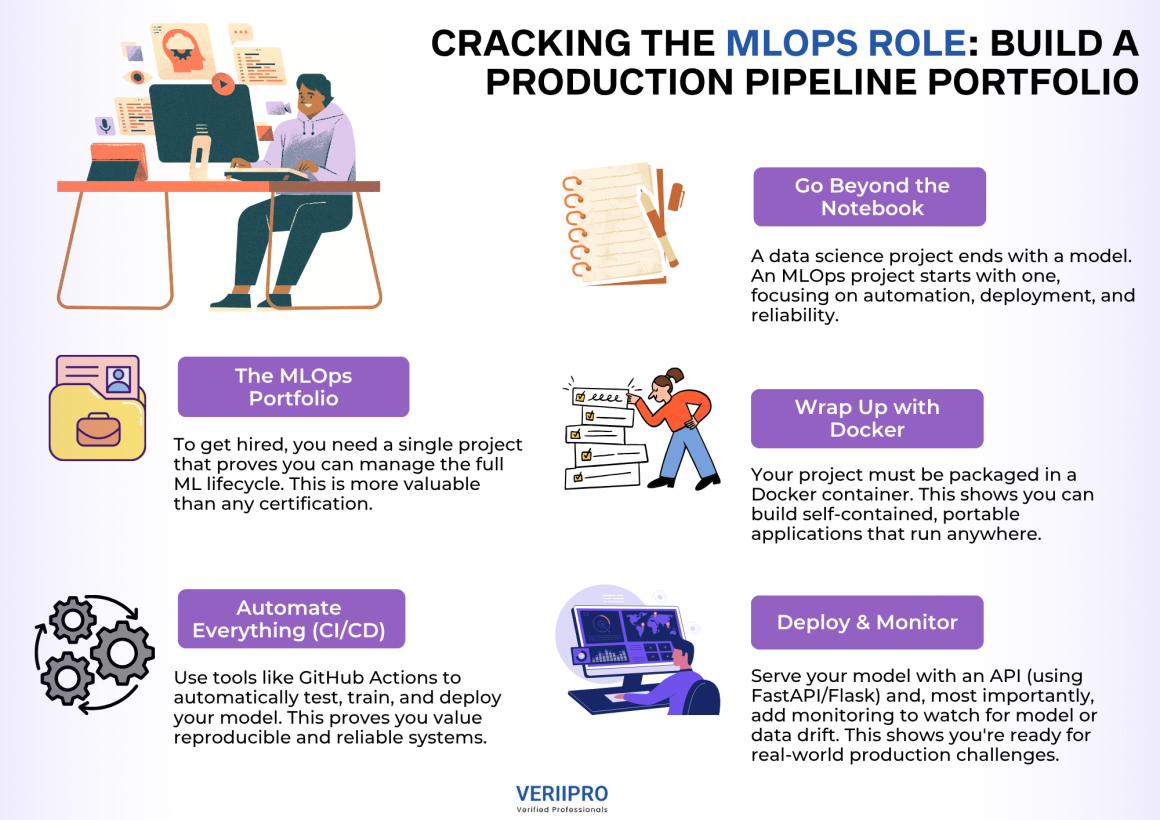
Let’s be clear: a “production-ready” project is not a Jupyter notebook. It’s not a .pkl file in a GitHub repository. A data science project ends with a model. An MLOps project starts with a model.
“Production-ready” means your system is automated, reliable, reproducible, and maintainable. A hiring manager wants to see that you can build a system that won’t break if the data changes, that can be updated without manual intervention, and that someone else on the team could understand and manage.
This means your portfolio project needs to demonstrate the full machine learning lifecycle. It’s not just about the model.fit() command; it’s about everything that comes before and, more importantly, after it. This is your blueprint for proving you are an MLOps engineer, not just a data scientist.
The Blueprint: Key Components of Your Portfolio Pipeline
To impress a hiring manager, your project needs to move beyond the script. It needs to be a pipeline. Here are the key components you must include.
1. Automation (CI/CD) This is the absolute, non-negotiable heart of MLOps. CI/CD stands for Continuous Integration and Continuous Delivery/Deployment. It’s the practice of using automation to test and deploy code. For your project, this means you should not be training your model on your laptop.
You should have a system like GitHub Actions or GitLab CI that automatically triggers your pipeline. For example, when you push new code to your repository, it should automatically run your data validation scripts, execute your training script, and then, if all tests pass, deploy the new model. This shows you value automation and reproducibility.
2. Containerization (Docker) “But it worked on my machine!” is the classic developer excuse that MLOps aims to eliminate. Your project must be containerized, and the industry standard for this is Docker.
By putting your application-your API, your training script, and all its dependencies-into a Docker container, you create a lightweight, portable package that will run the exact same way on your laptop, a testing server, or in the cloud. This proves you understand environment management and can build reproducible systems.
3. Deployment (As an API) A model is useless if nothing can use it. The most common way to “serve” a model is by wrapping it in an API. Using a simple framework like FastAPI or Flask in Python, you can create an endpoint that accepts new data (like a JSON payload) and returns your model’s prediction.
This is the “last mile” of deployment. By including an API, you demonstrate that you know how to make your model accessible to other applications (like a web front-end or another backend service).
4. Monitoring (The ‘Ops’ You Can’t Forget) This is the part most people skip, and it’s your biggest opportunity to stand out. What happens after your model is deployed? How do you know it’s still working well?
Real-world data changes, and a model that was 99% accurate in training can become useless in weeks. This is called model drift. As AWS explains, it’s the degradation of model performance due to changes in data and relationships between variables.
Your portfolio project should demonstrate that you’re thinking about this. You don’t need a massive, complex dashboard. It can be as simple as:
- Logging: Log every prediction your API makes.
- Data Validation: Run a script that compares the new data coming into your API with the training data. Are the distributions still the same?
- Performance Monitoring: If you have access to ground-truth labels later, you can track your model’s accuracy over time.
Including even a simple monitoring component shows a level of maturity and foresight that hiring managers crave.
Why This Project Gets You Hired
When a hiring manager looks at your resume, they are looking for evidence that you can solve their problems. A project built this way doesn’t just show you know machine learning; it shows you are an engineer.
It proves you can:
- Think in systems: You see the entire lifecycle, not just the model.
- Automate processes: You value reliability and efficiency (CI/CD).
- Build for production: You understand that code needs to be reproducible (Docker) and accessible (API).
- Own the full lifecycle: You think about maintenance and failure (Monitoring).
This single, comprehensive project speaks louder than any bullet point on your resume. It’s tangible proof that you aren’t just an aspiring data scientist; you are an MLOps engineer ready to build, deploy, and maintain the next generation of AI products.
Looking Forward
Looking for opportunities in MLOps and AI Engineering? VeriiPro is here to help! This field is exploding, but finding the right company that matches your technical skills can be tough. VeriiPro specializes in connecting skilled MLOps, platform, and AI engineers with forward-thinking companies that are scaling their machine learning operations. With our deep industry network and expertise, we have the resources to get your portfolio in front of the right hiring managers and help you land a role where you can build the future of AI.