

Introduction
Two offer letters in the same week is a good problem to have. It is still a problem.
Most of us are trained to look at one number when those emails land. The base salary. It is easy to compare, it feels solid, and it is the first thing your friends will ask about. But base salary is one line in a long document, and it is rarely the line that decides whether you are happy eighteen months from now.
When you are weighing multiple job offers, you are not just picking a paycheck. You are picking a manager, a commute, a calendar, a set of skills you will build, and a company whose stability you cannot fully verify from the outside. That is a lot to sort through in the week you are usually given to respond. This guide covers how to compare job offers properly, which factors deserve real weight, and how to reach a decision you will still feel good about later.
Why Comparing Job Offers Carefully Matters
A job offer is a multi-year commitment dressed up as a one-page PDF. The choice you make shapes your income, your skills, your professional network, and how you feel on a random Tuesday afternoon.
The research on why people leave jobs is pretty clear about what actually drives regret. When Pew Research Center surveyed workers who quit during 2021, the top reasons were low pay, no opportunities for advancement, and feeling disrespected at work, each cited by well over half of respondents. Notice that two of those three have nothing to do with the number on the offer letter.
There is a financial angle too. Accepting a role and leaving within eight months costs you more than lost salary. It costs you a gap you have to explain in interviews, a reference you probably will not use, and the momentum you would have built by staying somewhere that fit. Recruiters do notice short stints, especially back to back.
Then there is the quiet cost of a rushed yes. Comparing job offers under pressure, at 11pm, with a deadline the next morning, tends to produce decisions driven by whichever recruiter was warmest on the phone. That is not a strategy. A structured comparison takes maybe two hours and protects you from a choice you will spend two years living with.
Create a Job Offer Comparison Checklist
Before you put two offers side by side, decide what you are measuring. Build the framework first, then plug in the details. Doing it in that order keeps you from quietly rewriting your priorities to justify the offer you already like.
A useful job offer comparison checklist covers:
- Base salary
- Bonuses, both annual and signing
- Benefits package, including health insurance and retirement
- Work schedule and expected hours
- Remote, hybrid, or fully onsite
- Commute time and cost
- Career growth and promotion path
- Company culture and management style
- Day-to-day job responsibilities
- Learning and development opportunities
Write these into a simple spreadsheet with one column per offer. Fill in what you know, and mark the gaps. Those gaps are your follow-up questions, and asking them is completely normal. Any recruiter who treats a question about the promotion cycle as a red flag has just told you something useful about the company.
Key Factors to Compare Before Accepting a Job Offer
Some factors carry more weight than others, and which ones matter most depends on where you are in your career. A first-year analyst and a director with two kids in school are not optimizing for the same things. Here is what to examine in each offer.
1. Salary and Total Compensation
Start with the full picture, not the headline. Total compensation includes:
- Base salary
- Performance or annual bonus, and whether it is guaranteed or discretionary
- Signing bonus, plus any clawback if you leave early
- Stock options or equity, with the vesting schedule spelled out
- Employer retirement contributions, including the 401(k) match
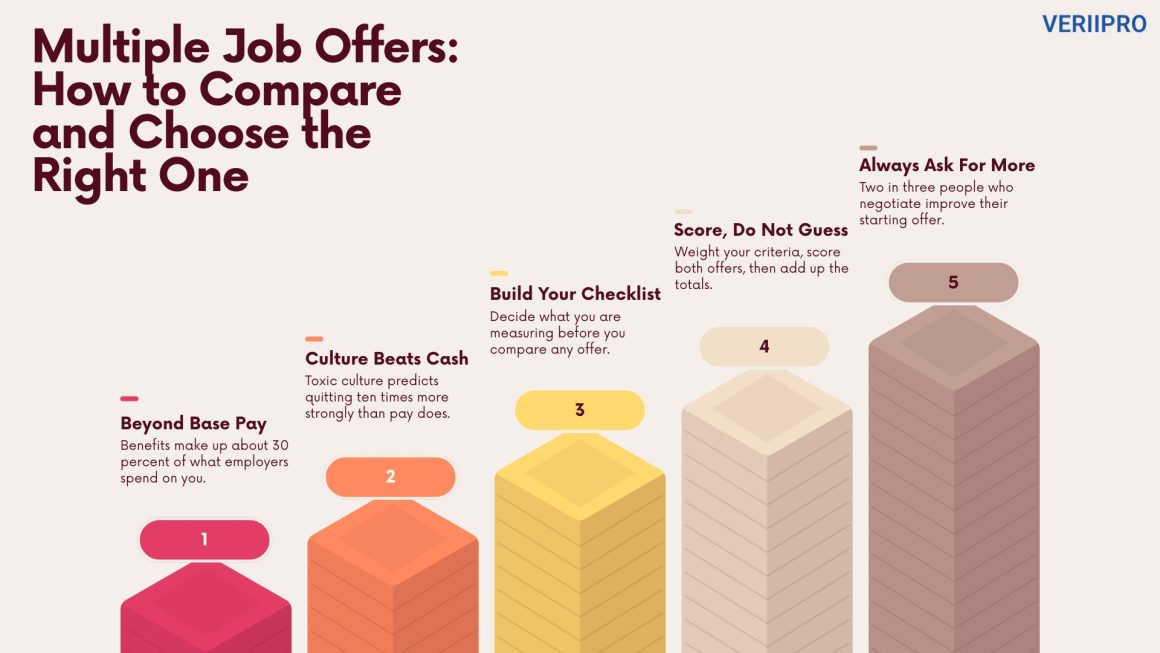
The gap between base pay and total compensation is bigger than most people assume. Bureau of Labor Statistics data for March 2026 shows that benefits made up 30.1 percent of total employer compensation costs for private industry workers. Roughly a third of what your employer spends on you never appears in your base salary.
So an offer that is $6,000 lower on base can easily come out ahead once you count a stronger 401(k) match, a real bonus, and a health plan that does not eat $300 a month out of your paycheck. Do the arithmetic. It takes ten minutes and it changes answers more often than you would expect.
2. Employee Benefits
Benefits are where offers separate quietly. Look at:
- Health insurance, specifically the premium you pay, the deductible, and whether your doctors are in network
- Paid time off, and whether people actually use it
- Retirement plan and match percentage
- Wellness programs and mental health coverage
- Tuition reimbursement
- Professional development budget for courses, certifications, and conferences
That last one is worth more than its dollar value. A company that funds your certifications is a company investing in you being more employable, which is a strange and genuinely good thing for an employer to do.
Also ask about parental leave and dependent coverage even if neither applies right now. Policies are hard to change once you are inside.
3. Career Growth Opportunities
This is the factor people underweight and later resent. Ask directly:
- What does the promotion path look like, and on what timeline
- Is there a formal mentorship program, or is it whoever happens to like you
- What upskilling or training does the company fund
- Are there leadership development tracks
- How often do people move between teams internally
The signal to listen for is specificity. “We promote from within” is a slogan. “The last two people in this role moved up in about eighteen months, and here is what they did” is information. If nobody can give you an example, there may not be one.
4. Company Culture and Values
Culture is the hardest thing to assess from outside and one of the most predictive of whether you stay. Research published in MIT Sloan Management Review found that toxic corporate culture was more than ten times more powerful than compensation in predicting attrition. Ten times. That should reframe how much weight you give a $5,000 salary difference.
What to look at:
- How leaders communicate, including how your interviewer talked about their own boss
- Whether teams collaborate or compete for credit
- Diversity and inclusion in practice, not just on the careers page
- Employee reviews on Glassdoor and similar sites, read for patterns rather than outliers
- The physical or virtual work environment
The strongest move here costs you one message. Find someone on LinkedIn who left the company in the last year and ask what they wish they had known. Former employees have no reason to sell you anything.
5. Work-Life Balance
Ask the questions that produce specific answers:
- What are the actual working hours, not the posted ones
- Is remote or hybrid work a written policy or a manager’s discretion
- How often does the team work evenings or weekends
- What is the vacation policy, and what is the average PTO people take
- How is workload distributed when someone leaves
Unlimited PTO deserves a skeptical eye. In practice it sometimes means people take less, because there is no accrued balance to use up and no clear norm for what is acceptable. Ask how many days the team averaged last year.
6. Job Responsibilities
Two job titles can be identical and describe completely different jobs. Compare:
- What you will actually do on a normal day
- How well the work maps to skills you already have
- Whether the role is clearly defined or a catchall
- The level of ownership and decision-making you get
- What new skills the job will force you to build
That last point matters more than the title. A role that stretches you into a skill the market wants can be worth taking at slightly lower pay. A comfortable role that uses only what you already know pays you now and costs you later.
7. Commute and Location
Commuting is a cost people consistently underprice. Factor in:
- Door-to-door travel time each way
- Gas, parking, tolls, or transit fares
- Relocation requirements and whether the company pays for them
- How easy the office is to reach on a bad weather day
Census Bureau data shows 9.3 percent of American workers had a one-way commute of 60 minutes or more in 2024. At that length you are spending ten hours a week in transit, which is roughly a part-time job you are not paid for. If one offer is hybrid and the other is fully onsite an hour away, the salary difference needs to be substantial to make up for it.
8. Job Security and Company Stability
Nobody can guarantee stability, but you can gather evidence:
- Recent financial performance, which is public for listed companies and often visible through funding news for startups
- The outlook for the industry as a whole
- Whether the company is growing headcount or quietly shrinking
- Any layoff history in the past two years, and how it was handled
A startup with eight months of runway and a great mission is a legitimate choice. Just make it with your eyes open, and weigh it against your own savings and risk tolerance rather than the founder’s optimism.
Use a Weighted Scorecard to Compare Job Offers
Once you know your factors, turn the comparison into something you can actually look at. This is the most useful tool I know of for figuring out how to decide between two jobs when both look reasonable.
Here is the process:
- List your evaluation criteria, usually five to eight of them
- Assign each one a weight based on how much it matters to you, totaling 100 percent
- Score each offer from 1 to 10 on every criterion
- Multiply score by weight, then add up the totals
| Factor | Weight | Offer A score | Offer A weighted | Offer B score | Offer B weighted |
|---|---|---|---|---|---|
| Total compensation | 30% | 9 | 2.70 | 7 | 2.10 |
| Career growth | 25% | 6 | 1.50 | 9 | 2.25 |
| Company culture | 20% | 7 | 1.40 | 8 | 1.60 |
| Work-life balance | 15% | 5 | 0.75 | 8 | 1.20 |
| Commute and location | 10% | 8 | 0.80 | 6 | 0.60 |
| Total | 100% | 7.15 | 7.75 |
In this example Offer A pays better and still loses, because growth and balance were weighted heavily enough to matter.
One caveat. The scorecard is a thinking tool, not a verdict. If the math points to Offer B and your gut sinks a little, that reaction is data. Usually it means a factor you care about did not make the list, or you weighted it too low to be honest. Go back and find it.
Red Flags to Watch Before Accepting an Offer
Some warning signs show up before you sign, and they are easy to talk yourself out of when you want the job. Watch for:
- Vague job responsibilities. If three interviewers describe the role differently, nobody has defined it.
- Unrealistic performance expectations. Targets nobody in the role has hit before are a setup, not a challenge.
- High turnover. Ask how long the last person stayed and why they left. Hesitation is the answer.
- A disorganized interview process. Rescheduled calls, interviewers who clearly have not read your resume, and long silences are a preview of how the company runs.
- Consistent negative reviews. One angry review means nothing. Six reviews describing the same manager mean something.
- Compensation details that stay fuzzy. “Competitive bonus” is not a number. Ask for the range, the criteria, and last year’s actual payout.
- Pressure to accept immediately. This one is the biggest. An exploding offer that expires in 24 hours is a company telling you it values compliance over fit.
None of these individually should sink an offer. Two or three together should make you slow down.
When Should You Negotiate Before Accepting?
Almost always, and yet most people do not. A Pew Research Center survey found that only about 30 percent of workers asked for higher pay the last time they were hired, and among those who did, 28 percent got exactly what they asked for while another 38 percent got more than the original offer. That is roughly two out of three people improving their offer by having one conversation.
ZipRecruiter’s survey of recent hires points the same direction, finding that about nine in ten new hires who negotiated received some additional benefit from doing so.
The window to negotiate is after you have the written offer and before you accept. You have the most leverage you will ever have with that employer, because they have already chosen you and restarting the search is expensive for them.
What is on the table:
- Base salary, backed by market data for your role, level, and city
- Benefits, such as an earlier eligibility date for health coverage
- Flexible work, including specific remote days written into the offer
- Signing bonus, which is often easier for a company to approve than base pay because it does not affect internal salary bands
- Start date, if you need two weeks to breathe between jobs
- Professional development support, like a conference budget or certification funding
Two ground rules. Negotiate one package, not a running list of new demands each time they respond. And do not use a competing offer as a threat. Mentioning that you are weighing multiple job offers is fine and often helpful. Issuing an ultimatum tends to sour the relationship before day one.
Common Mistakes to Avoid When Choosing Between Job Offers
- Deciding on salary alone. It is the most visible number and it is not the whole compensation package.
- Waving off culture. You can adjust to lower pay. Adjusting to a manager who undermines you is much harder.
- Ignoring the three-year view. Ask which job leaves you more employable in 2029, not just which one pays more in January.
- Skipping the full package. Health premiums, the 401(k) match, and PTO can swing thousands of dollars a year.
- Rushing. Fatigue at the end of a long job search makes any yes feel like relief. Sleep on it.
- Not asking follow-up questions. You are allowed to ask about promotion timelines, team turnover, and how performance is measured. Candidates who ask get treated better, not worse.
How to Make the Final Decision
When you have gathered everything and the deadline is close, work through it in this order.
- Name your top priority for the next two years. Income, skill growth, stability, flexibility. One of them, not all four. Everything else follows from that.
- Compare on paper, not in your head. Put the offers in the same spreadsheet and score them against your weighted criteria. Vague comparison favors whichever offer you heard about most recently.
- Extend the timeline. Ask what each job looks like in three years, including the roles it opens up and the ones it closes off.
- Talk to two people who know your field. A mentor, a former manager, someone doing the job you want next. Two is enough. Ten gives you noise and a headache.
- Then trust your judgment. Once you have done the analysis, your instinct is informed rather than random. If one offer keeps pulling at you after all the numbers are in, that pull is worth listening to.
Then commit. Send a clear acceptance, get the final details in writing, and decline the other offer graciously and promptly. That recruiter may hire you in five years.
Conclusion
The best offer is not always the one with the biggest number. Sometimes it is. Often it is the one with a manager who develops people, a benefits package that quietly closes the pay gap, and a commute that gives you back an hour every day.
Having multiple job offers means you have leverage and a real choice. Use both. Build your comparison checklist, weight the factors that matter to you rather than the ones that photograph well, ask the uncomfortable questions while you still have the leverage to ask them, and then decide with confidence. A good decision made carefully beats a great salary chosen carelessly nearly every time.