


Every product team eventually hits the same wall. There are more ideas than hours, more stakeholder requests than sprint capacity, and someone has to decide what gets built next. That someone is the product owner, and it’s one of the most important (and most misunderstood) jobs on any Agile team.
The job looks different in 2026 than it did even two years ago. AI tools now draft user stories and flag duplicate tickets, large companies run Agile across dozens of teams at once, and product owner jobs have spread well beyond tech into banking, healthcare, manufacturing, and government work. Digital.ai’s 18th State of Agile Report found that AI adoption among surveyed organizations jumped from 68% to 84%, while 76% said leadership is looking harder at the business return on Agile work. In plain terms, companies want people who can connect what a team ships to what the business earns.
This guide covers what product owners do, the skills that get you hired, what the role pays, and where the career can take you.
What Is a Product Owner?
A product owner is the person responsible for making sure a team builds the right things in the right order. The Scrum Guide makes the product owner accountable for maximizing the value of the product the Scrum team creates. It also makes a point many companies ignore: the product owner is “one person, not a committee.”
In practice, the product owner sits between two groups that don’t always speak the same language. On one side are executives, sales, support, and customers, each with their own priorities. On the other is the development team, which needs clear, well-ordered work to stay productive. The product owner turns business goals into a ranked product backlog, shapes the user stories that describe the work, and decides when something is ready to ship.
At its core, this is a decision-making job. A product owner who can’t say no to anyone isn’t really owning anything.
Key Responsibilities of a Product Owner
The fundamentals haven’t changed much since Scrum went mainstream. How product owners carry them out has. Here’s what the work looks like on a typical team today.
- Set and share the product vision. Everyone from engineers to the sales team should understand where the product is headed and why.
- Own and prioritize the product backlog. This is the heart of the job. Product owners rank work by value, risk, and effort, then defend that order when pressure hits.
- Write user stories and acceptance criteria. Clear acceptance criteria tell the team exactly what “done” means, which saves a lot of arguing at the end of a sprint.
- Use AI to manage backlog hygiene. Jira’s built-in AI features can suggest subtasks from a parent work item, generate backlog items from Confluence pages, and flag likely duplicates. The product owner still reviews every suggestion, but the clerical side of the job takes far less time.
- Collaborate with stakeholders. Regular check-ins with business leaders, customer-facing teams, and other product owners keep priorities aligned. When they clash, the product owner negotiates.
- Track product analytics. Usage data, conversion funnels, and feature adoption show whether last quarter’s work actually mattered. Data holds up far better than opinion in a tense stakeholder meeting.
- Keep customers at the center. Interviews, support tickets, and user testing should shape the backlog, not sit in a forgotten folder.
- Show up for Scrum events. Sprint planning, reviews, and backlog refinement all depend on a product owner who is prepared and available.
Essential Skills Every Product Owner Needs in 2026
Responsibilities describe the work. Skills decide how well you do it. Hiring managers usually look at three groups.
Technical skills. You don’t need to write production code, but you need to understand how software gets built. That means knowing Agile and Scrum inside out, grasping APIs and system dependencies at a conceptual level, and reading basic analytics without waiting on a data analyst. Comfort with AI tools is quickly becoming part of the baseline, too.
Business skills. Product strategy, market awareness, and a feel for revenue and retention separate product owners who manage tickets from those who manage value. You should be able to explain why a feature matters in dollars, not just in story points.
Leadership skills. Product owners lead without formal authority over the team, so communication, stakeholder management, and negotiation carry a lot of weight. Prioritization ties it all together. Anyone can make a list. Ranking it, defending the order, and changing it when the data proves you wrong is the hard part.
Most people enter the role strong in one of these groups and spend their first few years building the other two. That’s normal.
Product Owner Salary in 2026
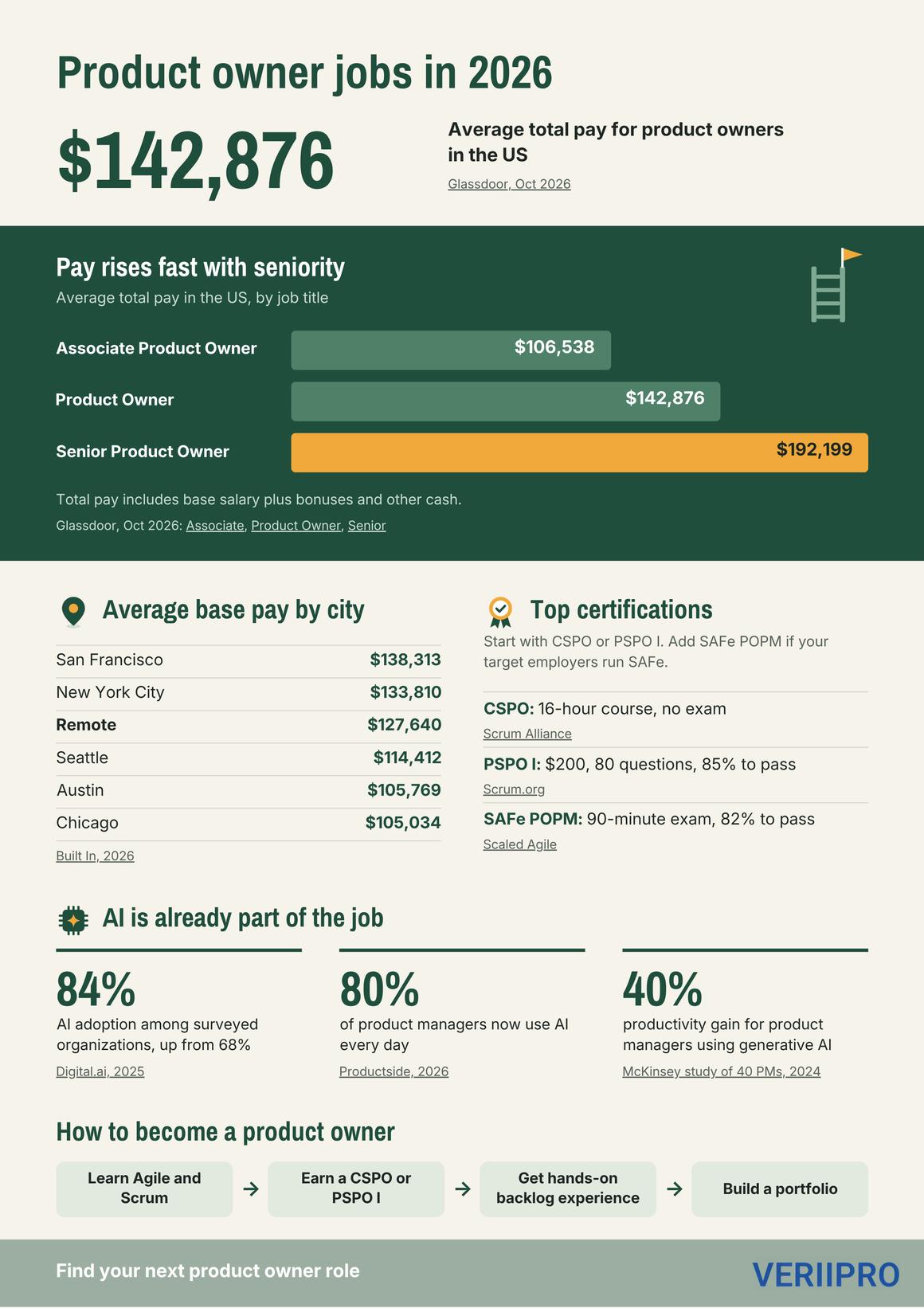
Product owner salaries in the US are strong, though the figure you see depends on the source. Built In reports an average base salary of $108,401, with additional cash bringing average total compensation to $121,100. Glassdoor puts average total pay higher at $142,876, partly because it includes bonuses and profit sharing. Neither is wrong. They measure slightly different things.
By experience level
Total pay climbs quickly with seniority. Here’s how the three most common titles compare on Glassdoor:
| Level | Typical Total Pay Range | Average Total Pay |
|---|---|---|
| Associate Product Owner | $84,000 to $136,000 | $106,538 |
| Product Owner | $110,000 to $187,000 | $142,876 |
| Senior Product Owner | $155,000 to $242,000 | $192,199 |
Source: Glassdoor US data for Associate Product Owner, Product Owner, and Senior Product Owner, October 2026. Total pay includes base salary plus bonuses and other cash.
By location
Location still moves the number. Built In’s city data shows these average figures:
- San Francisco: $138,313 base, $151,313 total
- New York City: $133,810 base, $175,143 total
- Seattle: $114,412 base, $120,162 total
- Austin: $105,769 base, $113,205 total
- Chicago: $105,034 base, $117,583 total
New York stands out. Additional cash there averages $41,333, more than three times the national figure, which makes sense in a market packed with banks and fintech firms.
By industry
Reliable industry-level salary data for this exact title is thin, so be skeptical of any precise “fintech pays X” claim. What the market does show is a premium for complexity. Staffing firm KORE1 reports higher offers for product owners on regulated products (think HIPAA or SOC 2), platform and API products, and data or machine learning products. That puts product owners in finance, healthcare, and AI-focused companies in a good spot to negotiate.
Beyond these three factors, pay also tends to rise with company size, technical depth, and how much real decision-making authority the job carries.
Product Owner Career Path
The role works as both a destination and a launchpad. A typical upward path looks like this:
- Associate Product Owner: Support a senior product owner, write stories, and learn the stakeholder side.
- Product Owner: Own the backlog for a team or product area and make the priority calls.
- Senior Product Owner: Handle larger, messier products, often across several teams.
- Lead or Principal Product Owner: Mentor other product owners and shape practices across a portfolio.
- Product Manager or Group Product Manager: Take on market strategy and business outcomes.
- Director or VP of Product: Run the product organization and own the roadmap.
- Chief Product Officer: Lead product strategy for the whole company.
Not every move has to be upward. Common lateral moves include Scrum Master or Agile Coach for people who love the process side, business analyst for those who prefer deep requirements work, and UX research for product owners drawn to customer insight. Some experienced product owners eventually start their own companies, which makes sense after years of learning what customers will actually pay for.
Industries Hiring Product Owners
Product owners started in software, but today they’re hired almost anywhere a company builds digital products.
- SaaS and enterprise software: The role’s natural home. Subscription businesses depend on retention, so they need someone constantly improving the product.
- Fintech and banking: Big banks have adopted Agile at scale. JPMorganChase and Capital One both hire product owners for areas like lending, wealth management, and cybersecurity.
- Healthcare: Patient portals, claims systems, and health data platforms need product owners who can work within strict privacy rules.
- E-commerce: Checkout flows, search, recommendations, and loyalty apps all need someone deciding what to improve next.
- Cybersecurity: Security products have to balance protection with usability, and that trade-off is a product decision.
- AI: Teams building AI products need product owners who understand model limits as well as user needs.
- Manufacturing: Connected devices, factory software, and supply chain platforms have pulled product owners into industrial companies.
Product Owner vs Product Manager
These titles get mixed up constantly, and some companies use them interchangeably. In a classic setup, the split looks like this:
| Area | Product Owner | Product Manager |
|---|---|---|
| Main focus | Delivering the right work, sprint by sprint | Choosing which problems the product should solve |
| Time horizon | Sprints and releases | Quarters and years |
| Works most with | Development team and Scrum Master | Executives, sales, marketing, and customers |
| Decision authority | Backlog order and what counts as done | Vision, roadmap, and business case |
| Typical next step | Senior Product Owner or Product Manager | Director or VP of Product |
The short version: a product manager decides where the product should go, and a product owner gets the team there one sprint at a time. At smaller companies, one person often does both. At larger companies using scaled frameworks like SAFe, the roles are usually separate, with product managers steering several teams and product owners embedded in each one. Moving from product owner to product manager is one of the most natural promotions in tech.
Best Certifications for Product Owners
A product owner certification won’t replace experience, but it helps you get past resume filters and proves you speak the language. Scrum Alliance cites research showing 55% of organizations would pay more for certified Agile professionals.
- CSPO (Certified Scrum Product Owner): Earned through a 16-hour course with no exam. You renew every two years for $100 plus continuing education credits. It’s the easiest entry point and widely recognized.
- PSPO I (Professional Scrum Product Owner I): Scrum.org’s exam-based option has 80 questions in 60 minutes, an 85% passing score, and a $200 fee. No course is required, and it never expires. Because you have to pass a tough exam to earn it, it arguably says more about what you actually know.
- SAFe POPM: Scaled Agile now markets it as AI-Empowered SAFe Product Owner/Product Manager. The 90-minute exam requires 82% to pass, plus 12 continuing education units a year to maintain. If you’re targeting big banks, insurers, or government contractors, it carries weight.
- PMI-ACP: PMI’s Agile credential requires 21 hours of Agile training plus project experience. The 120-question exam costs $435 for members and $495 for non-members. It suits product owners coming from project management.
For most people, the smart order is CSPO or PSPO I first, then SAFe POPM if your target employers run SAFe.
Product Owner Tools You Should Know
You don’t need to master every tool, but you should be comfortable with the ones your next team already uses.
- Jira: Still the most common backlog tool, now with AI features for drafting and organizing work.
- Confluence: Where requirements, decision logs, and release notes usually live.
- Azure DevOps: Common in Microsoft-heavy enterprises.
- Productboard and Aha!: Built for roadmaps, prioritization, and collecting customer feedback in one place.
- Figma: You won’t design screens, but you’ll review them and use prototypes to test ideas with users.
- Miro: The go-to whiteboard for story mapping, retrospectives, and planning workshops.
- AI assistants: ChatGPT, Claude, and Microsoft Copilot are now everyday tools for drafting stories, summarizing interviews, and preparing stakeholder updates.
Product analytics tools like Amplitude and Mixpanel round out the kit. One word of caution on AI: it can draft a user story in seconds, but it doesn’t know your customers. Treat its output as a first draft.
How to Become a Product Owner
There’s no single entry route, but most successful paths follow these steps.
- Build a relevant foundation. A degree in business, computer science, or information systems helps but isn’t required. Plenty of product owners come from marketing, operations, or customer support.
- Learn Agile and Scrum properly. Start with the free Scrum Guide, then learn how real teams apply it, messy parts included.
- Earn a certification. CSPO or PSPO I is enough to start.
- Get hands-on experience. This step matters most. If you’re a business analyst, QA tester, Scrum Master, or developer, offer to help your current product owner refine the backlog or write stories.
- Build a portfolio. Document two or three product decisions you influenced: the problem, the options, what you chose, and what happened. A sample backlog with solid user stories helps too.
- Network with intent. Join Agile meetups, Scrum user groups, and product communities. A warm referral often beats a cold application, especially for a first product role.
Associate product owner roles are the most realistic first target, and contract roles can be a faster way in.
Remote Product Owner Jobs vs Hybrid vs Onsite
Remote product owner jobs exist, but they’re harder to land than a few years ago. Robert Half’s analysis of US job postings found that in Q2 2026, 85% of technology roles were fully on-site, 11% were hybrid, and only 4% were fully remote.
Each model asks something different of a product owner:
- Onsite: Easiest for quick conversations with developers and stakeholders. Common at banks, manufacturers, and government contractors.
- Hybrid: The popular middle ground. Office days usually cluster around sprint planning, reviews, and workshops.
- Remote: Demands strong writing and disciplined documentation, since decisions can’t happen in hallway chats. Expect time zone overlap requirements and occasional travel for big planning events.
Pay is where it gets interesting. Built In shows remote product owners earning an average base salary of $127,640, well above the national average. The likely reason is that remote roles skew senior, since employers want a proven track record before handing someone a backlog they’ll manage from home. For a wider look at how IT professionals feel about each setup, see VeriiPro’s breakdown of hybrid vs remote vs onsite work.
Future of Product Owner Jobs Beyond 2026
AI is the headline, and the early numbers look good for product people. In a McKinsey study of 40 product managers, generative AI tools improved productivity by 40%. A 2026 Productside survey found that 80% of product managers now use AI every day.
Now look at where AI isn’t helping much yet. Atlassian’s State of Product report found teams mostly use it for routine tasks and documentation, not for prioritization, planning, or advanced analysis. Those happen to be the parts of the job that define a good product owner.
That points to where the role is heading:
- Less admin, more judgment. As AI handles story drafts and backlog cleanup, product owners will spend more time on discovery and decisions.
- Data-driven decisions as the norm. Reading experiments and usage data will be a baseline expectation.
- Customer-centric innovation. Faster delivery only pays off if the team builds what customers want.
- AI agents on the team. Digital.ai found more than a quarter of AI users already experimenting with agentic AI, which means writing work that both people and agents can act on.
So will AI replace product owners? It will replace the parts of the job that were never the point. Product owners who make good calls under uncertainty will be worth more, not less.
Conclusion
Product owner remains one of the most valuable and rewarding careers in product development. Senior product owners average more than $190,000 in total pay on Glassdoor, the role exists in nearly every industry that builds software, and it opens doors to product management and executive leadership.
The job is changing, though. AI is taking over the paperwork, and employers want product owners who can show their work moves business results. If you can prioritize with confidence, communicate clearly, and stay close to your customers, you’ll be in demand well beyond 2026.
Ready for your next move? Explore the latest product owner jobs on VeriiPro and find a role that fits where you want to go.