



Not long ago, an AI career meant being a data scientist or a researcher with a PhD. Not anymore. Today, high-paying AI jobs go to people who build AI agents, run models in production, manage AI products, and keep all of it compliant with new regulations.
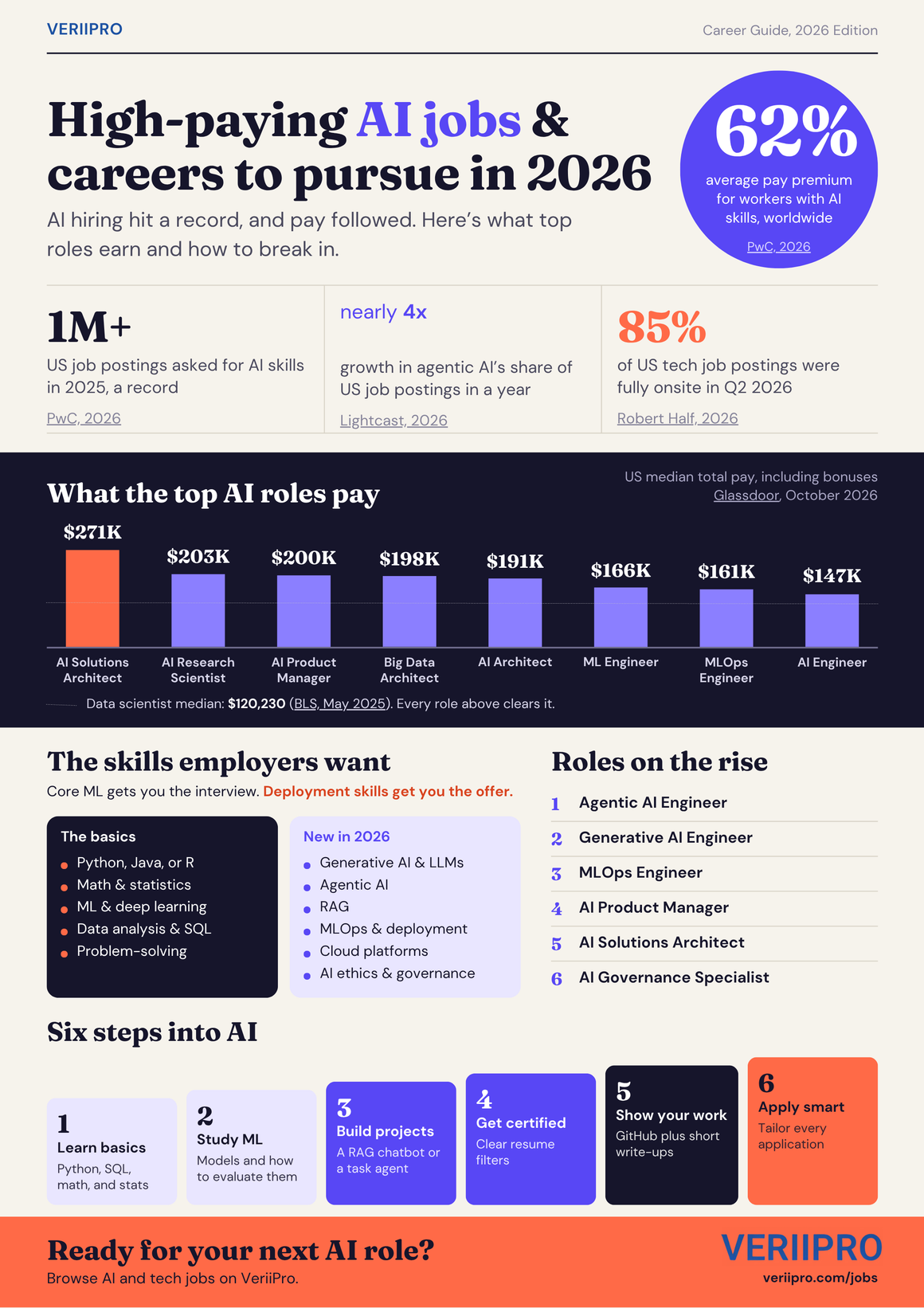
The hiring numbers back this up. US AI job postings topped 1 million in 2025, a record, according to PwC. CompTIA counted 349,821 active postings requiring AI skills in September 2026 alone, roughly 282% more than in May 2024. And pay is following demand: PwC’s 2026 global research found that workers with AI skills earn an average wage premium of 62%.
Here’s what employers want, what the top AI jobs pay, and how to break in.
Is AI a Good Career?
For most people with a solid technical foundation, yes. And it’s not just hype talking.
The Bureau of Labor Statistics projects that data scientist jobs will grow 35% from 2025 to 2035, much faster than average. Computer and information research scientists, a group that includes many AI researchers, should grow 22%. Employers have good reason to keep hiring, too. PwC found that companies in the most AI-exposed sectors saw 34% productivity growth from 2018 to 2025, versus 24% for the least exposed.
Still, this isn’t easy money. The entry-level bar keeps rising. PwC reports that AI-exposed junior roles are seven times more likely to ask for skills once reserved for senior staff. If you love learning, that’s a perk. If you’d rather master one toolset and coast, AI will wear you out.
What Skills Do You Need to Land an Entry-Level AI Position?
The fundamentals still do most of the heavy lifting:
- Programming languages (Python, Java, R): Python powers nearly half of all new AI repositories on GitHub. Java runs enterprise systems, and R suits statistics-heavy teams.
- Mathematics & statistics: Linear algebra, calculus, and probability explain why a model behaves the way it does.
- Machine learning & deep learning: Know the core methods (regression, classification, clustering, neural networks) and a framework like PyTorch or TensorFlow.
- Data analysis: Most AI work starts with messy data, so SQL and data cleaning are everyday tasks.
- Problem-solving & critical thinking: Knowing when not to use AI is underrated. So is explaining results to people who don’t care about loss curves.
That foundation used to be enough. Now employers expect newer skills too, even for junior roles:
- Generative AI & large language models (LLMs): Hands-on experience with ChatGPT, Claude, Gemini, or Llama, plus solid prompt engineering.
- Agentic AI & AI agents: Familiarity with autonomous agents and frameworks like LangGraph, CrewAI, or AutoGen, which Microsoft has since folded into its Agent Framework.
- Retrieval-augmented generation (RAG): How AI apps pull in external knowledge to give grounded answers.
- MLOps & AI deployment: Deployment, monitoring, Docker, Kubernetes, and CI/CD.
- Cloud platforms: AWS, Microsoft Azure AI, or Google Cloud, where Vertex AI now lives inside the Gemini Enterprise Agent Platform.
- AI ethics & governance: Responsible AI basics, including data privacy, bias mitigation, and compliance.
Most In-Demand AI Skills in 2026
So which skills are employers actually paying for? The ones that get AI into production.
AI skills now appear in 2.5% of all US job postings, up 55% in a year, according to Lightcast data used in Stanford’s 2026 AI Index. Agentic AI is the fastest climber, with its share of postings nearly quadrupling from 0.06% to 0.23%. PwC’s data agrees: jobs requiring specific AI skills, like prompt engineering or machine learning, are growing roughly eight times as fast as the overall job market.
What keeps showing up in job descriptions:
- Building with LLMs: Prompt engineering, RAG pipelines, and frameworks like LangChain.
- Vector databases: Pinecone, Weaviate, and pgvector for AI search and retrieval.
- Agent development: Designing agents that plan, call tools, and hand off tasks without going off the rails.
- Deployment and evaluation: Monitoring models and measuring how they perform after launch.
- Cloud AI services: Amazon Bedrock, Microsoft Foundry, and Google’s Gemini Enterprise Agent Platform.
- AI governance: Risk and compliance work as rules like the EU AI Act take hold.
Notice the pattern? Employers care less about training models from scratch and more about shipping something reliable with one. Core ML knowledge gets you the interview. Deployment skills get you the offer.
AI Jobs & Careers
These roles form the high-paying core of the AI job market. Unless noted, figures are US median total pay from Glassdoor, checked in October 2026. Location and equity can push offers much higher.
AI Research Scientist
Median total pay: $203,000
Research scientists invent new model architectures and training methods at AI labs, big tech firms, and universities. Most roles prefer a PhD. The BLS median for the broader category is $140,300, but top labs pay far more.
Big Data Architect
Median total pay: $198,000
Big data architects design the large-scale storage and processing systems AI depends on. Bad infrastructure sinks even the smartest model.
AI Architect (Software Architect)
Median total pay: $191,000
The AI-focused take on the software architect role. AI architects decide how models, data pipelines, and applications fit together, then set standards for security and scale.
Machine Learning Engineer
Median total pay: $166,000
ML engineers build, train, and deploy models at scale. It’s one of the most common AI titles and one of the best paid.
NLP Engineer
Median total pay: $166,000
NLP engineers build systems that understand and generate human language, from chatbots to voice assistants. LLM experience is now close to mandatory.
AI Engineer
Median total pay: $147,000
AI engineers turn models into working products, usually by building on foundation models rather than training their own. Our AI engineer salary guide breaks down pay by experience level.
Robotics Engineer
Median total pay: $146,000
Robotics engineers design machines that sense and act in the physical world, like warehouse robots.
Data Engineer
Median total pay: $135,000
Data engineers build the pipelines that move clean data into AI systems. Less glamorous than modeling, but no AI team gets far without them.
Data Scientist
Median pay: $120,230 (BLS, May 2025)
Data scientists use statistics and machine learning to find patterns and guide decisions. With 35% projected growth, it’s one of the most reliable entry points into AI.
Emerging AI Jobs to Watch in 2026
As companies moved from AI pilots to real deployments, new titles followed.
Agentic AI Engineer
Median total pay: $194,000 (early data)
These engineers build systems that complete multistep tasks on their own, like processing claims. It’s the hottest niche in AI right now (here’s why agentic AI is 2026’s biggest tech trend).
Generative AI Engineer
Median total pay: $151,000
Generative AI engineers build apps powered by LLMs, such as copilots and RAG-based search tools.
MLOps Engineer
Median total pay: $161,000
Think DevOps for machine learning. MLOps engineers automate deployment, monitor models, and retrain them when performance slips.
AI Product Manager
Median total pay: $200,000
AI product managers decide which AI features to build and why, balancing user needs, model limits, cost, and risk.
AI Solutions Architect
Median total pay: $271,000
Solutions architects design AI systems for clients and bridge engineering and sales, a rare mix that explains the top-tier pay.
AI Governance Specialist
Average pay: about $115,000 (ZipRecruiter)
Governance specialists make sure AI systems meet legal, ethical, and security standards. The IAPP found that 77% of surveyed organizations are already working on AI governance. Our guide on becoming an AI governance specialist covers the path.
Top Industries Hiring AI Professionals
AI hiring has spread well beyond Silicon Valley. Lightcast found that, as of 2024, 51% of job postings requiring AI skills are outside IT and computer science roles. Demand is strongest in:
- Healthcare: The FDA has authorized more than 1,400 AI-enabled medical devices, driving demand for ML engineers and clinical data scientists.
- Finance and banking: 33.9% of finance and insurance businesses use AI, versus 19.8% nationally, per the Census Bureau. Banks hire for fraud detection, risk modeling, and governance.
- Retail and e-commerce: Recommendation engines and demand forecasting keep data scientists busy.
- Manufacturing: Predictive maintenance and quality inspection drive hiring for robotics and computer vision engineers.
- Cybersecurity: Organizations using AI and automation extensively in security saved an average of $1.93 million per breach, according to IBM.
- SaaS and tech: Nearly every software company is adding AI features, so AI engineers and product managers stay in demand.
- Automotive: Waymo hit 500,000 paid robotaxi rides a week by March 2026, and autonomous driving firms need computer vision and robotics talent.
- Government: Federal agencies reported 3,611 AI use cases in their 2025 inventory, more than double the prior year.
AI Career Roadmap
There’s no single path into AI, but this sequence works for most people:
- Learn Python and the core math. Get comfortable with Python, SQL, linear algebra, and statistics.
- Study machine learning fundamentals. Understand supervised and unsupervised learning, neural networks, and how to evaluate a model honestly.
- Build real projects. Skip the tutorial clones. Build a RAG chatbot over your own documents or an agent that automates a boring task.
- Earn a certification. A recognized cert validates your skills and helps your resume clear automated filters.
- Create a portfolio. Put your code on GitHub with short write-ups on what you built and why. Recruiters skim, so make the impact obvious.
- Apply strategically. Tailor every application and consider adjacent roles, like data analyst, as stepping stones. An AI-native resume that shows how you work with AI helps you stand out.
Best AI Certifications for Career Growth
Certifications won’t replace experience, but they prove platform knowledge. One warning: vendors retired several popular AI certs in 2026, including Microsoft’s Azure AI Engineer Associate (AI-102) and the AWS Machine Learning Specialty. If a guide still recommends them, it’s out of date. Current picks:
- Google Cloud: Professional Machine Learning Engineer, or Generative AI Leader for business-facing roles.
- Microsoft: Azure AI Apps and Agents Developer Associate (AI-103), currently in beta.
- AWS: Generative AI Developer – Professional, or AI Practitioner if you’re just starting.
- NVIDIA: Generative AI LLMs Associate (NCA-GENL).
- IBM: The AI Engineering Professional Certificate on Coursera.
- Databricks: Generative AI Engineer Associate.
Remote AI Jobs vs Hybrid vs Onsite AI Jobs
If you’re hoping for a fully remote AI job, brace yourself. In Robert Half’s analysis of Q2 2026 job postings, 85% of technology job postings were fully onsite, 11% were hybrid, and just 4% were remote. Big employers set the tone, with Amazon moving to five office days a week in 2025.
Here’s how the models compare:
- Remote: Maximum flexibility, but fierce competition for few openings. Some people even trade pay for it: one study found tech job seekers would accept about 25.6% less pay for remote or hybrid roles.
- Hybrid: In-person collaboration on key days, focus time at home. For many AI teams, it’s the compromise everyone can live with.
- Onsite: Faster learning, easier mentorship, and direct access to hardware. Robotics teams and research labs often require it.
Early on, onsite or hybrid roles help you grow faster. With a track record, remote gets more realistic. Our hybrid vs. remote vs. onsite breakdown covers what IT workers actually prefer.
Future of AI Careers Beyond 2026
The next few years will reward people who can work alongside AI agents, not just build models. Gartner predicts that 40% of enterprise apps will include task-specific AI agents by the end of 2026, up from under 5% in 2025. It also expects over 40% of agentic AI projects to be canceled by the end of 2027 due to costs, unclear value, or weak risk controls. Both can be true. Agents are coming, and companies need people who can make them work.
Trends to watch:
- Agentic AI goes mainstream. In McKinsey’s latest survey, 40% of respondents at large organizations said they’re scaling AI agents, up from 27% a year earlier.
- Multimodal AI expands. Models that handle text, images, audio, and video together will open new work in media and medical imaging.
- Governance becomes a career track. The EU AI Act became broadly applicable in August 2026, with high-risk rules phasing in through 2028. US companies selling in Europe will need compliance talent.
- Roles keep blending. Expect more jobs where expertise in law, finance, or medicine meets AI fluency.
Tools will come and go. Strong fundamentals and the judgment to use AI responsibly won’t.
Final Thoughts
AI is one of the best-paying, fastest-growing areas in tech, and the range of roles keeps widening. You don’t need to master everything at once. Pick a direction, build strong fundamentals, ship a few real projects, and keep learning.
Ready to make your move? Explore AI and tech jobs on VeriiPro and get hired today.