

Introduction
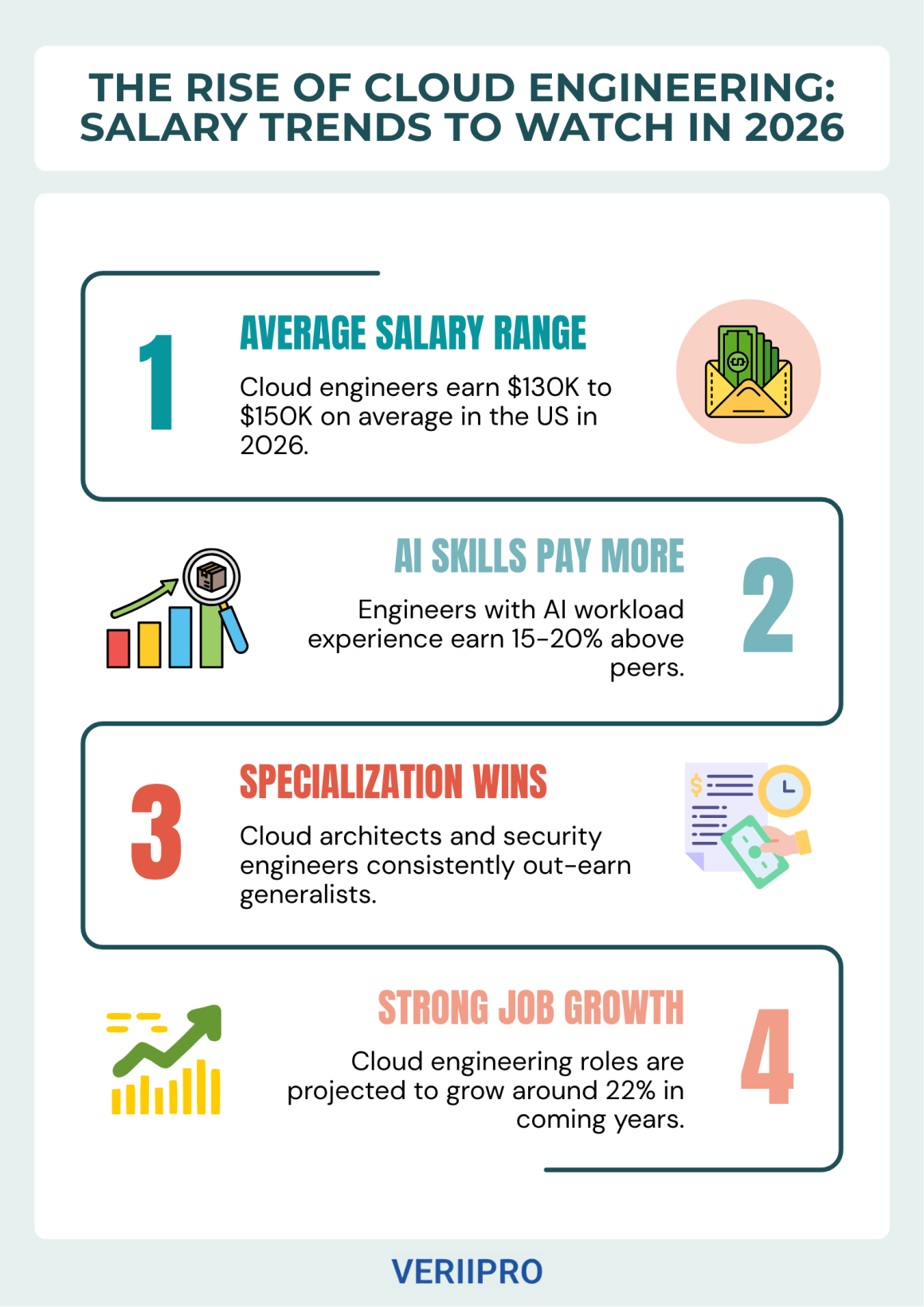
Cloud engineering is having a moment, and 2026 is showing no signs of slowing it down. Average salaries in the US now sit between $130K and $150K, AI is rewriting what cloud infrastructure even looks like, and companies are hiring faster than they can train new engineers. Whether you are already in the field or thinking about jumping in, the numbers are worth paying attention to. This guide walks through current salary ranges, what is driving demand, the skills that pay the most, and where cloud engineering is headed next.
What Is Cloud Engineering and Why Is It Growing?
Cloud engineering is the practice of designing, building, and maintaining the infrastructure that runs on platforms like AWS, Microsoft Azure, and Google Cloud. A cloud engineer handles everything from spinning up servers and configuring networks to writing automation code and keeping systems secure at scale.
The growth comes from a few directions at once. Companies are still migrating off legacy on-premises systems, and most are landing in hybrid or multi-cloud environments rather than picking a single provider. 89% of companies now run a multicloud strategy, which means more complexity and more demand for engineers who can navigate it. Cloud is no longer a side project for IT departments. It is core infrastructure for almost every business that exists.
Average Cloud Engineer Salary in 2026
The average cloud engineering salary in the US in 2026 lands somewhere between $129K and $150K, depending on which platform you trust. Glassdoor reports an average closer to $151,251, with top earners pulling in over $238,000. Indeed places the figure around $136,814 based on recent job postings. Median total compensation, which factors in bonuses and equity, sits near $138K for most engineers.
On the high end, senior cloud engineers and architects regularly clear $180K to $200K, with the very top of the market crossing $240K once equity is included. Where you fall in that range comes down to experience, location, and the specific skills you bring.
Cloud Engineer Salary by Experience Level
Experience moves the needle more than almost any other factor. Here is how cloud engineering salaries break down by career stage in 2026:
Entry-Level (0-2 Years)
Entry-level cloud engineers in the US typically earn between $90K and $110K. The entry level AWS cloud engineer salary tends to sit at the upper end of that range, around $95K to $115K, since AWS skills are in higher demand than ever. Junior roles are competitive right now, but candidates with hands-on projects and a certification or two stand out quickly.
Mid-Level (3-5 Years)
Mid-level cloud engineers earn between $118K and $148K. This is the stage where specialization starts to matter. Engineers who have deepened into a specific area, like Kubernetes, security, or infrastructure as code, generally command the higher end of the range.
Senior-Level (5+ Years)
Senior cloud engineers earn between $139K and $183K, and often more at top tech companies. By this point, you are leading designs, mentoring junior engineers, and owning large portions of infrastructure. Total compensation, including bonus and equity, regularly crosses $200K.
Leadership Roles (Architect / Manager)
Cloud architects and engineering managers earn $150K to $200K and beyond. Principal architects at major tech firms can clear $250K when stock is included. These roles blend deep technical knowledge with the ability to set strategy across multiple teams.
Cloud Salary by Role and Specialization
Specialization is one of the fastest ways to move up the salary ladder. Here is how different cloud roles compare in 2026:
- Cloud Engineer – $130K to $150K average
- Cloud Architect – $147K and up, often crossing $200K with experience
- Cloud Security Engineer – $120K to $160K, with senior roles averaging $152,773 nationally
- AWS Cloud Engineer – averages $135,741 with top earners reaching $177,500 or more
- Google Cloud Engineer – $125K to $170K, with a premium for AI and data analytics expertise
- DevOps Engineer – Similar range to cloud engineer, with significant role overlap
The pattern is consistent across the board. Specialized roles pay more than generalist ones, and that gap is only getting wider.
Key Salary Trends in 2026
A handful of trends are reshaping what cloud engineers earn this year. These are the ones worth tracking:
AI and Cloud Integration
Engineers who can deploy and tune AI workloads earn noticeably more than peers without those skills. Generative AI workloads have driven cloud infrastructure spending past Gartner’s projected $850 billion mark for 2026, and companies need people who can run GPU-aware Kubernetes clusters, manage inference pipelines, and optimize AI infrastructure costs. The premium for these skills runs 15 to 20% above standard cloud engineering pay.
Multi-Cloud Expertise Pays More
Knowing one cloud is table stakes. Knowing AWS, Azure, and Google Cloud together puts you in a much smaller pool of candidates. With 87% of enterprises running workloads across multiple clouds, multi-cloud architects are in short supply, and salaries reflect that.
Skills-Based Hiring
Degrees still help, but they matter less than they used to. More companies are hiring on demonstrated skills, certifications, and portfolio projects. If you can prove you can ship, the hiring conversation moves a lot faster.
Salary Growth Slowing but Stable
After a few years of aggressive jumps, salary growth has settled into a more sustainable 8 to 10% range. The market is still strong, just less frantic than it was post-2020.
Cloud Engineer Salary by Location
Location still has a big impact on what you earn, even with remote work normalized. The US average sits around $134K, but the top-paying cities push that figure significantly higher:
- San Francisco – 25-30% above national average
- Seattle – 20-25% above national average
- New York – 15-20% above national average
- Austin and Boston – 10-15% above national average
Globally, cloud engineering salaries vary widely. The UK averages around £65K to £85K. India is lower in absolute terms but growing fast, with senior roles in Bengaluru and Hyderabad now crossing ₹40 lakhs annually. Remote-friendly companies have flattened some of the geographic gap, but tech hubs still dominate the high end of the market.
Demand for Cloud Engineers in 2026
The job market for cloud engineers remains strong. Industry analysts project around 22% job growth in cloud-related roles over the next several years, well above the average for tech careers overall. Hiring is happening across industries, not just at tech companies:
- Technology and IT
- Finance and Banking
- Healthcare and Life Sciences
- Government and Public Sector
- Retail and E-commerce
Remote roles are also widely available. While entry-level positions have gotten more competitive, demand for mid-level and senior engineers continues to outpace supply, which keeps salaries climbing.
Skills That Impact Cloud Engineer Salary
Not all skills are paid equally. Some are baseline expectations. Others move your offer up by tens of thousands of dollars.
Technical Skills
- AWS, Azure, and Google Cloud
- Kubernetes and Docker
- Infrastructure as Code (Terraform, Pulumi)
- Python and Go for automation
- CI/CD and GitOps workflows
High-Paying Skills
- Cloud security and zero-trust architecture
- System design at scale
- Automation and DevOps
- AI and ML infrastructure
- FinOps and cost optimization
The pattern here is clear. Hybrid skillsets, where you combine core cloud expertise with something specialized like security or AI infrastructure, command the highest pay.
Cloud Engineering vs Other Tech Careers
How does cloud engineering stack up against other tech roles in 2026?
| Role | Average Salary |
|---|---|
| Cloud Engineer | $130K – $150K |
| DevOps Engineer | $128K – $148K |
| Software Engineer | $110K – $140K |
| Data Engineer | $120K – $160K |
Cloud engineering remains one of the highest-paying IT roles, especially when you factor in how broadly the skills apply across industries.
Is Cloud Engineering a Good Career in 2026?
Yes. The combination of high pay, strong demand, and broad applicability makes cloud engineering one of the best tech careers available right now. The skills transfer across industries, the work is remote-friendly, and the field continues to evolve in ways that keep it interesting.
It is also future-proof in a way many tech roles are not. As AI, edge computing, and data-heavy applications keep growing, the underlying infrastructure has to grow with them. Someone has to build and run that infrastructure, and cloud engineers are the people doing it.
How to Increase Your Cloud Engineering Salary
If you are already in the field and looking to push your salary higher, here is what actually works:
- Earn professional-level certifications, especially AWS Solutions Architect Professional, Azure Solutions Architect Expert, or Google Professional Cloud Architect
- Build real-world projects on GitHub. Terraform modules, Kubernetes setups, and CI/CD pipelines speak louder than a resume bullet
- Specialize in a high-demand area like cloud security, AI infrastructure, or architecture
- Move into senior or architect-level roles. The salary jump from senior engineer to principal architect is often $40K to $60K
- Negotiate hard, especially with a competing offer in hand. Most companies have more flexibility than they initially admit
Future Outlook for Cloud Engineering
Looking ahead, three forces are shaping where cloud engineering goes next:
- AI infrastructure – The fastest-growing area, with demand far outpacing supply
- Data-heavy applications – Real-time analytics and machine learning pipelines need engineers who can scale them
- Edge computing – Low-latency workloads moving closer to users are creating new architectural challenges
New roles are emerging from these shifts. Cloud AI Engineer is becoming its own discipline, and Cloud Architect roles are getting more strategic, with closer alignment to business outcomes. Expect specialization to keep deepening through 2027 and beyond.
Conclusion
Cloud engineering in 2026 is high-paying, in-demand, and built to last. Salaries depend on the usual suspects: experience, skills, and specialization. The engineers who pull ahead are the ones who pick a focus area, go deep, and keep learning as the field changes.
If you are early in your career, this is one of the best fields to enter. If you are already in it, the next two years offer real opportunities to push your salary higher by specializing in AI, security, or architecture.