

In the fast-paced world of software development, the pressure to ship features faster is constant. For years, DevOps has been the answer, successfully breaking down silos between development and operations. But as systems have grown more complex—think microservices, cloud-native architectures, and a dizzying array of tools—a new challenge has emerged: developer cognitive load. As defined by the team at Team Topologies, this refers to the total amount of mental effort being used in a person’s working memory. Developers are now expected to be experts not only in coding but also in Kubernetes, cloud infrastructure, CI/CD pipelines, security scanning, and observability.
This is where Platform Engineering comes in. It’s the next evolution in delivering software efficiently, and it’s centered around one core idea: treating your internal platform as a product, with your developers as the customers.
The Problem: When “You Build It, You Run It” Becomes “You Do Everything”
The DevOps principle of “you build it, you run it” empowers development teams with ownership. However, without the right support, it can quickly lead to burnout and inefficiency. When every team has to figure out its own infrastructure provisioning, deployment pipeline, and monitoring setup, it creates massive duplication of effort and mental overhead. According to a 2023 report by Gartner, by 2026, 80% of large software engineering organizations will establish platform engineering teams as internal providers of reusable services, components, and tools for application delivery.
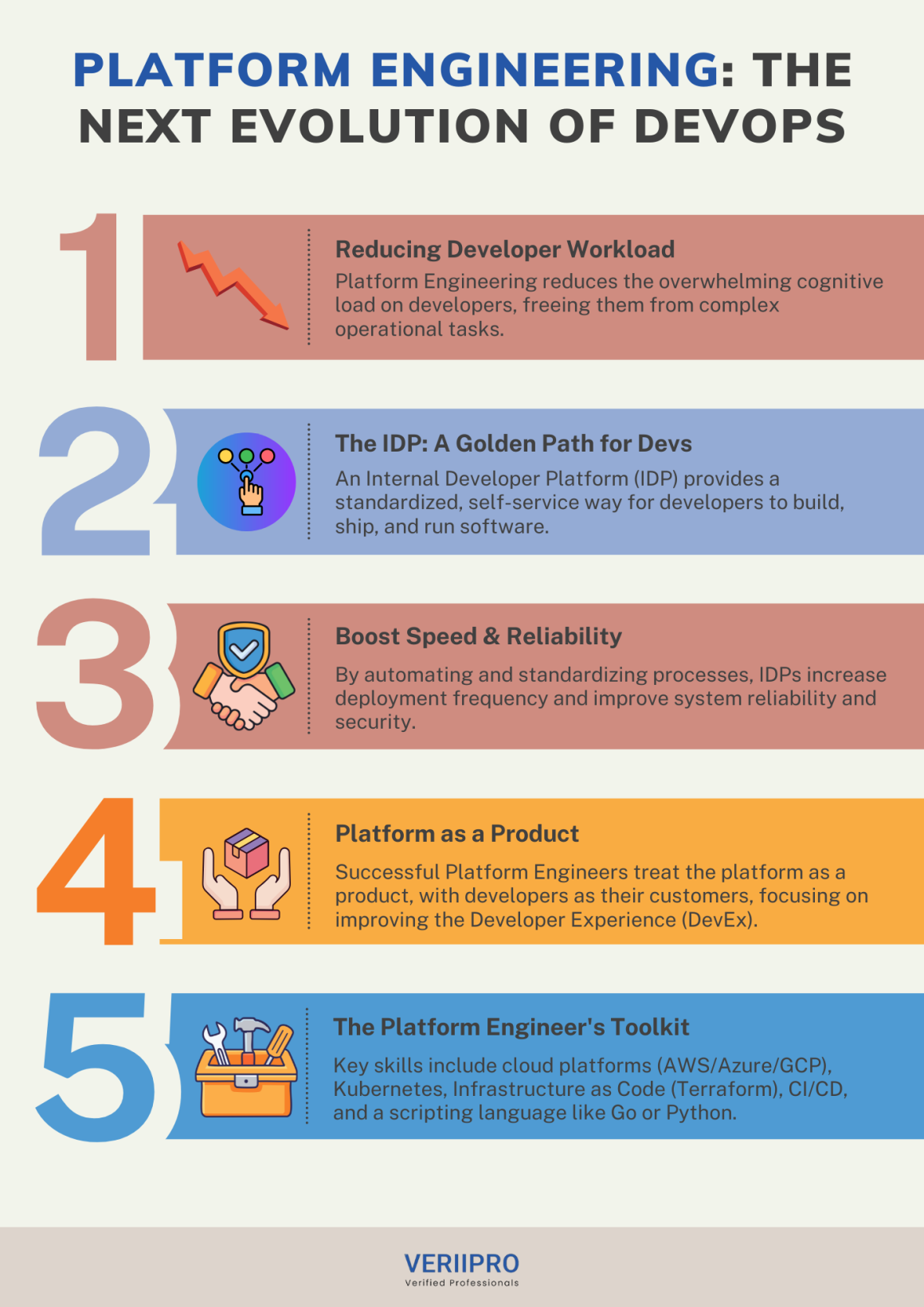
This is the problem Platform Engineering is designed to solve. Instead of saddling developers with operational burdens, a dedicated platform team builds and maintains a solid, streamlined foundation that enables developers to do what they do best: write code and create value. The goal isn’t to add another layer of bureaucracy but to provide a “golden path”—a well-lit, paved road that makes the right way the easy way.
The Solution: The Internal Developer Platform (IDP)
The primary tool of a platform engineering team is the Internal Developer Platform (IDP). Think of an IDP as your company’s internal version of Heroku or AWS, tailored specifically to your needs. It’s a self-service layer that sits on top of your existing tech and tools, abstracting away the underlying complexity.
An IDP isn’t a single, off-the-shelf product. It’s a curated collection of technologies and automated workflows, often including:
- Standardized Templates: Pre-configured starter kits for new services.
- Automated Infrastructure: Self-service provisioning of databases, caches, and other resources via tools like Terraform or Crossplane.
- Integrated CI/CD: Streamlined pipelines that automatically build, test, and deploy code.
- Built-in Observability: Centralized logging, metrics, and tracing without manual setup.
- Security by Default: Integrated vulnerability scanning and policy enforcement.
By providing these capabilities through a simple interface (like a web UI, a command-line tool, or even integrated into developer IDEs), the IDP empowers developers to manage the entire lifecycle of their applications with confidence and speed. This focus on the Developer Experience (DevEx) is paramount, as a smoother workflow directly translates to higher productivity and innovation.
How to Become a Platform Engineer: More Than Just a Title
The role of a Platform Engineer is a blend of a software engineer, a DevOps specialist, and a product manager. You’re not just managing infrastructure; you’re building a product for an internal audience. If you’re looking to transition into this exciting and in-demand field, here’s a roadmap to get you started.
1. Master the Foundational Skills
A strong technical foundation is non-negotiable. Your toolkit should be robust and modern.
- Cloud and Infrastructure as Code (IaC): Deep expertise in at least one major cloud provider (AWS, Azure, or GCP) is essential. You must be proficient in IaC tools like Terraform or Pulumi to automate infrastructure management.
- Containers and Orchestration: Docker and Kubernetes are the backbone of most modern platforms. You need to understand them inside and out, from writing Dockerfiles to managing complex Kubernetes clusters.
- CI/CD Pipelines: Get hands-on experience with tools like GitHub Actions, GitLab CI, or Jenkins. The goal is to build fully automated, secure, and efficient delivery pipelines.
- Scripting and Programming: Proficiency in a language like Go or Python is crucial for writing automation scripts, custom controllers, and the glue that holds the platform together.
2. Adopt a Product Mindset
This is what separates a good Platform Engineer from a great one. You must have empathy for your users—the developers.
- Listen to Your Customers: Actively seek feedback. What are their biggest pain points? Where are they getting stuck? Use this information to guide your platform’s roadmap.
- Prioritize the User Experience: Make your platform intuitive and easy to use. If a developer needs to read a 50-page manual to get started, you’ve failed.
- Measure What Matters: Track metrics like deployment frequency, lead time for changes, and developer satisfaction scores to demonstrate the value of your platform.
3. Build, Learn, and Contribute
The best way to learn is by doing.
- Start Small: Build a “mini-IDP” for your personal projects. Automate everything from code commit to a live deployment.
- Explore Open-Source Tools: Get familiar with popular open-source platforming tools like Backstage (a service catalog and developer portal from Spotify) and Crossplane (a Kubernetes-native way to manage cloud resources).
- Seek Out Opportunities: Look for roles or projects within your current organization that involve building shared services or improving developer tooling.
Platform Engineering represents a fundamental shift in how we build and deliver software. By focusing on developer enablement and treating our internal platforms as first-class products, we can unlock new levels of speed, reliability, and innovation.
Moving Forward
Looking for opportunities in Platform Engineering? VeriiPro is here to help! The demand for skilled Platform Engineers is skyrocketing, but navigating the job market for such a specialized role can be challenging. VeriiPro connects you with top-tier companies actively building their platform teams. Our experienced recruiters understand the nuances of this field and can match your skills in Kubernetes, Terraform, and CI/CD with organizations that value innovation and an excellent developer experience. We’re here to help you prepare for interviews, highlight your unique strengths, and land your dream job in this cutting-edge domain.