

Introduction
Machine learning engineering sits at the intersection of software development and artificial intelligence, and right now it’s one of the hottest career paths in tech. Companies across every industry are racing to build smarter products, automate complex processes, and extract value from mountains of data. Machine learning engineers make that happen.
In this guide, you’ll learn what an ML engineer actually does, which skills and tools the role requires, what the salary looks like in 2026, and the practical steps to break in – whether you’re coming from a CS background or switching careers entirely.
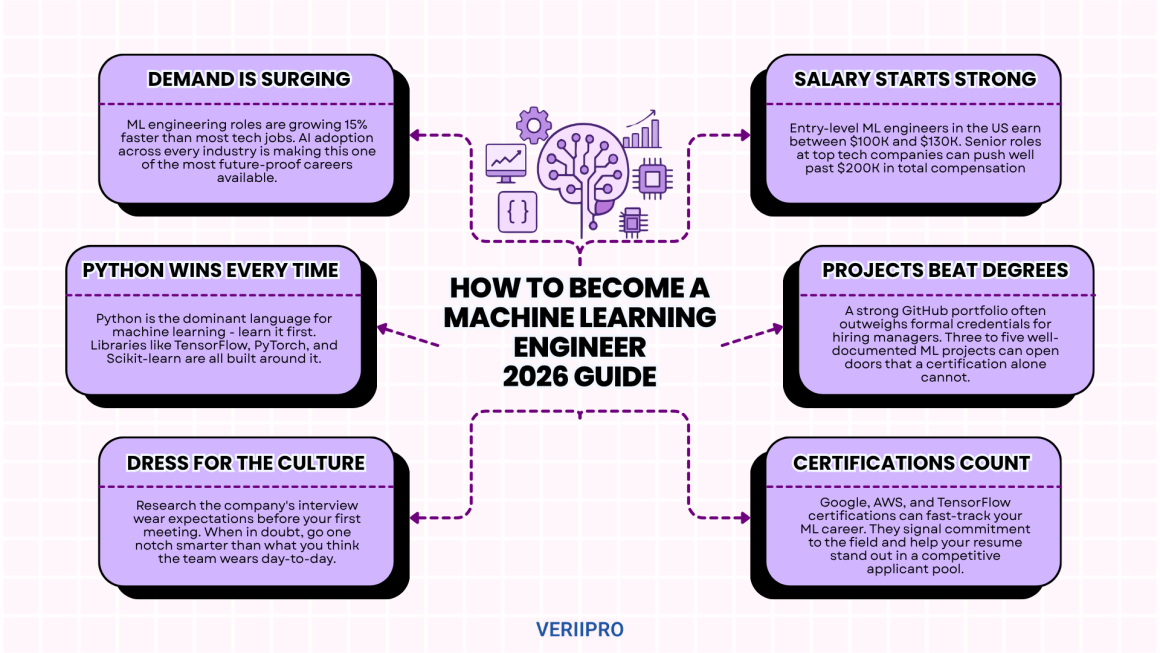
What Is a Machine Learning Engineer?
A machine learning engineer designs, builds, and deploys the systems that allow machines to learn from data and improve their performance over time. Think of them as the bridge between data science and software engineering. They take the models that data scientists prototype and turn them into production-ready systems that actually run at scale.
It’s a hands-on, technical role that requires both a strong understanding of ML concepts and solid software engineering fundamentals.
Why Machine Learning Engineers Are in High Demand
AI adoption isn’t slowing down. According to the U.S. Bureau of Labor Statistics, computer and information technology occupations are projected to grow 15% through 2033 – much faster than the average for all occupations. Machine learning roles in particular have exploded as organizations realize that embedding intelligence into their products requires dedicated engineers who can own the full lifecycle from model training to deployment. Whether it’s fraud detection in banking, recommendation engines in e-commerce, or diagnostic tools in healthcare, ML engineers are in demand nearly everywhere.
Also Read: How to Become a Robotics Engineer: Education, Skills & Career Path
What Does a Machine Learning Engineer Do? Key Responsibilities
- Model Development – Building and training machine learning models on real datasets.
- Data Processing – Cleaning, transforming, and preparing raw data for use in training pipelines.
- Algorithm Implementation – Selecting and applying the right ML algorithms to specific business problems.
- Model Deployment – Integrating trained models into production environments so they can serve live traffic.
- Performance Optimization – Improving model accuracy, reducing latency, and cutting infrastructure costs.
- Collaboration – Working closely with data scientists, software engineers, and product teams to ship end-to-end solutions.
Types of Machine Learning Roles
- Machine Learning Engineer – Builds, optimizes, and deploys ML systems end-to-end.
- AI Engineer – Develops broader intelligent applications and AI-powered products.
- Data Scientist – Focuses on statistical analysis, experimentation, and predictive modeling.
- Deep Learning Engineer – Specializes in neural network architectures and large-scale model training.
Key Skills Required to Become a Machine Learning Engineer
The skill set is broad, but these are the non-negotiables:
- Programming (Python is the dominant language; Java and C++ are useful for production systems)
- Machine learning algorithms – supervised, unsupervised, and reinforcement learning
- Data structures and algorithm fundamentals
- Mathematics and statistics – linear algebra, calculus, probability
- Data preprocessing and feature engineering
- Deep learning frameworks like TensorFlow and PyTorch
- Strong problem-solving and analytical thinking
Tools and Technologies Used by Machine Learning Engineers
- Python and R for development
- TensorFlow and PyTorch for deep learning
- Scikit-learn for classical ML
- Jupyter Notebook for experimentation
- SQL and database management
- Cloud platforms – AWS, Azure, and Google Cloud Platform
Machine Learning Engineer vs Data Scientist vs AI Engineer
Here’s a quick breakdown of how these roles differ:
| Role | Primary Focus | Key Skills | Typical Output |
|---|---|---|---|
| ML Engineer | Build and deploy ML systems | Python, MLOps, cloud, software engineering | Production ML pipelines |
| Data Scientist | Analysis and predictive modeling | Statistics, Python/R, visualization | Insights, experimental models |
| AI Engineer | Intelligent application development | NLP, computer vision, APIs | AI-powered products |
Machine Learning Engineer Salary and Job Outlook (2026)
Compensation for ML engineers is strong. In the United States, Glassdoor reports median base salaries ranging from $130,000 to $180,000 annually, with senior roles at major tech companies often reaching $200,000 or more when total compensation is factored in. Internationally, the UK and Canada have seen strong growth in ML roles, while India’s AI market continues to scale rapidly.
The long-term outlook is positive. As generative AI tools become standard infrastructure, engineers who understand the underlying systems will stay in high demand.
| Experience Level | US Median Salary | Growth Outlook |
|---|---|---|
| Entry Level (0-2 yrs) | $100,000 – $130,000 | Strong |
| Mid Level (3-5 yrs) | $140,000 – $170,000 | Very Strong |
| Senior (5+ yrs) | $180,000 – $220,000+ | Excellent |
Also Read: Big Data Engineer: Roles, Skills, Salary, and How to Start Your Career in 2026
How to Become a Machine Learning Engineer
There’s no single path, but this sequence works for most people:
- Earn a relevant degree – Computer science, mathematics, or statistics degrees give you the strongest foundation. That said, plenty of working ML engineers are self-taught.
- Learn programming and ML fundamentals – Start with Python. Then work through core ML concepts using courses and textbooks before moving to frameworks.
- Build real projects – Kaggle competitions, open-source contributions, and personal projects on GitHub matter more than most people expect.
- Gain experience in adjacent roles – Data analyst, software engineer, or data scientist positions are all solid stepping stones.
- Apply strategically – Platforms like LinkedIn, Wellfound, and AI-focused job boards can surface the right opportunities faster.
Certifications That Can Boost Your Career
- Google Machine Learning Certification
- AWS Machine Learning Specialty
- TensorFlow Developer Certificate
- IBM AI Engineering Professional Certificate
Industries Hiring Machine Learning Engineers
- Technology and IT
- Finance and Banking
- Healthcare and Life Sciences
- E-commerce and Retail
- Automotive – particularly self-driving and ADAS development
Tips to Get Your First Machine Learning Job
Breaking into machine learning job requires more than just technical skills. Your portfolio, network, and how you present yourself all matter. When you eventually land an interview, don’t overlook the basics. Your interview outfit and overall presentation still shape first impressions, even in tech. Here’s what actually moves the needle:
- Build 3-5 strong ML projects with well-documented code on GitHub
- Participate in Kaggle competitions to demonstrate real problem-solving ability
- Network actively on LinkedIn and at local AI meetups
- Prepare for technical interviews with mock sessions covering coding, system design, and ML theory
- Research modern interview outfits appropriate for the company culture – some teams expect business casual, others are fully casual
Common Challenges in Machine Learning Engineering
- Data quality issues – Garbage in, garbage out. Sourcing and cleaning reliable datasets takes more time than most engineers expect.
- Model overfitting and underfitting – Getting the bias-variance tradeoff right is an ongoing challenge, especially with limited data.
- Deployment complexity – Getting a model to work in a notebook is one thing; running it reliably in production is another.
- Scalability – Models that perform well at small scale often break when traffic spikes.
- Keeping pace with the field – ML moves fast. New architectures, tools, and best practices emerge constantly.
Tools & Resources to Learn Machine Learning
- Online courses on Coursera, Udemy, and Fast.ai
- Classic textbooks like Hands-On Machine Learning by Aurelien Geron
- YouTube channels from researchers and practitioners
- Kaggle and GitHub for practice and community
- ML communities like Papers With Code and Hugging Face forums