
Introduction
Software teams used to plan a year ahead and watch reality refuse to cooperate. That mismatch is why agile methodologies quietly took over modern project work. As Indeed notes in its career guide, agile is essentially the ability to adapt and respond to change effectively. Instead of locking everything in upfront, agile development assumes change is the default and builds the work around it. This guide walks through what agile actually is, the main types, the real benefits, and how to pick the right framework without overthinking it.
What is Agile Methodology?
Most agile methodology definitions land on the same idea: it is a mindset for delivering work in small, useful chunks while staying open to change. People call it a methodology, a framework, or a process, and that is all fine, but the mindset comes first. Without it, you get teams running daily standups and calling themselves agile while behaving exactly like a waterfall shop.
The clearest agile methodology explanation treats it as both a way of thinking and a way of working. Three principles sit at the core: flexibility, iteration, and a real focus on the customer. Everything else is implementation detail.
Key Principles of Agile Methodology
The agile process rests on a few non-negotiables. Iterative development means you ship something small, learn from it, then ship again. Continuous feedback keeps the team honest, both from users and from each other. Collaboration replaces the old habit of throwing requirements over a wall to engineering. And adaptability means a roadmap is a guess, not a contract. Teams that nail these four tend to ship better software. Teams that skip them tend to call meetings about why nothing is shipping.
Types of Agile Methodologies
Agile is an umbrella term. Underneath it sit several frameworks, each with its own rhythm. Product School lays out the main ones clearly, and the list below covers the ones worth knowing.
1. Scrum
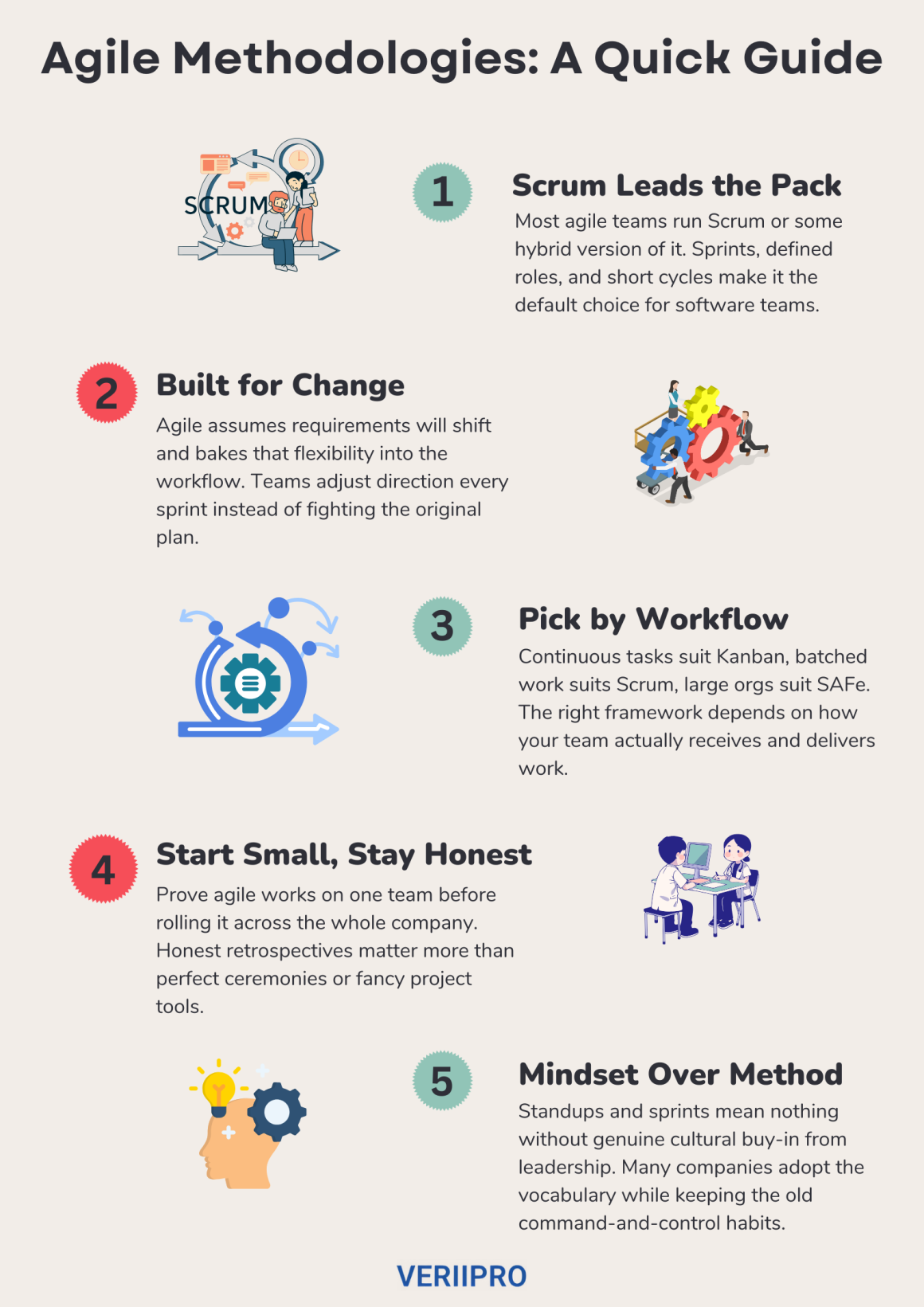
Scrum is the most popular agile project management methodology by a wide margin. Work is broken into sprints, usually two weeks long, with defined roles like Product Owner and Scrum Master. If you want the textbook agile methodology example, this is it. Most teams that say they are doing agile are actually doing some version of Scrum.
2. Kanban
Kanban came out of Toyota’s manufacturing floors. It uses a visual board with columns like To Do, Doing, and Done. The point is to limit work in progress and keep things flowing. No sprints, no ceremonies, just a steady pull system. Ops, support, and content teams love it.
3. Lean
Lean is obsessed with one thing: eliminating waste. Anything that does not add value for the customer gets cut. It pairs well with startups running on tight budgets and short runways.
4. Extreme Programming (XP)
XP is the engineer’s agile software development methodology. Pair programming, test-driven development, continuous integration, frequent releases. It demands strong technical discipline, which is also why some teams quietly drop the harder parts after six months.
5. Scaled Agile Framework (SAFe)
SAFe is what you reach for when 200 people need to coordinate without descending into chaos. It is heavier and more structured than Scrum, and that is the point.
6. Adaptive Project Framework (APF)
APF is built for projects where the requirements genuinely cannot be known upfront. Research projects, R&D, anything exploratory. It adjusts plans every cycle based on what was just learned.
7. Feature-Driven Development (FDD)
FDD organizes work around a list of client-valued features, then builds them in short, repeatable steps. It scales reasonably well and works for teams that think in features rather than user stories. This beginner’s guide on Medium is worth a read if you want a deeper walkthrough of FDD and other lesser-known variants.
Agile vs Traditional (Waterfall) Methodology
Waterfall moves in a straight line: gather requirements, design, build, test, release. Each phase finishes before the next begins. It works when the scope is fixed and the cost of change is low, like construction or hardware. Agile development moves in loops. You build a slice, ship it, learn, then build the next slice. Use waterfall for regulated, well-understood projects. Use agile for anything where the requirements are likely to shift, which is most software.
Benefits of Agile Methodologies
The agile development process delivers working software faster, in small slices users can actually react to. Collaboration improves because designers, engineers, and product folks talk every day instead of every quarter. Teams adapt to change without rewriting the whole plan. And because customers see progress early, satisfaction goes up. Zennaxx breaks down the practical benefits well, pointing out that agile methods are far more flexible and adaptable than traditional approaches, especially when priorities shift mid-project.
How to Choose the Right Agile Methodology
Based on Project Size
Small teams under ten people usually thrive with Scrum. Large enterprises with multiple teams shipping into the same product should look at SAFe or LeSS.
Based on Workflow
If work arrives in a continuous stream like support tickets or content requests, Kanban fits. If you can batch work into time-boxed chunks, Scrum makes more sense.
Based on Industry
Software product teams gravitate toward Scrum and XP. Operations, marketing, and support teams tend to land on Kanban. Hardware and regulated industries often blend agile with stage-gate processes.
Challenges of Agile Methodology
Agile is not magic. It requires a real cultural shift, and managers used to command-and-control will struggle. Teams depend heavily on each other, so one weak link slows everything. Scaling agile across hundreds of people without the right framework usually creates more ceremonies than outcomes. Many companies adopt the vocabulary without changing the behavior, which is worse than not adopting it at all.
Best Practices for Implementing Agile
Start Small
Pick one team and one project. Prove it works there before forcing it on the rest of the company.
Train Your Team
Send people to certified training. Agile vocabulary without agile understanding is just expensive theater.
Use the Right Tools
Jira, Linear, Trello, Asana. The tool matters less than the discipline of keeping it updated.
Focus on Continuous Improvement
Run honest retrospectives. If the same complaint shows up three sprints in a row, something is broken and nobody is fixing it.
Conclusion
Agile methodologies reshaped how modern teams build software, and the reasons are practical, not philosophical. Faster delivery, happier customers, better team morale. The trick is picking the framework that fits your reality, not the one that sounds impressive in a board deck. Start small, stay honest in your retros, and remember that agile is something you practice, not something you announce. Pick one method this quarter, run it for 90 days, and judge it by what actually ships.