
Spend ten minutes scrolling tech job boards and you’ll spot the pattern. One company is hiring a software tester. Another wants a QA tester. A third posts for a QA analyst, and a fourth calls basically the same role a test engineer. If you’re trying to break into the field (or you already test software for a living), it’s fair to ask whether you’re looking at one job wearing four different name tags.
Mostly, you are. The software tester vs QA tester debate exists because companies borrow titles from different traditions. Some teams treat testing as a hands-on activity: run the software, break it, report what broke. Others treat quality assurance as a bigger discipline that also shapes how the team builds software in the first place. The title a company picks often says more about its history, and about whoever wrote the job posting, than about the work itself.
The short answer? The titles overlap heavily, and plenty of companies use them interchangeably. But responsibilities depend on the organization, which means the job description will tell you far more than the title ever could. Below, we’ll look at where the two roles match, where they drift apart, and what all of it means for your pay and your long-term software testing career.
What Is a Software Tester?
A software tester checks whether software does what it’s supposed to do, and figures out what happens when it doesn’t. That’s the whole purpose of the job. Everything else supports it.
So what does a software tester do on a normal day? The work often starts before any code exists. Testers review requirements and user stories, hunting for gaps, contradictions, and fuzzy lines like “the page should load quickly.” (How quickly? On what connection?) From there, they write test cases: step-by-step scenarios, each with an expected result.
Then comes execution. Typical software tester responsibilities include:
- Running functional tests to confirm each feature works as designed
- Running regression tests to make sure new code didn’t break something that used to work
- Doing exploratory testing, which means poking around the product without a script, the way a curious (or careless) user would
- Logging bugs in a tracking tool with clear steps to reproduce them
- Retesting fixes and following each defect until it’s closed
The Department of Labor’s O*NET profile for this occupation reads a lot like a tester’s to-do list, from designing test plans and scripts to documenting defects in a bug tracking system and building regression tests.
Some of this work is manual, with a person clicking through screens. Some is automated, with scripts handling the repetitive checks. Most software tester roles today involve at least a little of both, and the balance shifts with the company and the product.
What Is a QA Tester?
A QA tester, short for quality assurance tester, does much of the same hands-on testing. The difference is in the framing. “Quality assurance” suggests ownership of the product’s quality and, at least in theory, the process that produces it.
The International Software Testing Qualifications Board draws that line pretty clearly. Its Foundation Level syllabus acknowledges that people use “testing” and “QA” interchangeably, then explains why they aren’t the same thing. Testing is a form of quality control, which is product-focused and corrective. QA is process-focused and preventive. Put simply, testing catches problems. QA tries to keep them from happening again.
That preventive angle matters because bugs get expensive. The Consortium for Information & Software Quality estimated that poor software quality cost the U.S. economy at least $2.41 trillion in 2022.
In practice, QA tester responsibilities commonly include reviewing specifications, developing test plans, executing test cases, identifying defects, and collaborating with cross-functional teams. A QA tester might sit in on sprint planning, push back on vague acceptance criteria, or propose a release checklist so the same bug doesn’t ship twice.
So what does a QA tester do that a software tester doesn’t? Sometimes nothing at all. At a small startup, the “QA tester” might spend most of the day running test cases. At a bank or a healthcare company, the same title might also cover documenting test procedures for compliance. The Bureau of Labor Statistics description of the occupation spans both ends: creating test plans, identifying project risks, running manual and automated tests, and giving developers feedback on usability and functionality.
And like software testers, people in QA tester roles work across both manual and automated testing. The toolbox is the same. The title just hints at a wider lens.
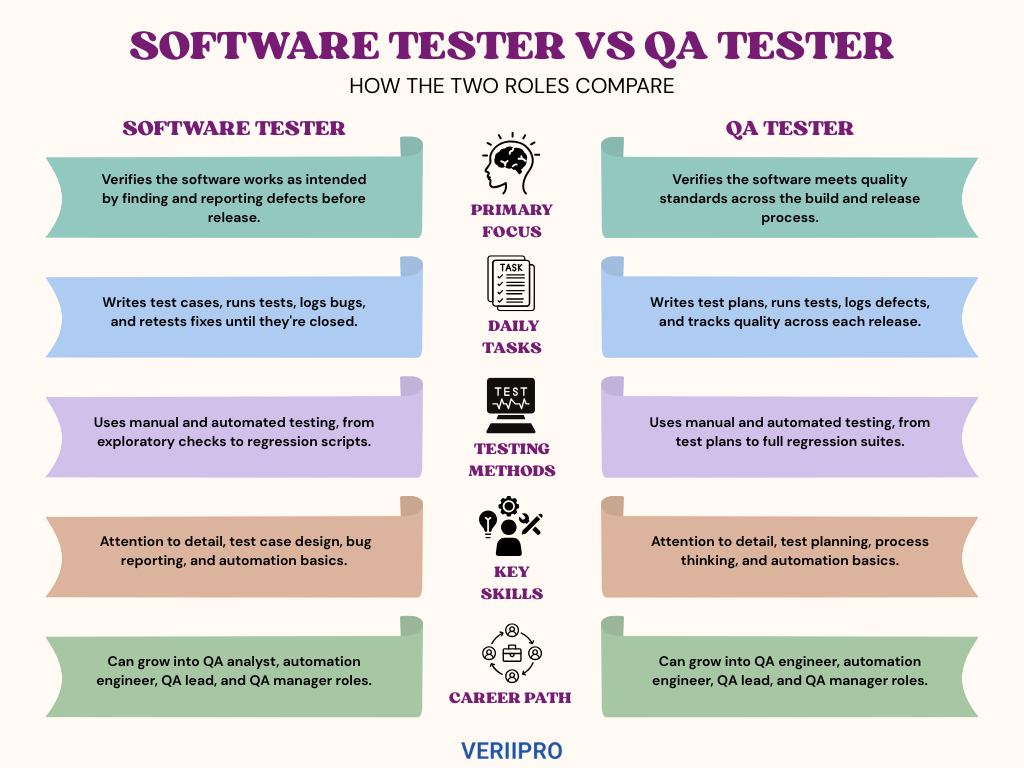
Software Tester vs. QA Tester: Key Differences
Here’s how the two titles typically compare. Keep in mind that “typically” is doing a lot of work in that sentence.
| Factor | Software Tester | QA Tester |
|---|---|---|
| Primary focus | Software testing: does this build work? | Software quality: is the product (and the process) up to standard? |
| Main activities | Finding, reporting, and retesting defects | Testing plus quality processes and standards |
| Testing methods | Manual and automated | Manual and automated |
| Test planning | Depends on the role | Often included |
| Process involvement | Varies | Potentially broader |
| Collaboration | Developers and the QA team | Developers, product, and QA teams |
| Job title usage | Varies by company | A common title in QA departments |
Count how many rows say “varies,” “depends,” or “potentially.” That’s the honest picture of QA tester vs software tester. The differences are tendencies, not rules, and a software tester at one company can easily have a broader job than a QA tester at another.
The same goes for QA testing vs software testing as disciplines. On paper, QA is the umbrella and testing sits underneath it. On a real team, people use the words loosely, and nobody’s going to correct you in standup.
Are Software Tester and QA Tester the Same Job?
For most practical purposes, yes.
The strongest evidence comes from the federal government. The BLS doesn’t track software testers and QA testers separately. Both fall under one occupation, software quality assurance analysts and testers. And O*NET’s sample of job titles reported for that occupation includes QA analyst, QA engineer, software test engineer, test engineer, and automation tester. Same bucket, different labels.
So why do companies bother with different titles? A few reasons come up again and again:
- History and habit. Plenty of older enterprise companies built “QA departments” decades ago, and the name stuck.
- Seniority signals. Some organizations use “tester” for junior roles and save “QA analyst” or “QA engineer” for experienced hires.
- Recruiting. Titles get chosen for search visibility. If more candidates search for “QA tester,” that’s what goes on the posting.
- Real differences in scope. Sometimes the title does reflect a broader process role. Sometimes.
That’s why the job description matters more than the title. Read the responsibilities. Does the posting mention test strategy, process improvement, or release sign-off? Then it’s a broader quality role, whatever it’s called. Does it mostly describe executing test cases and logging bugs? That’s classic testing, even if the title says “QA Specialist.” Check the tools list too. A posting that asks for Selenium or Playwright scripting is an automation job, no matter what’s at the top.
One caution. Titles like QA engineer and SDET (software development engineer in test) are a different animal. Those usually mean real coding work, building and maintaining test frameworks, and they tend to pay accordingly.
Skills Required for Software Testers and QA Testers
Good news if you’re weighing both paths: the software tester skills and QA tester skills employers ask for are nearly identical. These are the ones that matter most.
- Software testing fundamentals. Know functional versus non-functional testing, black-box versus white-box testing, and when each one makes sense.
- SDLC and STLC. The software development life cycle is how a product gets built. The software testing life cycle is how testing fits inside it, from requirement analysis through test closure. Interviewers love asking about both.
- Test case design. Writing tests that catch real problems is a skill. Techniques like boundary value analysis and equivalence partitioning help you test smarter instead of testing everything.
- Bug and defect tracking. A bug report developers can’t reproduce is a bug report that gets ignored. Clear title, exact steps, expected versus actual result, screenshots. Every time.
- Regression and functional testing. This is the daily bread of most testing jobs.
- API testing. Modern apps are stitched together with APIs, and plenty of bugs hide behind the user interface. Tools like Postman let you test those connections directly.
- Automation testing. Even manual-focused roles increasingly expect some comfort with a framework like Selenium, Playwright, or Cypress.
- Testing tools. O*NET flags Selenium, Jira, Git, and Jenkins as in-demand technologies for this occupation, based on how often they show up in employer job postings.
- Analytical thinking and attention to detail. You’re paid to notice what everyone else missed.
- Communication and collaboration. You’ll deliver bad news to developers on a regular basis. Doing it clearly, and without drama, is half the job.
One skill is climbing fast. In Capgemini’s World Quality Report 2025-26, generative AI came out as the top-ranked skill for quality engineers at 63 percent, just ahead of core quality engineering skills at 60 percent. Testers who can check AI-generated test cases, and test AI-powered features, are going to have options.
Manual Testing vs. Automated Testing
Honestly, this split matters more than the tester-versus-QA split. It’s where job descriptions (and paychecks) really start to diverge.
What manual testers do. They execute test cases by hand, explore the product the way a real user would, and make judgment calls a script can’t, like whether a checkout flow feels confusing or an error message actually helps. Manual testing shines for new features, usability checks, and exploratory work.
What automation testers do. They write code that runs tests automatically, usually inside a CI/CD pipeline that kicks off with every code change. The point is to hand repetitive checks, like a full regression suite, to machines so people can focus on the tricky stuff.
Common tools and frameworks. Selenium is the long-standing standard for browser automation. Playwright and Cypress are newer favorites for web apps. Appium handles mobile, Postman covers APIs, and frameworks like JUnit, TestNG, and pytest organize the tests themselves. Jenkins or GitHub Actions run it all in the pipeline.
When automation skills become important. Usually sooner than people expect. According to the BLS, testers run manual and automated checks after a product is released and again after every upgrade or round of maintenance. When a team ships updates weekly (or daily), manual regression testing simply can’t keep pace.
How to move from manual to automation. Pick one language. Python and JavaScript are friendly starting points, and Java is common in enterprise shops. Learn one framework well instead of dabbling in five. Then automate a test suite you already run by hand, since you already know exactly what each test should prove. That’s the natural bridge, and it’s how a lot of automation engineers got their start.
Software Tester vs. QA Tester: Career Path
Whichever title you start with, the ladder looks about the same:
- Junior Software Tester / QA Tester. You run test cases others wrote, log bugs, and learn the product inside and out. This is where your instincts get built.
- Software Tester / QA Analyst. You write your own test cases, own specific features, and start weighing in on requirements.
- Senior QA Tester / QA Engineer. You design test strategies, mentor newer testers, and usually start writing automation.
- Automation QA Engineer. Automation becomes the main job. You build and maintain frameworks, wire tests into CI/CD, and work side by side with developers.
- QA Lead. You coordinate testing for a team or product, set priorities, and help decide what “ready to ship” means.
- QA Manager. You manage people, budgets, hiring, and the quality process across multiple teams.
Notice how the paths merge by the middle rungs. By the time someone’s a QA engineer, nobody cares whether their first title said “software tester” or “QA tester.” They care about what that person can do. That should be a relief if you’re worried about picking the “wrong” starting title.
There’s also a formal on-ramp that doesn’t get enough attention. The Department of Labor has approved Software Quality Assurance Tester as a Registered Apprenticeship title, so some employers offer structured, on-the-job training into the field.
Salary and Job Opportunities
Let’s talk money, because this is where the title question gets interesting.
Start with the official numbers. According to the BLS, software quality assurance analysts and testers earned a median annual wage of $104,300 in May 2025. The lowest-paid 10 percent earned under $61,440, which roughly reflects entry-level pay, while the top 10 percent earned more than $167,010. Since BLS counts both titles as one occupation, that’s effectively the benchmark for software tester salary and QA tester salary alike.
Salary sites do split the data by title, and the gaps are smaller than you might expect. ZipRecruiter puts the average software tester salary at $90,490 a year and QA testing pay at $83,472. Close enough that the title alone isn’t the story.
The story is the other words in the title. On Glassdoor, the average QA tester earns about $66,774, a QA automation tester about $86,800, and a QA test engineer about $117,282. The “software” versus “QA” gap is a few thousand dollars. The jump from “tester” to “engineer” is more than $50,000.
A few other factors shape compensation:
- Technical skills. Automation, API testing, and coding ability are the clearest paths to higher pay.
- Experience. Senior testers who design strategy and own releases earn far more than those executing someone else’s scripts.
- Industry. BLS data shows QA analysts and testers in manufacturing earned a median of $129,930, compared with $99,960 in computer systems design.
- Location. Major tech hubs usually pay more, though a higher cost of living eats into some of that difference.
As for job opportunities, the outlook is steady rather than explosive. The BLS projects employment of QA analysts and testers to grow 6 percent from 2025 to 2035. That’s slower than the 10 percent projected for software developers, but it’s double the 3 percent average for all occupations. BLS ties the demand to growth in AI, IoT, robotics, and security software, all of which need someone to try to break them before users do.
Which Role Should You Choose?
The twist is that you usually don’t choose between titles. You choose between kinds of work, then look for job descriptions that match.
Choose software testing if you enjoy:
- Finding defects and figuring out exactly how to trigger them
- Test execution, the hands-on work of running a product through its paces
- Problem-solving with clear, concrete goals
- Product validation, proving a feature does what it promised
Consider QA if you enjoy:
- Test strategy and deciding what’s worth testing in the first place
- Quality processes, standards, and checklists that prevent repeat problems
- Cross-functional collaboration with product managers, designers, and developers
- Improving the development process itself, not just the product
- Automation and broader quality initiatives that scale across teams
If you’re in the first group, look for postings heavy on test execution and exploratory testing, whatever they’re titled. If you’re in the second, watch for phrases like “test strategy,” “process improvement,” and “release readiness.” And if both lists sound good? Great. A long QA testing career usually ends up blending the two anyway.
How to Become a Software Tester or QA Tester
The path is the same for both titles. We’ve laid it out step by step in our guide on how to become a QA tester, but here’s the condensed version.
- Learn testing fundamentals. The ISTQB Certified Tester Foundation Level syllabus is a structured starting point, and the certification is one of the most widely recognized in the field.
- Understand SDLC and STLC. Learn how Agile teams work in sprints and where testing fits in each one.
- Build hands-on testing experience. Test open-source projects, public demo sites, or apps you use every day. Write real bug reports as you go.
- Learn testing tools. Start with a defect tracker like Jira and a test case management tool, then branch out.
- Develop API and automation skills. Get comfortable with Postman first, then pick one automation framework and one programming language.
- Build a testing portfolio. Put your test plans, test cases, bug reports, and automation scripts on GitHub. Employers want proof, not promises.
- Apply for entry-level testing roles. Search every variation: software tester, QA tester, QA analyst, test analyst, junior QA engineer. Casting a wide net across titles is the easiest win in this whole article.
About degrees: BLS says these roles typically require a bachelor’s, but O*NET’s survey data paints a more flexible picture. Half of respondents said a bachelor’s degree was required, while 26 percent said an associate’s degree was the requirement. A strong portfolio and a certification can carry real weight, especially at the entry level.
When you’re ready to start applying, browse open QA and software testing jobs on VeriiPro to see which skills employers are asking for right now.
Final Takeaway
Software tester and QA tester can describe essentially the same role, but the scope varies by company. So don’t get hung up on the title. Read the job description, study the responsibilities and the tool list, and ask in the interview what a normal week actually looks like. That’s where the real answer lives.
And if you’re building a career in testing, put your energy where it pays off: solid fundamentals, automation skills, and a portfolio that proves you can find the bugs everyone else missed. The title will sort itself out.