



Introduction
If you have spent any time exploring careers in tech recently, you have probably noticed that “big data” keeps coming up. And for good reason. Companies today are sitting on more data than they know what to do with, and the people who actually know how to build the systems to handle it are in seriously short supply. That is where big data engineers come in. They are the ones building the pipelines, the storage systems, and the infrastructure that makes data useful in the first place. According to the U.S. Bureau of Labor Statistics, jobs in this space are growing much faster than most other fields, and that trend is not slowing down. This article walks you through what the role actually involves, what skills you need, what you can expect to earn, and how to realistically get started in 2026.
What Is a Big Data Engineer?
At its core, a big data engineer builds and maintains the systems that collect, store, and process large volumes of data. Think of it this way: data analysts and data scientists need clean, organized data to do their jobs. Someone has to build the infrastructure that gets them that data. That someone is the big data engineer. They are not analyzing trends or training machine learning models. They are building the plumbing that makes all of that possible. If the data is the fuel, the big data engineer builds the refinery.
Why Big Data Engineers Are in High Demand
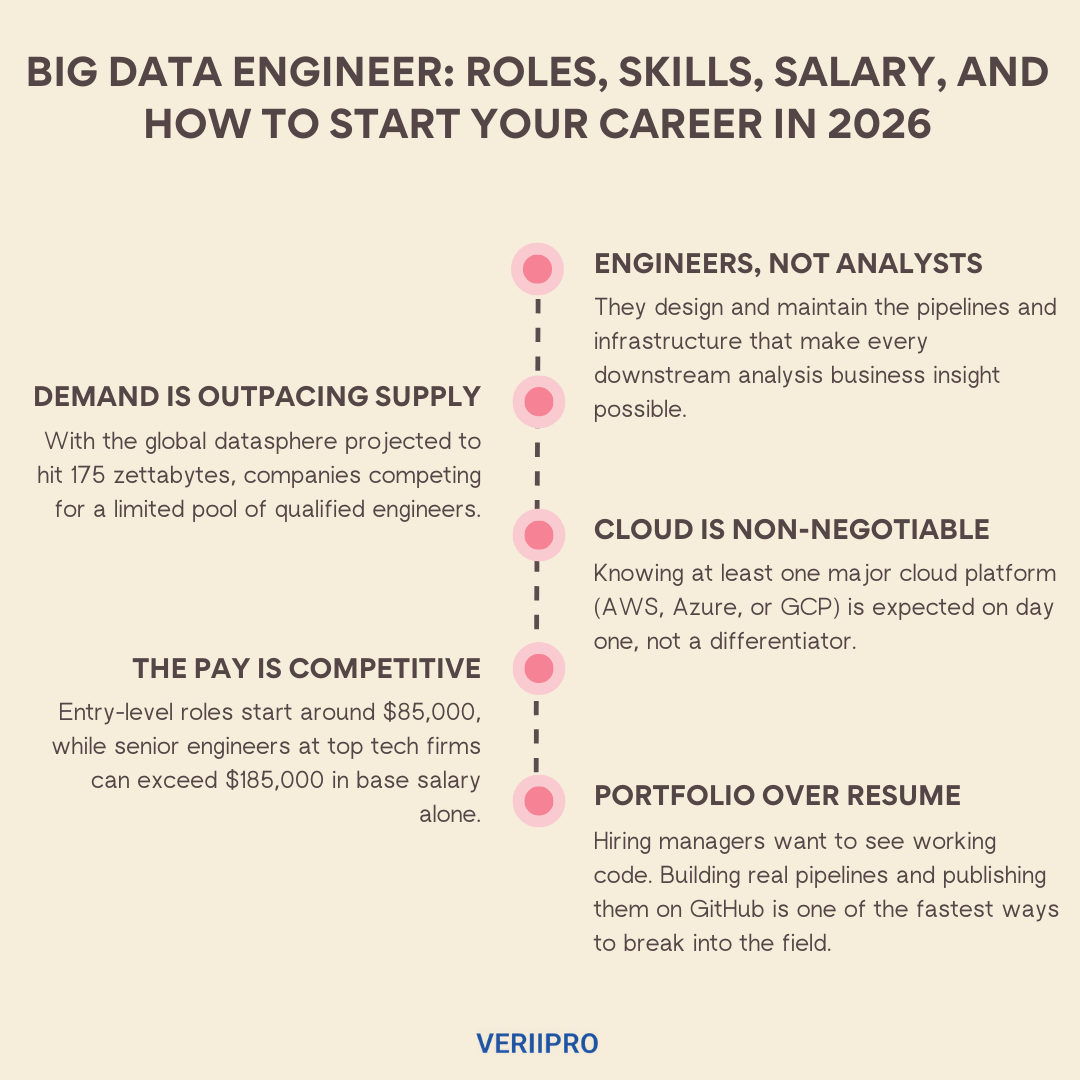
Here is the honest reality: most companies are drowning in data they cannot use. The explosion of cloud computing, e-commerce, connected devices, and AI-powered tools has created more raw data than ever before, but raw data is essentially worthless without the right infrastructure behind it. Organizations across every industry have figured this out and are racing to hire engineers who can build that infrastructure. A 2025 report from IDC puts the global datasphere at a projected 175 zettabytes, and that number keeps climbing. On top of that, regulatory pressure around data governance and the mainstream adoption of machine learning have made big data engineers genuinely indispensable. This is not a niche role anymore.
Also Read: How to Ask for a Raise: A Step-by-Step Guide to Salary Negotiation
What Does a Big Data Engineer Do? Key Responsibilities
- Data Pipeline Development – Building automated systems that pull raw data from APIs, databases, and applications and route it to wherever it needs to go. When something breaks at 2 AM, this is what breaks.
- ETL Processes – Extracting data from source systems, cleaning and transforming it into a usable format, and loading it into data warehouses or lakes. Boring to describe, critical in practice.
- Data Architecture Design – Deciding how data is structured, stored, and accessed across the organization. These decisions are hard to reverse, so getting them right matters a lot.
- Data Integration – Combining data from multiple sources that were never designed to talk to each other. This takes more patience than most people expect.
- Collaboration – Working with data scientists, analysts, and product teams to understand what they actually need and then building infrastructure that delivers it reliably.
Types of Data Engineering Roles
- Big Data Engineer – Focuses on distributed systems and large-scale data processing. This is the role that deals with truly massive datasets across many machines.
- Data Engineer – Builds and manages pipelines and storage infrastructure, often at a smaller scale or within a single cloud environment. A common entry point into the field.
- Cloud Data Engineer – Specializes in cloud-native data architecture on AWS, Azure, or Google Cloud. Increasingly, this is just what data engineering looks like.
- Analytics Engineer – Sits between data engineering and analytics, turning raw data into clean, reliable datasets that business teams can actually use without engineering help.
Key Skills Required to Become a Big Data Engineer
- Programming in Python, Java, or Scala – Python is the place to start, but Scala becomes important if you do heavy Spark work
- SQL and database management – you will use SQL every single day, no matter how senior you get
- Big data technologies like Hadoop and Apache Spark for distributed processing at scale
- Data warehousing platforms such as Snowflake, Redshift, or BigQuery
- ETL tools for moving and transforming data between systems
- Cloud platforms – knowing at least one of AWS, Azure, or Google Cloud is effectively required in 2026
- Problem-solving under pressure – distributed systems fail in creative ways, and debugging them is part of the big data job
- Analytical thinking to design systems that are fast, cost-effective, and built to scale
Tools and Technologies Used by Big Data Engineers
- Hadoop ecosystem – HDFS, MapReduce, and YARN for distributed storage and batch processing
- Apache Spark – the go-to tool for fast, large-scale data processing, both batch and streaming
- Apache Kafka – for real-time data streaming and event-driven pipelines
- Apache Hive – SQL-style querying layered on top of Hadoop
- NoSQL databases like MongoDB, Cassandra, and HBase for unstructured or semi-structured data
- Talend and Informatica – enterprise-grade ETL and data integration platforms
- AWS, Azure, and Google Cloud – the backbone of modern data infrastructure
Also Read: The Death of the Chatbot: Why 2026 Will Be the Year of ‘Agentic AI’
Big Data Engineer vs Data Engineer vs Data Scientist
| Dimension | Big Data Engineer | Data Engineer |
|---|---|---|
| Primary Focus | Large-scale distributed systems | Pipelines and infrastructure |
| Core Tools | Hadoop, Spark, Kafka | SQL, ETL tools, cloud services |
| Data Volume | Petabyte scale | Moderate to large |
| Typical Employer | Large enterprises, tech firms | Mid-size to large companies |
| Works Closest With | Data scientists, architects | Analysts, product teams |
Big Data Engineer Salary and Job Outlook (2026)
The pay is genuinely good, and it reflects how hard these roles are to fill. According to Glassdoor, most big data engineers in the US are earning somewhere between $120,000 and $160,000 in base salary, with senior engineers at larger tech companies often landing well above $180,000 when you factor in total compensation. If you are just starting out, entry-level roles typically pay between $85,000 and $100,000, which is a solid starting point with room to grow quickly once you build real experience.
| Experience Level | Average Annual Salary (US) | Notes |
|---|---|---|
| Entry Level (0-2 years) | $85,000 – $100,000 | Junior roles, focused learning |
| Mid Level (3-5 years) | $120,000 – $145,000 | Independent project ownership |
| Senior Level (6+ years) | $155,000 – $185,000+ | Architecture and leadership |
How to Become a Big Data Engineer
There is no single path in, which is actually good news. Some people come in with computer science degrees, others transition from software development or database administration. What matters more than your background is whether you can demonstrate real skills. Here is what a realistic path looks like:
- Start with a degree in computer science or a related field if that is an option, but a well-structured bootcamp can work too as long as it covers the fundamentals properly
- Get comfortable with Python first, then SQL, then start exploring the big data tools as your confidence grows
- Build actual projects using real datasets – sources like Kaggle are great for this, and the projects do not need to be complicated to be impressive
- Earn a cloud certification on whichever platform interests you most – it signals to employers that you can work in modern environments
- Apply broadly through platforms like VeriiPro, LinkedIn, and Indeed, and do not rule out junior data engineer roles as your starting point
Certifications That Can Boost Your Career
- Google Professional Data Engineer – highly respected, covers BigQuery, Dataflow, and the broader GCP ecosystem
- AWS Certified Data Engineer – Associate – validates hands-on skills with Glue, Redshift, Kinesis, and other AWS data services
- Cloudera Certified Professional Data Engineer – carries weight at larger enterprises still running on-premise Hadoop infrastructure
- IBM Data Engineering Professional Certificate – available through Coursera, a solid option for career changers who need to build foundational credentials without going back to school
Industries Hiring Big Data Engineers
- IT and Software – tech companies building data products, recommendation systems, and analytics platforms at scale
- Finance and Banking – fraud detection, risk modeling, and the kind of real-time reporting that regulators demand
- Healthcare – patient data management, clinical research pipelines, and predictive health modeling
- E-commerce – personalization engines, inventory forecasting, and understanding what customers are actually doing
- Telecommunications – network performance monitoring and making sense of enormous volumes of subscriber data
Tips to Get Your First Big Data Engineering Job
Hiring managers have seen a lot of resumes from people who say they know Spark or have “experience with cloud platforms.” What actually gets attention is proof. Here is what separates candidates who get interviews from those who do not:
- Build something real – an ETL pipeline that pulls from a public API and loads into a database tells a much better story than a list of tools on a resume
- Put your work on GitHub and write a clear README – if a hiring manager cannot understand what you built in 30 seconds, it might as well not exist
- Contribute to open-source data projects – it shows you can collaborate and write code that other people can read
- Network more than you think you need to – communities like the Data Engineering Weekly newsletter are full of practitioners who share job leads and advice
- Practice SQL and system design questions specifically – these come up in almost every data engineering interview and are easy to prepare for if you put in the time
Common Challenges in Big Data Engineering
- Handling massive datasets – Processing terabytes or petabytes efficiently means you cannot afford sloppy choices around storage formats, partitioning, or compute. Every decision has a cost.
- Ensuring data quality – Garbage in, garbage out. The machine learning model downstream is only as good as what you fed it, which means validation and monitoring are never optional.
- Managing system scalability – Building something that works today but falls apart when data volume doubles is a real failure mode. Scalability has to be a design consideration from day one.
- Debugging distributed systems – When a failure is spread across 40 nodes, finding the root cause is genuinely hard. This is one of those skills you really only develop through experience.
- Keeping up with evolving tools – The ecosystem moves fast. What was best practice two years ago might already be outdated. Staying current is part of the job, not a bonus.
Tools and Resources to Learn Big Data Engineering
- Online courses on Coursera and Udemy – both have solid data engineering tracks that cover Python, Spark, and cloud fundamentals
- Bootcamps from providers like DataCamp and Springboard – useful if you need structure and accountability to actually finish what you start
- YouTube – genuinely underrated for data engineering. There are detailed tutorials on setting up Airflow, dbt, and Spark locally that are completely free
- GitHub – browsing real pipeline code from engineers who share their work teaches you things no course will
- The Towards Data Science publication on Medium and the r/dataengineering subreddit are both worth following for staying current with what practitioners are actually talking about