
If you want into tech but you’re not sure coding is your thing, QA testing might be the smartest door to walk through. It’s one of the most beginner-friendly roles in the entire industry, and it doesn’t demand a computer science degree or years of programming to get started.
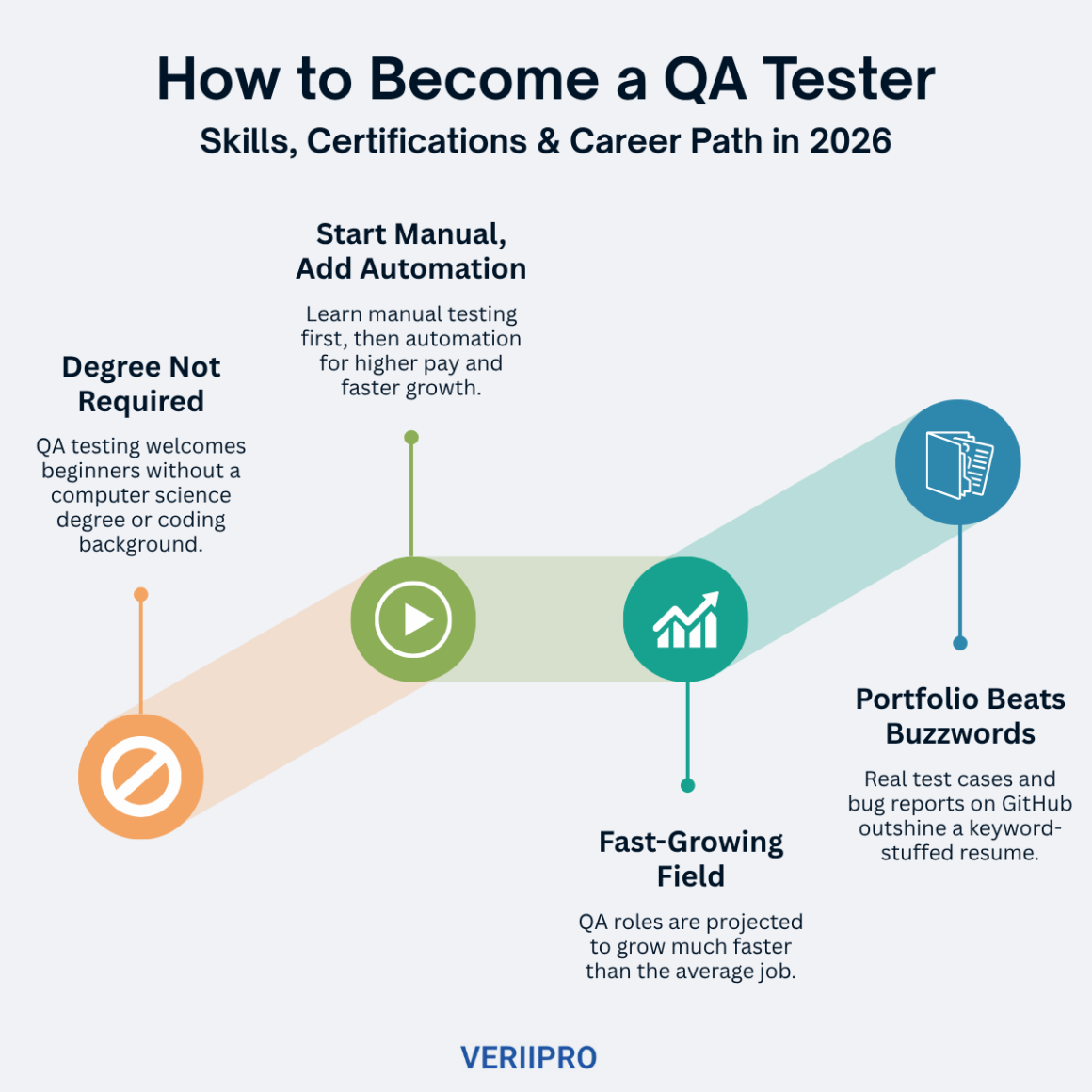
Here’s why that matters right now. The Bureau of Labor Statistics projects 15 percent job growth for software quality assurance analysts and testers through 2034, which is much faster than the average job. Companies are pouring money into software quality because a single bad bug can cost them customers, revenue, and reputation. Someone has to catch those bugs. That someone could be you.
This guide walks you through everything: what a QA tester actually does, the skills and tools you need, a step-by-step roadmap to job-ready, certifications worth getting, salary expectations, and how to nail the interview. QA work splits into two big lanes, manual testing and automation testing, and we’ll cover both so you can figure out where you fit.
What Is a QA Tester?
A QA tester (short for quality assurance tester) is the person who makes sure software works the way it’s supposed to before real users ever touch it. They hunt for bugs, broken features, confusing screens, and anything that doesn’t behave right, then report it so developers can fix it.
Think of them as the last line of defense between a buggy app and an angry customer.
QA testers play a key role in the Software Development Life Cycle (SDLC), the process teams follow to build software from idea to launch. Testing isn’t a step tacked on at the end. Good QA runs alongside development the whole way, catching problems early when they’re cheap to fix instead of late when they’re expensive.
You’ll hear a few job titles thrown around, and they overlap:
- QA Tester / Software Tester: usually focused on running tests and finding defects, often through manual work.
- QA Engineer: typically a more technical role that builds testing systems and writes automation code. QA engineer skills lean heavier on programming.
The other big split is how the testing gets done. Manual testing means a human clicks through the app like a real user would, checking that everything works. Automation testing means writing scripts that test the software automatically, which saves huge amounts of time on repetitive checks. Most testers start manual and grow into automation, and that’s a perfectly normal path.
Why Choose a Career in QA Testing?
QA testing hits a sweet spot that few tech careers manage: it’s accessible to start but has real room to grow. Here’s what makes it worth your time.
High demand. Software is everywhere, and all of it needs testing. Openings are steady across nearly every industry, not just tech companies.
Entry-level friendly. You can break in without a degree in computer science or a decade of coding. Curiosity and attention to detail matter more than a fancy resume when you’re starting out, which is why QA entry level jobs are among the most realistic first tech roles for career switchers.
Competitive salaries. Even at the start, the pay is solid, and it climbs fast once you pick up automation skills.
Multiple career paths. You can go deep on automation, move into performance or security testing, or climb into leadership. You’re not boxed in.
Remote-friendly. Testing translates well to remote work, and remote QA tester jobs are common, so you’re not tied to one city.
Room to grow. The jump from manual tester to automation engineer to QA lead is a well-worn path, and each step brings a meaningful pay bump.
Skills Required to Become a QA Tester
You’ll need a mix of technical know-how and people skills. Don’t panic at the technical list. You won’t need all of it on day one, and much of it you’ll pick up as you go.
Technical Skills
- Manual testing: the foundation. Learning to test software by hand teaches you how to think like a tester.
- Automation testing: writing scripts to run tests automatically. This is where the higher salaries live.
- SDLC & STLC: understanding the software and testing life cycles so you know where your work fits.
- Agile & Scrum: most teams work in short sprints, and you’ll need to know how that flows.
- API testing: checking that the behind-the-scenes parts of an app talk to each other correctly.
- SQL basics: enough to pull data from a database and verify it’s correct.
- Basic programming: a working grasp of Java, Python, or JavaScript. You don’t need to be a developer, just comfortable reading and writing simple code.
- Test case writing: documenting exactly what to test and what the expected result is.
- Bug reporting: writing clear, reproducible defect reports that developers can actually act on.
- Version control (Git): the standard tool for tracking code and collaborating with a team.
Soft Skills
The soft skills are where good testers separate from great ones. These qa tester skills matter just as much as the technical ones:
- Attention to detail: you’re paid to notice what everyone else missed.
- Analytical thinking: breaking problems down to find root causes.
- Problem-solving: figuring out why something broke, not just that it broke.
- Communication: you’ll explain bugs to developers and updates to managers, so clarity counts.
- Time management: juggling multiple test cycles under deadline pressure.
- Teamwork: QA sits between developers, product, and design, so collaboration is constant.
- Critical thinking: questioning assumptions and imagining how users might break things.
- Adaptability: requirements shift, tools change, and you roll with it.
Essential QA Testing Tools You Should Learn
You don’t need to master every tool out there. Focus on the ones employers actually ask for, and here’s what each one does.
- Jira: the go-to for tracking bugs and managing test tasks. You’ll use it daily.
- Selenium: the most popular tool for automating web browser tests. A must-know for automation.
- Cypress: a modern, developer-friendly automation tool that’s grown fast, great for web apps.
- Postman: the standard for API testing, letting you check that data flows correctly behind the scenes.
- Appium: used to automate testing on mobile apps.
- JMeter: for performance and load testing, checking how software holds up under heavy traffic.
- TestRail: helps organize and manage test cases in one place.
- Browser developer tools: built into Chrome and Firefox, essential for inspecting and debugging web pages.
- GitHub: where code lives and where you’ll showcase your own testing projects to employers.
Start with Jira and Selenium if you want the two that show up most in job postings.
Step-by-Step Guide to Becoming a QA Tester
Here’s the roadmap from total beginner to landing your first role.
Step 1: Learn QA Testing Fundamentals
Before any tools, understand the basics. Learn the Software Development Life Cycle and the Software Testing Life Cycle so you know how software gets built and tested. Get comfortable with core testing concepts and the different types of testing. This foundation makes everything else click. Skip it and you’ll be memorizing tools without understanding why you’re using them.
Step 2: Learn Manual Testing
Manual testing is where you build your instincts. Practice writing clear test cases and solid bug reports. Get familiar with the common testing types: functional testing (does the feature work?), regression testing (did a new change break something old?), smoke testing (do the basics work before deeper testing?), and exploratory testing (poking around like a curious user to find the unexpected). This is your bread and butter, and it’s how you learn to think like a tester.
Step 3: Learn Automation Testing Basics
Once manual testing feels natural, start automating. Pick up a tool like Selenium, Cypress, or Playwright and learn basic scripting. You don’t need to be an expert overnight. Just understand the core concepts: how tests get automated, when automation makes sense, and how to write a simple script that checks a feature. This single step is what separates decent testers from well-paid ones.
Step 4: Work on Real Projects
Nothing beats hands-on practice. Test open-source projects, build a personal testing portfolio, and document everything in a GitHub repository. Try freelance gigs or explore bug bounty platforms where you get paid to find security flaws. Real projects give you something concrete to show employers, which matters far more than saying you “know” testing.
Step 5: Earn Industry Certifications
Certifications signal that you’re serious and give you a structured way to learn. The big one for beginners is the ISTQB Foundation Level, widely recognized and often listed in job postings. Others worth considering as you grow include the Certified Software Quality Analyst (CSQA), Selenium certifications, and Agile testing certifications. For your first job, ISTQB Foundation is the one to prioritize.
Step 6: Build a Resume and Portfolio
Pull your work together into proof. Include sample test cases, real bug reports, your GitHub profile, and clean project documentation. Then optimize your LinkedIn profile so recruiters can find you. A portfolio that shows actual testing work will beat a resume full of buzzwords every time.
Step 7: Apply for QA Tester Jobs
Now go get hired. Customize your resume for each role instead of blasting the same one everywhere. Prepare for interviews by practicing common questions (more on those below). Network on LinkedIn, use job portals, and always follow up after an interview with a short thank-you note. Persistence pays here. Expect to apply widely before things click, especially for your first role.
QA Tester Career Path
One of the best things about QA is that the ladder is clear. Here’s a typical progression:
QA Intern → Junior QA Tester → QA Tester → QA Automation Engineer → Senior QA Engineer → QA Lead → QA Manager → Test Architect
You won’t climb every rung, and plenty of people branch off into specialties like performance or security testing. But the point is that there’s a real path forward, and each step up brings more responsibility and better pay. Many testers reach automation engineer within a few years, which is where earnings really start to jump.
Manual Testing vs Automation Testing
Both matter, and understanding the difference helps you plan your learning. Here’s how they stack up:
| Factor | Manual Testing | Automation Testing |
|---|---|---|
| Skills required | Attention to detail, testing basics | Coding, scripting, tool expertise |
| Learning curve | Gentle, great for beginners | Steeper, needs programming |
| Salary potential | Solid, but grows slower | Higher, faster growth |
| Best for beginners | Yes, start here | After you learn the basics |
| Career opportunities | Steady demand | Broader and better paid |
| Common tools | Jira, TestRail | Selenium, Cypress, Playwright |
The smart move for most beginners: start with manual testing to build your foundation, then layer automation on top. That combination makes you far more hireable.
QA Tester Salary and Job Outlook
The money is genuinely good, and it scales with your skills.
For QA testers in the US, Glassdoor reports an average around $86,000 a year, with entry-level roles often starting in the $50,000 range. The BLS puts the median wage for QA analysts and testers at roughly $102,610 as of May 2024, though that blends in more experienced professionals.
Several factors move your number:
- Experience: entry-level to senior can nearly double your pay.
- Location: tech hubs pay more, though remote work is flattening that gap.
- Industry: finance, insurance, and tech tend to pay at the top end.
- Skills: automation and programming knowledge command a premium.
- Automation expertise: this is the big one.
Here’s the key takeaway. Automation testing generally pays significantly more than manual testing. QA automation engineers average around $118,000 on Glassdoor, well above the manual side. If you’re deciding where to invest your learning time, automation is where the salary growth lives.
Common Interview Questions for QA Testers
Interviews lean heavily on fundamentals, so know these cold:
- Severity vs Priority: severity is how bad the bug is, priority is how urgently it needs fixing. A typo in the CEO’s name might be low severity but high priority.
- SDLC vs STLC: the software development life cycle covers building the whole product, the software testing life cycle covers just the testing process within it.
- Bug life cycle: the stages a defect moves through, from new to assigned to fixed to closed.
- Types of testing: be ready to explain functional, regression, smoke, and exploratory testing.
- Regression testing: re-testing existing features after a change to make sure nothing broke.
- Smoke testing: a quick check that the core functions work before deeper testing begins.
- Test cases: know how to write a clear one with steps and expected results.
- API testing: verifying that the app’s behind-the-scenes services return the right data.
- Automation basics: expect questions on Selenium and when automation is worth it.
Practice saying these answers out loud. Knowing the concept isn’t the same as explaining it smoothly under pressure.
Common Mistakes Beginners Should Avoid
A few missteps trip up almost every newcomer. Dodge these:
- Skipping the fundamentals and jumping straight to tools. You’ll be lost fast.
- Ignoring SDLC and STLC concepts, which come up constantly in interviews.
- Learning tools without understanding testing. Selenium is useless if you don’t know what to test or why.
- Not building a portfolio. Employers want proof, not promises.
- Writing weak bug reports that developers can’t reproduce. Clear reporting is a core skill.
- Not practicing interview questions. The concepts are predictable, so there’s no excuse.
- Applying with nothing to show. No projects, no certification, no portfolio makes for a tough sell.
Tips to Get Your First QA Tester Job Faster
Want to speed things up? Do these:
- Build a GitHub portfolio with real test cases and bug reports so employers can see your work.
- Practice writing test cases until it’s second nature.
- Learn Jira and Selenium, the two tools that show up in the most postings.
- Earn an ISTQB certification to check the box recruiters look for.
- Network on LinkedIn. Connect with QA professionals and recruiters, and engage with testing content.
- Join testing communities where people share job leads and advice.
- Stay current with testing trends, especially how AI is starting to shape the field.
If you’re actively hunting, browsing QA tester jobs and remote QA tester jobs on job platforms is a good way to see what skills local employers are actually asking for right now.
Conclusion
QA testing is one of the best entry points into the software industry, and it doesn’t ask you to be a coding wizard to get started. Learn the fundamentals first, get comfortable with the essential tools, build real projects you can show off, and earn a certification like ISTQB to prove you’re serious.
From there, keep growing. The testers who move up are the ones who learn automation, sharpen their skills continuously, and stay curious about how software breaks. Start with manual testing, add automation as you go, and you’ll have a career with real staying power and a salary that climbs right along with your skills. Your first QA role is closer than you think. Go build the portfolio that gets you there.