

Ask five IT professionals where they want to work and you will get five different answers, plus at least one long story about a commute. The argument over remote work vs hybrid work has been running since 2020, and in 2026 it still has not settled into anything like a consensus. What has changed is the quality of the evidence. We are no longer guessing. There are now years of remote work statistics, a few genuinely rigorous studies, and enough failed return-to-office experiments to see which arrangements actually hold up.
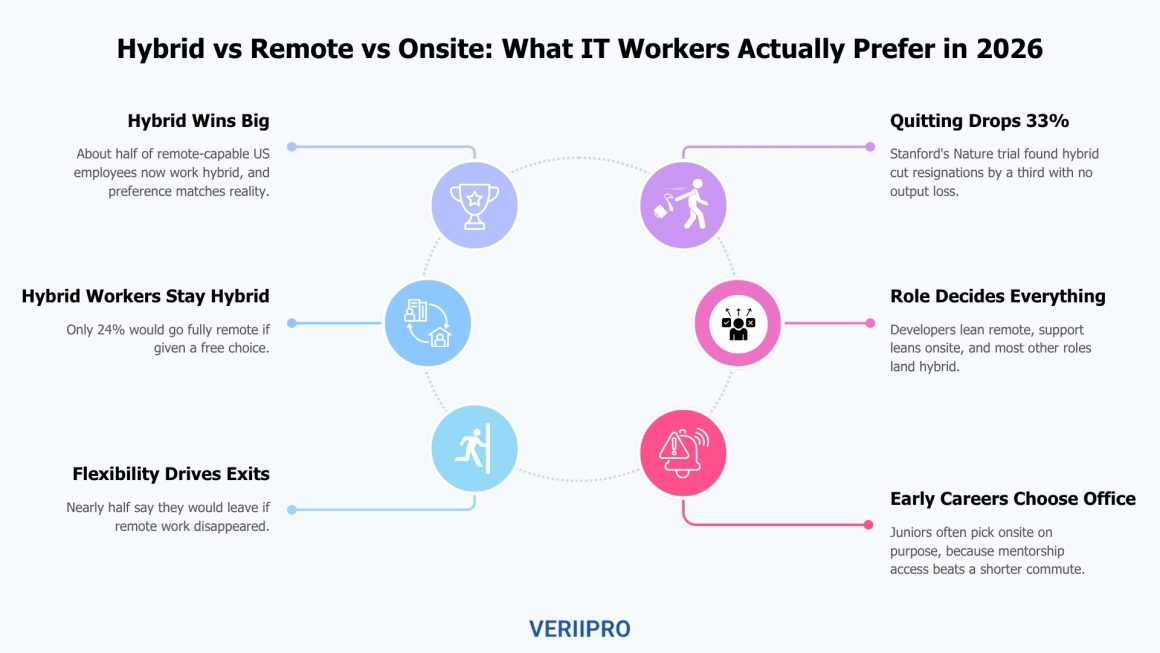
Here is the short version. Hybrid has quietly won the popular vote. Gallup’s tracking of US employees in remote-capable jobs puts roughly half in hybrid arrangements, about a quarter fully remote, and the rest back onsite full time. That split has held steady for about three years, despite a very loud news cycle suggesting everyone was being marched back to their desks.
Averages hide a lot, though. A backend engineer, a desktop support technician, and a first-year QA analyst want very different things from a workweek, and they get very different results from the same policy. So let’s break down all three models, what the numbers say about preference and productivity, and how to figure out which one actually fits your career instead of somebody else’s.
Understanding the Three Work Models
Remote Work
Remote work means the role carries no standing office requirement. You might live 20 minutes from headquarters or 2,000 miles away, and it does not change how you do the job. Communication runs through Slack, Jira, GitHub, and a calendar that hopefully still has some empty space in it. Good remote teams write things down. Great ones make asynchronous updates the default, so nobody has to be awake at 6 a.m. for a status call.
In IT, the roles that go fully remote most easily are the ones with clear output and low physical dependency: front-end and back-end developers, data engineers, machine learning and AI engineers, cloud architects, QA automation engineers, technical writers, and a growing share of security analysts. When the work lives in a repository or a cloud console, location stops mattering fast.
Hybrid Work
Hybrid splits the week between home and office. The most common pattern is the “3-2” setup, three days in the office and two at home, though plenty of companies run it in reverse. Others use anchor days, where an entire team picks Tuesday and Thursday so the office is not a ghost town, or flexible arrangements where you come in when there is an actual reason to.
That last detail matters more than most policies admit. Hybrid works when office days have a purpose. It falls apart when people drive an hour to sit on video calls with the same colleagues they could have called from their kitchen.
Onsite Work
Onsite means five days at a desk in a building the company pays for. It is no longer the default in tech, but it has not disappeared, and for some roles it never will.
Hardware and embedded engineers need lab access. Data center and network infrastructure teams need to touch equipment. Desktop and IT support staff need to be where the broken laptops are. Then there is regulated work: defense contracts, parts of fintech and healthcare, and government roles where restricted systems cannot leave a secured facility.
Some companies also prefer onsite for less technical reasons. Onboarding is faster in person. Mentoring happens by accident when people sit near each other. And plenty of leadership teams signed 15-year office leases and would very much like the building used.
What Do IT Workers Actually Prefer in 2026?
The hybrid work statistics are strikingly consistent across sources. Gallup finds that around six in ten remote-capable employees want a hybrid arrangement, while fewer than one in ten want to be onsite full time. Robert Half’s job seeker research lands in similar territory, with hybrid ranked the top preference and only a small slice of professionals actively chasing a five-day office job.
Here is the part that surprises people. Hybrid workers do not secretly want to go fully remote. Pew Research Center found that only 24% of hybrid workers would switch to working from home all the time if given the choice, while 72% would keep the schedule they already have. They like the office. In moderation.
Fully remote still has a large and loyal base, and it skews technical. Developers, AI and data professionals, and infrastructure engineers do the kind of deep, uninterrupted work that a home office suits well, and many took remote roles specifically so they would not have to relocate to an expensive metro. The stakes for that group are high. Pew also found that 46% of workers with home-capable jobs said they would be unlikely to stay with their employer if remote work were taken away.
The smallest group prefers onsite, and it is not who you might guess. Early-career professionals often choose it on purpose. Two years into a career, sitting near a senior engineer is worth more than a shorter commute.
| Work Model | Typical Preference | Best For |
|---|---|---|
| Hybrid | High | Collaboration plus flexibility |
| Remote | Moderate to High | Deep-focus technical work |
| Onsite | Lower | Hands-on collaboration and training |
Why Hybrid Work Is Becoming the Preferred Choice
Preference is one thing. Evidence is another, and this is where hybrid pulls ahead.
The most rigorous study available is a randomized controlled trial led by Stanford economist Nicholas Bloom and published in Nature. More than 1,600 employees at a large tech company were split into two groups: one stayed in the office five days a week, the other worked a hybrid schedule with two days at home. Resignations in the hybrid group fell by 33%. Performance reviews, promotion rates, and lines of code written showed no measurable difference. Managers had predicted a 2.6% productivity drop going in. By the end of the trial, they estimated a small gain instead.
That is a rare result that satisfies both sides of the argument. Employees get hours back. Employers keep their people. Nobody’s output falls off a cliff.
The everyday benefits are easier to feel than to measure. Two or three commute-free days give back a real chunk of the week. Errands, workouts, school pickups, and doctor appointments stop competing with sprint deadlines. And the office days still cover what video calls handle badly: whiteboarding an architecture decision, running a postmortem where tone matters, or getting a new hire productive in an afternoon instead of a month.
Hybrid work productivity statistics generally show hybrid teams matching or slightly beating both fully remote and fully onsite teams on output, and working from home productivity statistics point the same direction for solo tasks. In the hybrid vs remote work comparison, the output gap is small. The retention gap is not, and retention is where the money actually sits.
Benefits and Challenges of Each Work Model
Remote Work
Benefits
- Maximum control over your schedule and your environment
- Access to jobs nationwide, not just within driving distance
- Long stretches of focused time, which is why remote work productivity statistics look strong for individual technical work
- No commuting costs, and often a lower cost of living
Challenges
- Isolation is real, and it builds slowly
- Communication takes deliberate effort instead of happening by default
- Time zone spread can turn a simple decision into a two-day thread
- Fewer casual moments with leadership, which can slow visibility and promotion
Hybrid Work
Benefits
- Flexibility without giving up in-person contact
- Better team communication and fewer misread messages
- A culture that survives past the first year
- Far easier onboarding for new hires
Challenges
- Coordinating office days is a permanent low-grade headache
- Two-tier dynamics, where whoever is in the room carries more influence
- You still commute, just less often
- Badly planned office days feel like pure overhead
Onsite Work
Benefits
- Questions get answered in seconds instead of hours
- Mentorship and knowledge transfer happen naturally
- Immediate access to labs, hardware, and secured systems
- Relationships form faster, which helps early in a career
Challenges
- Daily commuting costs both time and money
- Very little schedule flexibility
- Deep focus is harder to protect in an open office
- Work-life balance depends heavily on your manager
Which IT Roles Work Best in Each Model?
Not every job fits every model, and the remote vs hybrid work question usually answers itself once you look closely at the day-to-day tasks. Here is how the most common IT roles typically line up when you compare remote vs onsite arrangements and the hybrid middle ground.
| IT Role | Remote | Hybrid | Onsite |
|---|---|---|---|
| Software Developer | High | Medium | Low |
| Front-End Developer | High | Medium | Low |
| Back-End Developer | High | Medium | Low |
| DevOps Engineer | Medium | High | Low |
| Product Manager | Low | High | Medium |
| UX/UI Designer | Medium | High | Low |
| IT Support | Low | Medium | High |
| Cybersecurity Analyst | Medium | High | Low |
Treat this as a fit guide, not a rule. A remote-native company can make a product manager role work beautifully from anywhere, and a rigid employer can make a developer commute for no reason at all.
Factors IT Professionals Consider Before Choosing a Work Model
Salary is the obvious starting point, and it is murkier than it looks. Remote roles often compete in a national talent market, which lifts pay, but some employers adjust offers to your location. Ask about geographic pay bands during the first or second interview, not after the offer lands.
Beyond compensation, these are the trade-offs worth weighing honestly:
- Career growth: are promotions decided by people who see your work, or only your output?
- Learning opportunities: junior engineers absorb an enormous amount just by sitting near senior ones
- Company culture: a remote-native employer and a remote-tolerant employer are completely different experiences
- Team collaboration: how much of your role is genuinely shared work versus solo work?
- Commute: 30 minutes each way is roughly 10 working days a year
- Work-life balance and mental well-being: be honest about whether you actually close the laptop at home
Most people optimize for one factor and discover the others two months later. Rank them before you start interviewing.
How Employers Are Responding to Employee Preferences
Employers have largely stopped issuing sweeping declarations and started making quieter, role-by-role decisions. Robert Half’s research found that a large majority of employers now offer some hybrid option, but only about a quarter extend it to everyone. Flexibility has become a benefit that gets allocated, not a blanket policy.
Return-to-office requirements have also gotten firmer where they exist. Pew’s tracking shows that three-quarters of hybrid workers now say their employer requires a set number of in-person days, up sharply from a few years earlier. The days themselves are mandated more often than they used to be.
The smarter organizations are pairing that with outcome-based performance measurement. Instead of counting badge swipes, they track shipped work, incident response times, code review turnaround, and customer results. It is harder to set up and much harder to argue with. Companies that skipped this step and went straight to attendance mandates are the ones showing up in attrition data.
Tips for Choosing the Right Work Model
Start with how you actually work rather than how you wish you worked. Some people focus better in a quiet house. Others need the structure of leaving the building or they drift by Wednesday.
A few practical filters:
- Career stage: if you are in your first three years, weight mentorship access heavily. Remote is easier to do well after you have a network.
- Family responsibilities: flexibility during weekday hours is worth more than most salary bumps if you have caregiving duties.
- Collaboration needs: platform and infrastructure work tolerates async better than product discovery does.
- Long-term goals: if you want to move into management, visibility matters more than you would like it to.
- Nature of the role: hardware, lab access, and classified systems are non-negotiable constraints.
And test the claim during interviews. Ask how many days people actually come in, not how many the policy says. Ask when the policy last changed. The gap between the two answers tells you most of what you need to know.
The Future of Work in IT Beyond 2026
The next phase looks less like a fight over days in the office and more like a redesign of how distributed teams operate.
AI-assisted collaboration is already reshaping the boring parts of remote work. Meeting summaries, automatic documentation, and code review assistance reduce the coordination tax that made distributed teams expensive. Global hiring keeps expanding as companies build engineering pods across time zones instead of concentrating them in one metro. Asynchronous communication is becoming a skill teams hire for, not an accident of geography.
Skills-first hiring fits neatly into all of this. When you evaluate candidates on demonstrated ability rather than which campus they can reach by car, the location question loses most of its force. Expect more personalized flexibility too, with arrangements negotiated by role and life stage instead of announced company-wide. And expect employee experience to be measured seriously, because the work from home statistics have made one thing clear: flexibility is now something people quit over.
Conclusion
There is no universally best work model, and anyone selling you one is selling something. Hybrid has emerged as the most balanced option for a majority of IT professionals, backed by the strongest evidence on retention and no real penalty on output. Fully remote remains excellent for deep-focus technical roles and for anyone whose life does not fit near a corporate campus. Onsite still delivers genuine value for hands-on work, fast onboarding, and mentorship that is hard to replicate over video.
The right answer depends on your role, your career stage, and what you personally need from a week. Look at the remote work stats, then look honestly at your own. Those two things should agree before you sign anything.