


Introduction
Think about the best leader you’ve ever worked with. What made them stand out? Chances are it wasn’t their title or their corner office. It was the way they communicated, made decisions under pressure, and actually gave a damn about the people around them.
Leadership qualities are what separate managers who just clock in from leaders who actually move teams forward. Whether you’re running a startup, managing a department, or just trying to grow in your career, understanding what makes a great leader matters more than most job descriptions let on.
This article breaks down the top 20 qualities of a good leader, with real-world examples and practical context. Some of these you probably already have. Others take time, feedback, and a bit of humility to develop.
What Are Leadership Qualities?
Leadership qualities are the combination of traits, behaviors, and skills that help a person guide, influence, and inspire others. They’re different from technical skills. You can train someone to use software or run a report. Leadership characteristics are harder to teach and even harder to fake.
Some qualities are innate personality traits, like natural curiosity or a calm presence under stress. Others are leadership skills you build deliberately over time, like active listening, strategic thinking, or delegation. The best leaders work on both.
Why Leadership Qualities Matter
Bad leadership is expensive. Gallup research has consistently found that managers account for at least 70% of the variance in employee engagement scores. Low engagement costs U.S. companies hundreds of billions in lost productivity every year. The flip side: teams with strong leaders perform better, stick around longer, and are significantly more productive.
Strong leadership skills create a ripple effect. Good leaders build good teams. Good teams drive results. Results build cultures people actually want to be part of.
Must-Have Leadership Qualities for Success
1. Strong Communication
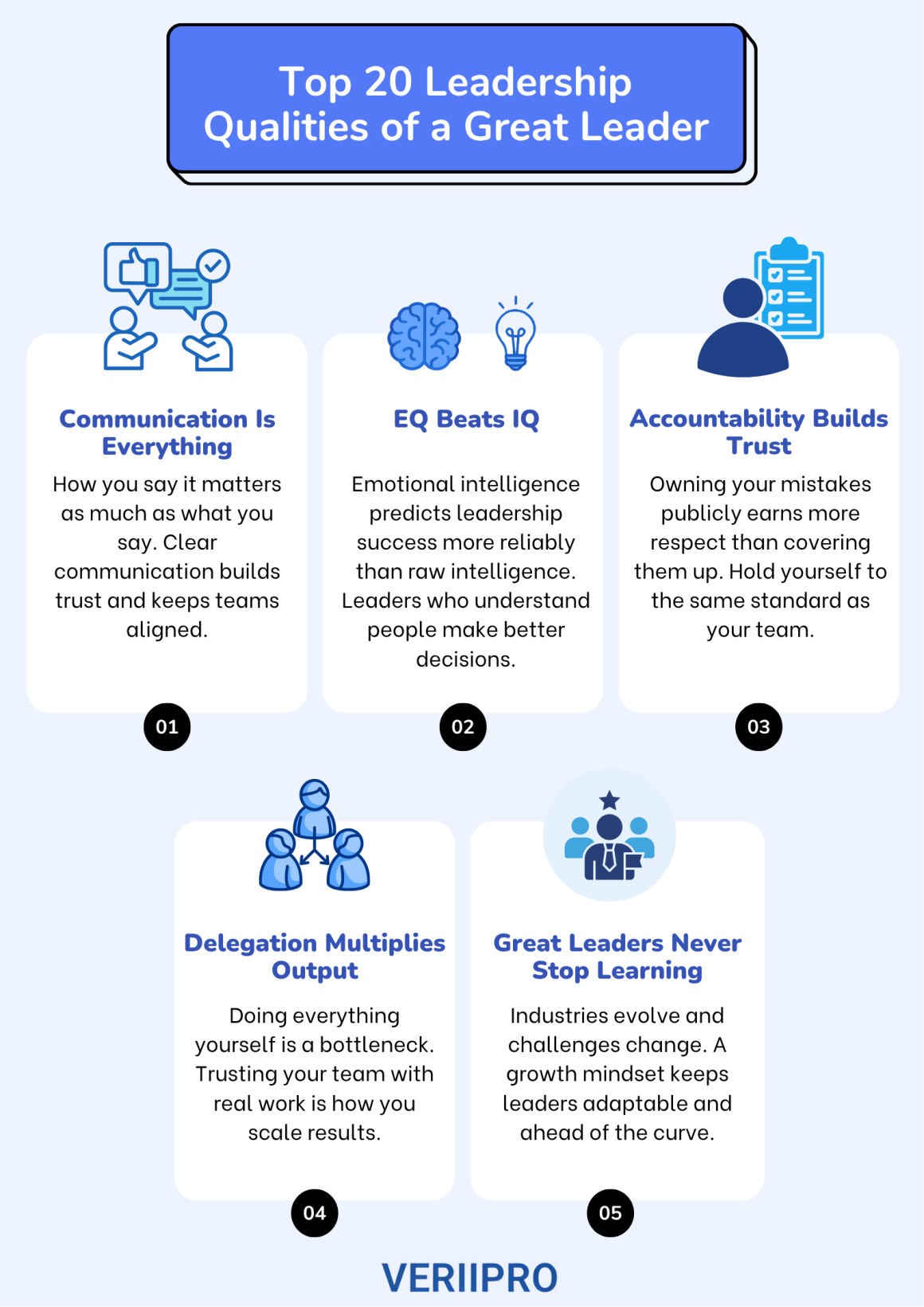
Great leaders say what they mean and mean what they say. They listen actively, give clear direction, and make sure the message they intend is the message people actually receive. Clear communication cuts down on confusion, missed deadlines, and unnecessary conflict. Example: A team lead who holds a brief Monday sync to align priorities instead of sending a wall-of-text email.
2. Integrity
People follow leaders they trust. Integrity means doing the right thing even when it’s inconvenient. Leaders with integrity don’t cut corners, take credit for others’ work, or say one thing and do another. It’s one of the most foundational characteristics of a good leader. Example: A manager who owns a mistake publicly instead of quietly pinning it on their team.
3. Emotional Intelligence
Emotional intelligence (EQ) is the ability to recognize, understand, and manage your own emotions, while also reading and responding to the emotions of others. Research from TalentSmart shows that EQ accounts for 58% of job performance across most roles. For leaders, it’s a core trait. Example: A director who notices a top performer seems disengaged and has a genuine one-on-one conversation before assuming the worst.
4. Vision
Strong leaders think beyond the next quarter. They have a clear picture of where they’re headed and can communicate that direction in a way that actually motivates people to move. Vision turns day-to-day tasks into meaningful contributions. Example: Satya Nadella joining Microsoft and shifting the entire company culture toward a growth mindset and cloud-first strategy.
5. Decision-Making Skills
Leaders make decisions constantly, and often without complete information. Good decision-making isn’t about being right every time. It’s about making thoughtful calls, moving forward with confidence, and course-correcting when needed. Paralysis is just as costly as a bad call. Example: A product manager who makes a go/no-go call with 70% of the data available rather than delaying the team indefinitely.
6. Adaptability
Plans change. Markets shift. Teams evolve. Leaders who can’t adapt become roadblocks. Adaptability means staying flexible without losing focus. It’s one of the most valuable leadership skills examples in fast-moving industries. Example: A department head who pivots the team’s entire workflow when a major client changes requirements mid-project.
7. Accountability
Accountability means owning your outcomes, good and bad. Leaders who blame others when things go wrong undermine trust fast. When you hold yourself to the same standard you expect from others, your credibility goes up. Example: A CEO who publicly acknowledges a failed product launch and shares what the company learned from it.
8. Confidence
Confidence isn’t arrogance. It’s the ability to lead decisively and inspire trust even when things are uncertain. Teams look to leaders for stability. If a leader looks panicked, people panic. Quiet, grounded confidence is reassuring. Example: A team leader who calmly walks the group through a system outage without catastrophizing.
9. Empathy
Empathy is understanding what someone else is experiencing from their perspective. Not agreeing with everything, but genuinely trying to understand. Leaders with empathy build stronger relationships and make better decisions because they actually understand the humans involved. Example: A manager who adjusts a team member’s schedule during a family crisis without making it a big deal.
10. Resilience
Every leader faces setbacks. Resilience is the ability to recover, regroup, and keep going without burning out your team in the process. It’s not about pretending things are fine. It’s about staying functional under pressure. Example: A founder who navigates a funding collapse, restructures the team, and gets the company to profitability within 18 months.
11. Strategic Thinking
Strategic thinkers can zoom out and see the big picture while still managing the details that matter. This attribute of a good leader means anticipating challenges before they hit and positioning the team to succeed long-term, not just this sprint. Example: A VP who builds out a hiring pipeline six months before a growth phase rather than scrambling when the workload spikes.
12. Problem-Solving Ability
Problems don’t stop because you’re busy. Leaders who can analyze a situation, identify root causes, and drive toward solutions are invaluable. The best ones involve their teams in the process, which builds skills and buy-in at the same time. Example: A department manager who runs a structured post-mortem after a missed deadline and implements real process changes from it.
13. Delegation Skills
Trying to do everything yourself isn’t leadership. It’s a bottleneck. Effective delegation means trusting your team with meaningful work, giving them the resources to succeed, and then getting out of the way. Example: A senior leader who hands ownership of a client relationship to a junior team member and coaches them through it instead of taking back control.
14. Team Building
The best leaders build teams that work well together, not just collections of talented individuals. They pay attention to team dynamics, address friction early, and create environments where people feel safe contributing. Example: A manager who designs onboarding for new hires specifically to integrate them into the team’s culture, not just its processes.
15. Creativity
Good leaders don’t just manage the status quo. They look for better ways to do things. Creativity in leadership means being open to unconventional ideas, encouraging experimentation, and not punishing smart failures. Example: A marketing leader who tests an entirely new channel on a small budget before recommending a full shift in strategy.
16. Self-Awareness
Self-aware leaders know their strengths, are honest about their weaknesses, and understand how their behavior affects those around them. This is a huge factor in leadership characteristics that separate good leaders from great ones. Example: A manager who actively tracks feedback from their team to catch blind spots they can’t see from inside their own perspective.
17. Motivation
A good leader knows what drives each person on their team and uses that understanding to keep people engaged. Blanket pep talks don’t cut it. Real motivation is personalized. Example: A team lead who recognizes one team member’s need for autonomy and another’s need for visibility, and designs assignments accordingly.
18. Humility
Humble leaders don’t have all the answers and don’t pretend to. They give credit where it’s due, ask for input, and stay open to feedback. Humility is what makes a leader approachable and keeps them growing. Example: A CTO who credits their engineering team publicly when a major launch goes well and takes responsibility personally when it doesn’t.
19. Trustworthiness
Trust is the foundation of every effective team. Trustworthy leaders are consistent, follow through on commitments, and keep confidences. Once trust breaks down it’s hard to rebuild. Leaders who earn and protect it have teams that will go the extra mile. Example: A manager who never shares what a team member confides during a one-on-one, even under pressure from above.
20. Continuous Learning
The best leaders are perpetual students. Industries change, teams evolve, and new challenges require new skills. Leaders who stop learning stop growing, and eventually get left behind. A growth mindset is one of the most future-proof traits of a good leader. Example: A VP who regularly reads outside their industry, takes courses, and brings back ideas the team wouldn’t have encountered otherwise.
How to Develop Leadership Qualities
Leadership qualities aren’t fixed. Most of them can be developed with the right habits and a bit of self-honesty.
Practice Self-Reflection
Set aside a few minutes each week to ask yourself what went well, what didn’t, and why. Journaling, even briefly, can surface patterns you’d otherwise miss.
Seek Feedback
Ask for honest input from people who will actually tell you the truth. Structured 360 feedback or even a direct question after a project can be revealing.
Learn from Experience
Volunteer for stretch assignments. Take on projects that make you a little uncomfortable. Real leadership development happens in the field, not just in training sessions.
Take Leadership Training
Formal training, mentorship, and executive coaching all have their place. Even a single well-chosen book or course can shift how you think about people and problems.
Benefits of Strong Leadership Qualities
Organizations that invest in developing leadership skills see tangible returns. Better team performance, higher employee retention, stronger workplace culture, and measurably higher engagement are all directly tied to leadership quality. Leadership isn’t just good for the people at the top. It shapes the experience of every person in an organization.
Tips to Become a Better Leader
Lead by Example
Your team watches what you do, not just what you say. Show up the way you want them to.
Communicate Clearly
Don’t assume people know what you mean. Be direct, be specific, and check for understanding.
Stay Consistent
Consistency builds trust. People need to know what to expect from you, especially under pressure.
Build Trust with Your Team
Trust is built in small moments. Follow through on small commitments. Acknowledge contributions. Be honest when you don’t know something.
Conclusion
Leadership isn’t about having a title. It’s about how you show up, how you treat people, and how you handle the moments that actually matter. The 20 qualities covered here, from communication and integrity to resilience and continuous learning, aren’t a checklist you complete once. They’re a practice.
The good news: most of them are within reach. Pick one or two to focus on, get some feedback, and start building. The best leaders weren’t born that way. They worked at it.