

Future-Proof Your Skills: Focus on What Machines Cannot Do
We are living through a moment of collective anxiety. You open LinkedIn, and it feels like every other post is about an AI tool that can write code, design logos, or draft legal contracts in seconds. It’s easy to look at tools like ChatGPT or Midjourney and think, “Well, there goes my job.”
But let’s take a deep breath. While it is true that AI is rapidly changing the landscape of work, the narrative that “robots are coming for everyone” misses the point. AI is incredible at tasks that involve processing data, recognizing patterns, and following rules. It is, however, terrible at being human.
The secret to future-proofing your career isn’t to try and outcompute the computer. You will lose that race every time. Instead, the strategy is to double down on the traits that are uniquely yours: empathy, judgment, complex problem-solving, and creativity. As the World Economic Forum’s Future of Jobs Report highlights, the skills on the rise aren’t just technical; they are analytical and social. The future belongs to those who can do what the machines cannot.
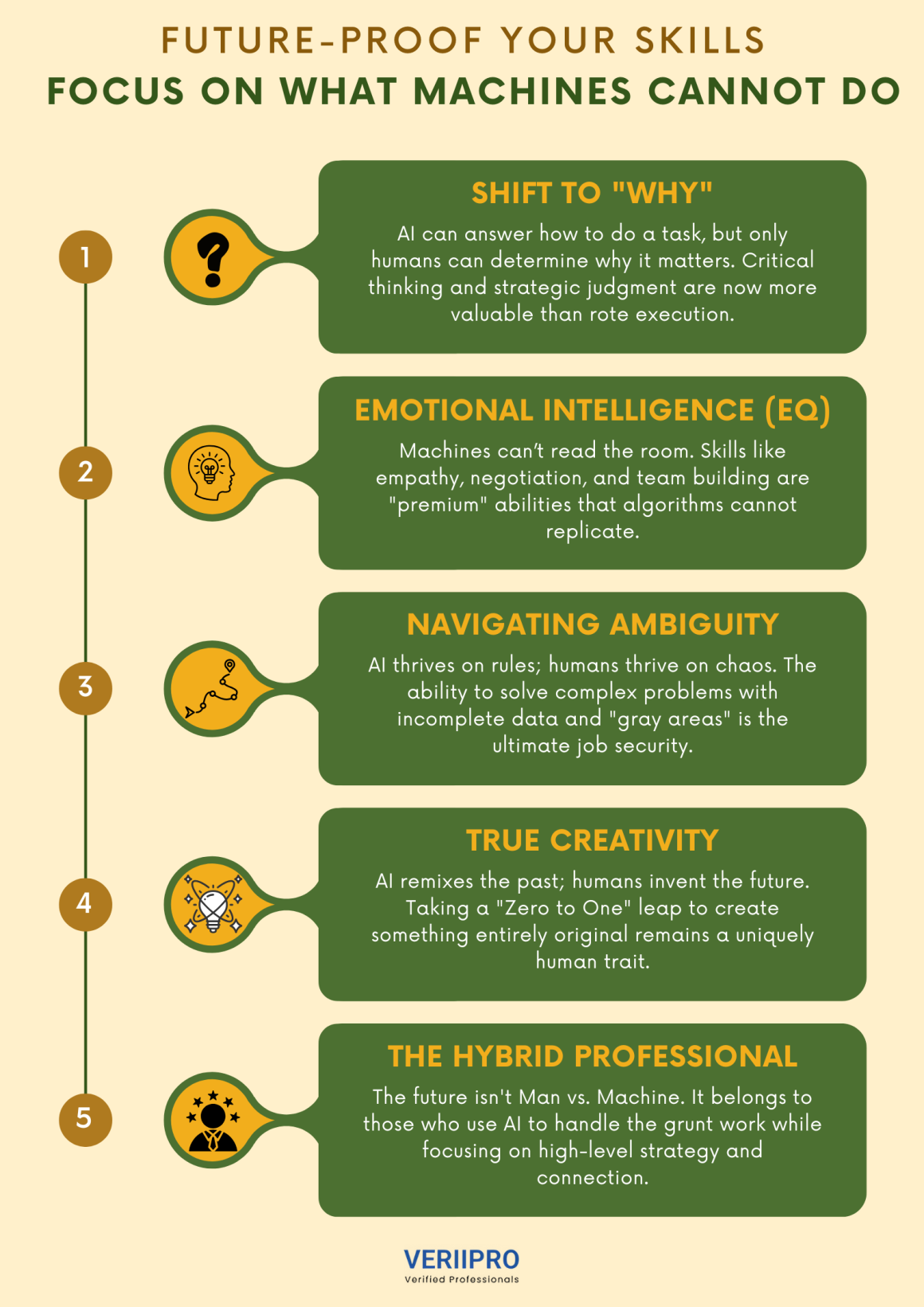
The Shift from “How” to “Why”: Critical Thinking
For a long time, the most valuable employees were the ones who knew how to do things. How to write a specific SQL query, how to format a financial report, or how to diagnose a known engine failure. Today, AI can answer the “how” in milliseconds.
The value has shifted to the “why”
This is where critical thinking comes in. An AI can give you ten different marketing strategies, but it cannot tell you which one fits your company’s specific culture, budget constraints, and risk tolerance. It lacks context. It lacks “skin in the game.”
Developing your critical thinking means moving from being an order-taker to a strategic partner. It’s about looking at the output the AI gives you and asking: “Is this actually true? Is it ethical? Does it align with our long-term goals?” As noted in a recent article by Harvard Business Review, the ability to ask the right questions is becoming far more valuable than simply knowing the answers.
The Human Touch: Emotional Intelligence (EQ)
Have you ever tried to complain to a customer service chatbot when you were truly angry? It is a frustrating experience. The bot might apologize, but it doesn’t care. It can’t read the room. It can’t sense that you are about to cancel your subscription because of a tone of voice, not just a technical error.
This is the domain of Emotional Intelligence (EQ). Whether you are in sales, management, or HR, the ability to empathize, negotiate, and build trust is something AI cannot replicate. Machines can process language, but they cannot process intent or emotion.
In a future where routine interactions are automated, the remaining human interactions will become “premium.” The ability to rally a discouraged team, navigate office politics, or close a deal over a handshake involves subtle, non-verbal cues that are invisible to an algorithm. A study by McKinsey Global Institute suggests that demand for social and emotional skills will grow by 24% by 2030. If you are good with people, you are safe.
Navigating Chaos: Complex Problem Solving
AI loves rules. It thrives in structured environments like chess or coding, where there is a clear right and wrong. But the real world is messy. It’s full of ambiguity, conflicting data, and “gray areas.”
This is where Complex Problem Solving shines. Think about a crisis manager dealing with a PR disaster, or a supply chain lead navigating a geopolitical conflict. There is no playbook for these situations. You have to synthesize incomplete information, use intuition (which is really just internalized experience), and make a call.
AI often hallucinates or breaks down when it encounters “edge case” situations it hasn’t seen in its training data. Humans, on the other hand, are adaptable. We can draw on analogies from totally unrelated fields to solve new problems. This mental agility is the ultimate firewall against automation.
Creativity: The “Zero to One” Problem
Generative AI is exactly that: generative. It remixes existing data. It can create a variation of a Van Gogh painting, but it could never have invented the style of Van Gogh. It can write a song that sounds like the Beatles, but it can’t revolutionize music.
This is the difference between “1 to N” (copying and scaling) and “0 to One” (true innovation).
True creativity requires a spark of originality, often born from human experience, suffering, joy, or sheer randomness. It requires taking a risk on an idea that data says “shouldn’t work.” If your job involves genuine innovation, whether that’s designing a new product, writing a novel, or formulating a scientific theory, you are bringing something into the world that didn’t exist before. The machine is a tool in your hand, but you are still the artist.
The Verdict: Embrace the Hybrid
The goal isn’t to ignore AI. The goal is to let it handle the drudgery, the scheduling, the data entry, and the basic coding so you can focus on the high-level human work. The professionals who will thrive in 2025 and beyond are the ones who view AI as a powerful exoskeleton, not a replacement.
By sharpening your judgment, deepening your empathy, and embracing complexity, you ensure that no matter how smart the bots get, there will always be a “human in the loop.”
Looking Forward
Looking to pivot your career or sharpen your soft skills? VeriiPro is here to help! In a job market that is shifting beneath our feet, knowing what skills to highlight is half the battle. VeriiPro specializes in connecting professionals with roles that value human ingenuity and leadership. Whether you are looking for a leadership position or a role requiring complex strategic thinking, we have the resources and network to help you land a job where your human edge is your greatest asset.