

Every business decision is a bet. You are wagering time, money, and energy on the idea that customers want what you are about to sell them. Market analysis is how you tilt those odds in your favor before you place the bet.
Here is the uncomfortable part. Plenty of companies skip it, or do a thin version of it, and pay for that later. When CB Insights dug into why startups die, it found that roughly 42% fail because there was no real market need for what they built. That is not a pricing problem or a hiring problem. That is a “nobody wanted this” problem, and good market analysis catches it early, while it is still cheap to fix.
This guide covers what market analysis is, why it matters, when to run one, and the exact steps to do it yourself. Whether you are a founder validating a first idea, a small business owner eyeing a new city, or a marketing lead at an established company, the process is the same. You will also get the main frameworks, a worked example, a tools list, the mistakes that trip people up, and a checklist you can use today.
None of this requires a research degree or an expensive consultant. It requires curiosity, a few free tools, and the discipline to follow evidence even when it disagrees with you. Let’s get into it.
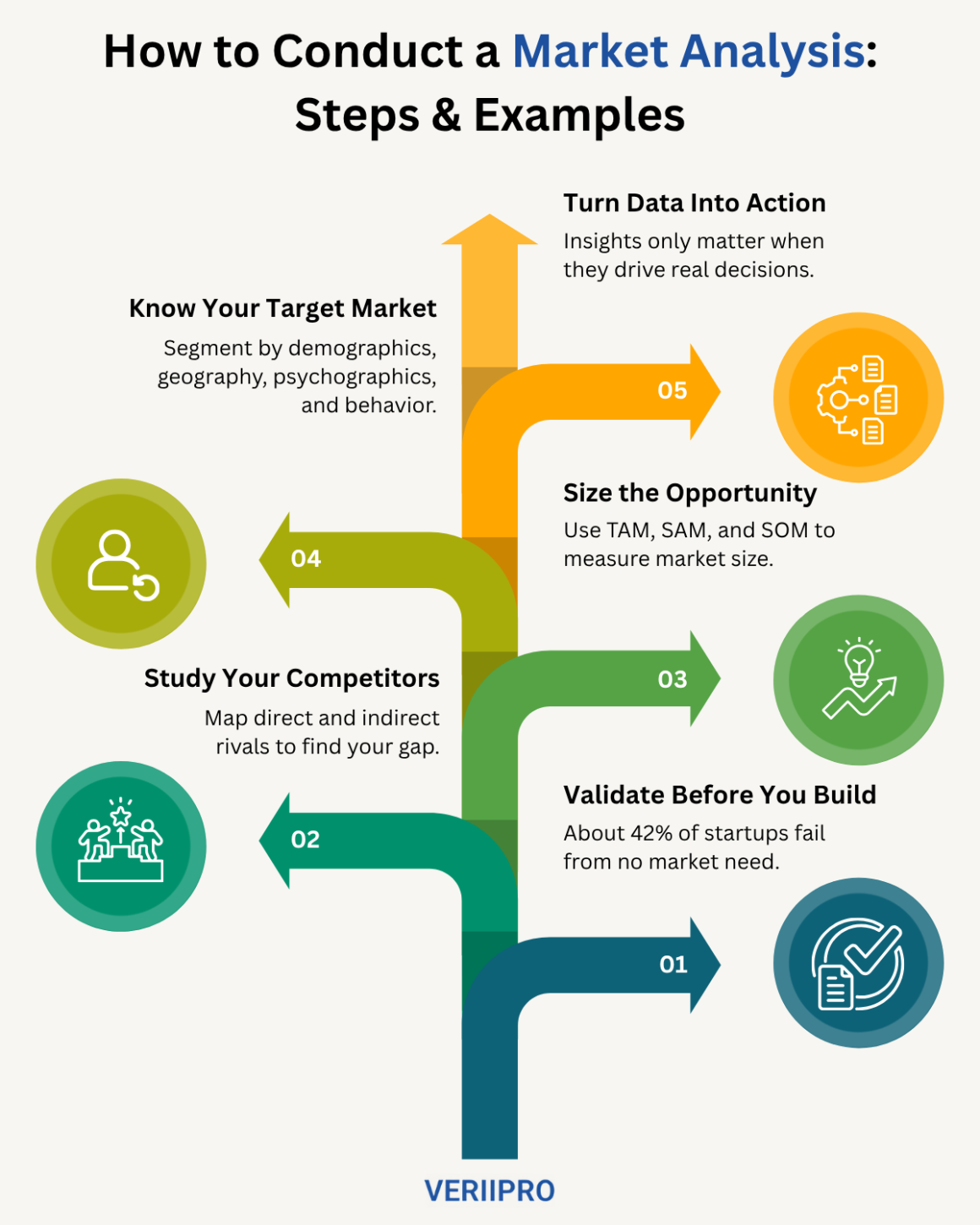
What is Market Analysis?
So what is market analysis, really? At its core, it is the work of studying a market so you understand who is in it, what those people want, who else is competing for them, and where the whole thing is headed. It is a big enough discipline that companies pour serious money into it. The global market research industry is worth tens of billions of dollars a year, which tells you something about how much knowing your market is worth.
Market Analysis Definition
Here is a simple market analysis definition: it is the process of evaluating a specific market within an industry to understand its size, its customers, the competition, and the trends shaping it. It pulls together data on demand, pricing, buyer behavior, and growth potential so you can decide with evidence instead of gut feeling.
Think of it as a map. It does not drive the car for you, but it shows you which roads exist, where the traffic sits, and which routes actually lead somewhere worth going.
Why Market Analysis Matters
The honest answer is that it lowers your risk and sharpens your aim. A solid analysis helps you understand what customers need before you spend a dollar building for them. It lets you measure real demand instead of assumed demand. It surfaces growth opportunities you would have walked right past, and it makes every downstream choice about product, pricing, and marketing more grounded.
The payoff shows up in the numbers. McKinsey found that data-driven companies are 23 times more likely to acquire customers and 6 times more likely to keep them. Decisions built on insight simply land better than decisions built on hope.
The reverse is true too. Skip the analysis and you can end up pouring a marketing budget into the wrong audience, pricing yourself out of a deal, or launching into a market that peaked two years ago. The cost of finding out is small. The cost of not finding out can be the whole business.
Market Analysis vs Market Research
People swap these terms like they mean the same thing. They don’t. They are related, but they play different roles.
| Market Analysis | Market Research |
|---|---|
| Evaluates overall market conditions | Collects specific customer data |
| Focuses on trends, competition, and opportunities | Focuses on customer opinions and behaviors |
| Strategic decision-making tool | Data collection process |
The short version: research is how you gather the raw material. Analysis is what you do with it once you have it. You need both, but they are not interchangeable.
Benefits of Conducting a Market Analysis
The benefits stack up fast once you commit to doing this well. Here is what you actually walk away with.
Understand Customer Needs Better
You stop guessing what people want and start knowing. Real demand, real pain points, real priorities. That clarity changes everything you build next.
Identify Market Opportunities
Gaps reveal themselves when you look closely. Underserved segments, unmet needs, and niches your competitors ignore all come into view, and any one of them can become your opening.
Reduce Business Risks
Knowing the terrain means fewer nasty surprises. You can spot weak demand, fierce competition, or a shrinking category before you over-invest in it.
Improve Product Development
When you understand what customers actually struggle with, you build features that matter instead of features that just look good in a demo. Your roadmap gets a lot more honest.
Gain Competitive Advantage
Studying your rivals shows you where they are strong, where they are soft, and how to position yourself in the daylight between them. That is where real advantage lives.
Support Business Planning and Investment Decisions
Investors and lenders want evidence, not enthusiasm. A grounded analysis backs up your projections and makes your business plan far more convincing in a room full of skeptics.
Enhance Marketing Strategies
Once you know who your buyer is and what moves them, your messaging, your channels, and your budget all get sharper. You stop shouting into the void.
Forecast Future Market Trends
Patterns in the data hint at where things are going. That foresight lets you prepare for a shift instead of scrambling to react after it has already hit you.
When Should You Conduct a Market Analysis?
Timing matters. A few specific moments are when this work pays off the most.
Before Launching a New Business
This is the big one. Validate that real demand exists before you sink your savings into an idea you have fallen in love with.
Before Introducing a New Product or Service
A new offering deserves its own check. Will your existing audience want it, and is someone already selling something close to it?
Entering a New Market
A new city, country, or customer segment behaves differently than your home turf. Assume nothing carries over until the data says it does.
Expanding Operations
Scaling up multiplies both your costs and your risk. Make sure the demand genuinely supports the expansion before you commit to it.
Developing a Marketing Strategy
You can’t target what you don’t understand. Analysis feeds the segmentation and positioning your campaigns depend on to work.
Seeking Funding or Investors
No serious investor funds a hunch. They want to see that you understand your market cold, including its size, its trends, and its competition.
How to Conduct a Market Analysis: Step-by-Step Guide
Here is how to do a market analysis without getting lost in spreadsheets. Follow these market analysis steps in order and you end up with something useful instead of a folder full of random charts. This is the practical core of the whole thing, so let’s walk through how to conduct a market analysis one step at a time.
Step 1: Define Your Purpose and Objectives
Start with why. Are you validating an idea, planning an expansion, or repositioning a product that has lost its edge? Write down the specific questions you need answered and the business goals tied to them. Then set success metrics so you know what a useful result even looks like. A goal like “find out whether there is demand for a meal-prep service in Austin” is workable. A goal like “understand the food market” is not. The tighter your question, the more useful your answer. Skip this step and you will drown in data with no idea which numbers matter.
Step 2: Identify Your Target Market
You can’t analyze a market until you define who is in it. Break your audience down across four lenses, and a clearer picture starts to form.
Demographic Analysis
Age, gender, income, education, occupation. These are the basic facts of who your customer is, and they are the easiest place to start.
Geographic Analysis
Where people live and work, from country down to zip code. Location shapes needs, pricing power, and how easily customers can even reach you.
Psychographic Analysis
Values, interests, attitudes, and lifestyle. This is the “why they buy” layer that plain demographics always miss.
Behavioral Analysis
How people actually act: what they buy, how often, how loyal they stay, and what finally triggers a purchase.
Step 3: Analyze Market Size and Growth Potential
Now figure out how big the opportunity really is. The cleanest way to size it uses three nested numbers that move from dream to reality.
Total Addressable Market (TAM)
The entire revenue available if you somehow captured 100% of the market. This is your ceiling, the absolute best case.
Serviceable Available Market (SAM)
The slice of that TAM you can realistically reach given your business model, your geography, and your product.
Serviceable Obtainable Market (SOM)
The portion of SAM you can actually win in the near term, given your resources, your team, and the competition in your way.
Market Growth Trends
Is the market expanding, flat, or quietly shrinking? A small market growing fast often beats a huge one in slow decline.
Step 4: Research Industry Trends
Markets move. You need to know which direction, and how fast.
Emerging Technologies
New tech can create demand overnight or make your offering obsolete just as quickly. Track what is coming over the hill.
Consumer Behavior Changes
Buying habits shift, sometimes for good. After the pandemic, for example, plenty of categories never went back to how they were.
Economic Factors
Inflation, interest rates, and employment levels all shape how freely people open their wallets. Read the macro mood.
Regulatory Influences
New rules can open a door or slam one shut. Stay ahead of the laws and standards that touch your industry.
Step 5: Evaluate Competitors
You are never selling in a vacuum, so map the field carefully.
Direct Competitors
Companies offering basically the same thing to the same buyers you want. These are the obvious ones.
Indirect Competitors
Different solutions that solve the same underlying problem. Easy to overlook, and dangerous to ignore.
Competitor Strengths and Weaknesses
Where do rivals shine, and where do their customers complain? Their soft spots are usually your best openings.
Competitor Pricing Strategies
How competitors price tells you what the market will bear and where you have room to stand apart.
Market Positioning
How each rival is perceived in the mind of the buyer. Your job is to find the position nobody else owns yet.
Step 6: Conduct a SWOT Analysis
A SWOT analysis organizes everything you have learned into four honest buckets.
Strengths
Internal advantages you can lean on, from a strong brand to a cost edge.
Weaknesses
Internal gaps you need to manage or fix before they cost you.
Opportunities
External openings in the market that you are positioned to seize.
Threats
External risks, from new entrants to shifting regulations, that could hurt you if you ignore them.
Step 7: Analyze Customer Demand
Now zoom back in on the buyer and what actually drives the purchase.
Customer Pain Points
The problems people are actively trying to solve. The sharper the pain, the stronger the demand.
Buying Behaviors
How and where people buy, and what nudges them across the line from interested to paying.
Product Preferences
The features, formats, and qualities customers genuinely care about, not the ones you assume they care about.
Customer Expectations
The baseline of service, quality, and experience people simply assume they will get from anyone in your space.
Step 8: Interpret Findings and Create Actionable Insights
Data is useless until you turn it into decisions. This is where your market analysis report comes together and earns its keep.
Key Takeaways
Pull out the handful of findings that actually change what you should do. Ignore the noise.
Strategic Recommendations
Translate those insights into concrete moves: enter this segment, price at this level, lead with this message.
Decision-Making Framework
Set up a simple way to weigh options against your goals, so the analysis drives action instead of just sparking a long meeting.
Market Analysis Frameworks and Models
You do not have to invent your method from scratch. These proven frameworks give your analysis structure and keep you from missing something obvious.
SWOT Analysis
The fastest way to map strengths, weaknesses, opportunities, and threats. It is great for a quick strategic snapshot before you go deeper.
PESTLE Analysis
PESTLE looks at the big external forces: Political, Economic, Social, Technological, Legal, and Environmental. Use it to catch the macro risks that sneak up on businesses.
Porter’s Five Forces
This model examines competitive intensity through five lenses: rivalry among existing players, the threat of new entrants, supplier power, buyer power, and substitutes. It tells you how attractive a market really is before you commit to it.
Competitive Analysis Matrix
A side-by-side grid that compares you against rivals on features, price, and positioning. Clarity at a single glance, and it makes gaps in the market jump off the page.
Customer Segmentation Analysis
This splits a broad market into distinct groups so you can aim at the ones that fit you best instead of trying to please everyone. The tighter your segments, the more precise your marketing and product decisions become.
Market Analysis Example
Theory only goes so far, so here is one of the more relatable market analysis examples you can actually picture.
Example Scenario: Launching an Online Fitness App
Say you want to launch a subscription fitness app built for busy professionals who never make it to the gym. Here is how the analysis might shake out.
Target Audience
Working adults aged 25 to 45, mostly urban, chronically short on time, comfortable with technology, and willing to pay for convenience that fits their schedule.
Market Size
The global fitness app space runs well into the billions and keeps climbing as health awareness and remote work hold steady. Your realistic SOM in year one might be a few thousand paying subscribers, not millions.
Competitor Analysis
A handful of big, established apps dominate the category, but many of them feel generic and one-size-fits-all. Your indirect competitors include gyms, personal trainers, and the endless free workouts on YouTube.
Industry Trends
Wearable integration, AI-driven coaching, and short-format workouts are all on the rise. Building around those trends gives you a tailwind instead of a headwind.
SWOT Analysis
Strength: a sharp, well-defined niche. Weakness: a small marketing budget. Opportunity: busy professionals who feel underserved by generic apps. Threat: a crowded category full of easy free substitutes.
Final Insights
The smart path is a tight niche, one clear differentiator like 15-minute guided sessions, and pricing that comes in under a gym membership. The analysis takes a vague “fitness app” idea and turns it into a focused, defensible plan.
Tools and Resources for Market Analysis
You do not need a big budget to do this well. A handful of tools cover most of what you need.
Google Trends
Google Trends shows search interest over time. It is perfect for gauging demand and spotting seasonality, and it costs nothing.
Google Analytics
Google Analytics reveals who visits your site and how they behave once they land. A goldmine of first-party data you already own.
Statista
Statista aggregates market data and reports across thousands of industries. Great when you need a quick, citable number for a deck.
Similarweb
Similarweb estimates competitor traffic, its sources, and audience overlap. Handy for sizing up rivals from the outside.
SEMrush
SEMrush digs into competitor keywords, ads, and SEO performance. Strong for understanding the search side of any market.
Industry Reports
Reports from research firms and trade associations give you depth that free tools simply cannot match. They cost money, but they are often worth it.
Customer Surveys
Sometimes the best data comes straight from the source. A well-built survey gathers opinions, preferences, and pain points firsthand, in your customers’ own words.
Common Market Analysis Mistakes to Avoid
Even a good process can go sideways. Watch for these.
Using Outdated Data
A market from three years ago might barely exist anymore. Old data leads to confident decisions that turn out to be wrong.
Ignoring Competitor Activities
Competitors change prices, launch products, and shift strategy constantly. Miss that and you are planning against a market that has already moved on.
Defining the Target Market Too Broadly
“Everyone” is not a target market. A vague audience leads to vague strategy that ends up reaching no one in particular.
Overlooking Customer Feedback
Your customers are quietly telling you what they want. Reviews, support tickets, and survey replies are free insight, so actually read them.
Making Assumptions Without Data
The most expensive words in business are “I’m sure customers will love this.” Test it. Don’t assume it.
Failing to Monitor Market Changes
Analysis is not one and done. Markets shift, and your understanding has to keep pace or it goes stale fast.
Market Analysis for Different Business Types
The fundamentals stay the same, but where you put your focus shifts depending on what you run.
Startups
Focus on validating demand and finding product-market fit before you scale anything. For a startup, this is the survival check.
Small Businesses
Local demand and direct competitors matter most. Know your neighborhood market better than anyone else trying to serve it.
E-commerce Businesses
Online behavior, search trends, and shipping logistics drive your decisions. Watch traffic and conversion data like a hawk.
SaaS Companies
Churn, customer lifetime value, and feature demand sit at the center. Recurring revenue lives or dies on retention.
Retail Businesses
Foot traffic, seasonality, and local competition shape your moves. For retail, location data is pure gold.
B2B Organizations
Smaller buyer pools, longer sales cycles, and account-level research. In B2B, depth beats breadth every time.
How Market Analysis Supports Business Growth
Done right, this work does not just protect you. It actively fuels growth.
Better Product-Market Fit
Understanding the market means building what people genuinely want, which is the foundation under any business that grows.
Improved Marketing ROI
Aim at the right people with the right message and every marketing dollar suddenly stretches further.
More Effective Pricing Strategies
Knowing what the market will actually pay lets you price for both volume and margin instead of guessing.
Stronger Competitive Positioning
Clear differentiation makes you the obvious choice instead of one more option in a crowded list.
Increased Revenue Opportunities
New segments, new needs, and new trends each translate into fresh ways to earn. Growth follows insight.
Market Analysis Checklist
Use this quick market analysis template as a checklist before you call your analysis finished:
- Define objectives
- Identify target audience
- Assess market size
- Study competitors
- Analyze trends
- Conduct a SWOT analysis
- Evaluate customer demand
- Prepare recommendations
Tick all eight and you are in good shape to make a confident call.
Conclusion
Market analysis is not busywork. It is the difference between building on evidence and building on hope, and that difference shows up in your results.
When you understand your customers, your competitors, and where your market is heading, every decision gets easier and your odds get better. Data-driven decision-making is one of the clearest things separating the businesses that grow from the ones that stall out. It is rarely about having more information than everyone else. It is about acting on the information you have while your competitors are still guessing.
So make it a habit, not a one-time event. Markets keep moving, and the companies that keep watching are the ones that turn insight into growth. Start with the checklist above, pick one tool, and run your first analysis this week. Your future self will thank you for it.