



For the last decade, the mantra of the software world was simple: “You build it, you run it.” This was the core promise of DevOps. It was supposed to break down silos and make developers faster and more independent. And for a while, it worked.
But somewhere along the way, we made a mistake. We interpreted “independence” as “everyone has to know everything.” Suddenly, a frontend developer wasn’t just writing React code; they were expected to configure Kubernetes clusters, manage Terraform state files, debug networking meshes, and secure cloud IAM roles.
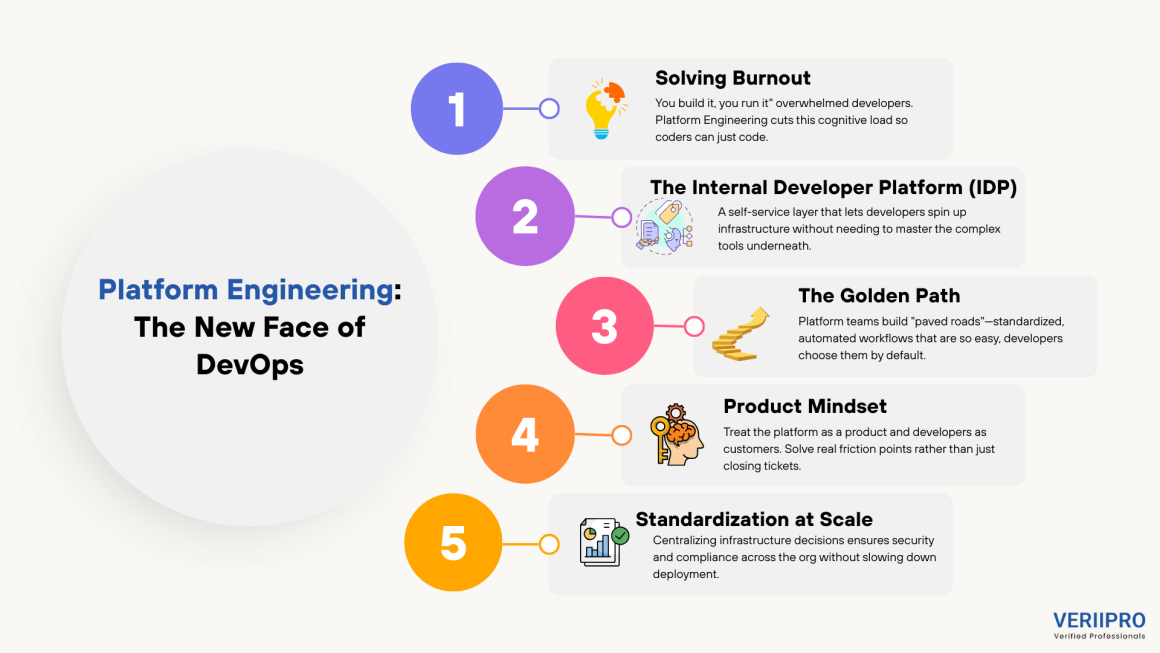
The result? Massive cognitive load and burnout. We turned our creative developers into exhausted part-time operations engineers.
This unsustainable situation has given birth to the hottest trend in infrastructure today: Platform Engineering. It is not a replacement for DevOps, but rather its necessary evolution. It’s the discipline of building an “Internal Developer Platform” (IDP) that allows developers to self-serve the infrastructure they need without having to become experts in the underlying complexity.
The Cognitive Load Crisis
The primary driver for Platform Engineering is complexity. The modern cloud-native landscape is a beast. The Cloud Native Computing Foundation (CNCF) landscape now includes over 1,000 different tools. Expecting every developer to master this toolchain is unrealistic and inefficient.
When a developer has to stop coding a feature to figure out why a Helm chart is failing, the business loses money. This is what the industry calls “cognitive load.” A report by Puppet found that highly evolved platform teams can reduce this load significantly, leading to faster deployment times and higher job satisfaction. Platform Engineering acknowledges that while we want developers to be autonomous, we don’t want them to be overwhelmed.
Building the “Golden Path”
The core philosophy of Platform Engineering is the “Golden Path” (sometimes called the Paved Road).
In a traditional DevOps setup, a developer might ask, “How do I spin up a database?” and the Ops team would say, “Here are the AWS credentials, figure it out.” In a Platform Engineering model, the Platform team builds a simplified, automated tool, a “platform” that offers a standardized way to do it.
The developer clicks a button or runs a simple command like run-db, and the platform handles the messy details of provisioning, security, and networking in the background.
Crucially, this isn’t about restriction; it’s about reducing friction. As noted by Gartner, the goal is to provide “paved roads” that are so easy to use that developers choose to stay on them, rather than being forced. If a developer wants to go off-road and build a custom setup, they can, but the platform offers a supported, easy default.
Treat Your Platform as a Product
This is the biggest mindset shift. The Platform team is not an IT helpdesk. They are a product team.
Their product is the Internal Developer Platform (IDP). Their customers are the software engineers.
Successful platform engineers don’t just build tools they think are cool. They conduct user research. They interview developers to find out where the bottlenecks are. They ask, “What is the most annoying part of your week?” and then build a tool to fix it. This “product mindset” is essential. If the platform is hard to use, developers simply won’t use it, and you are back to square one. This approach transforms the Ops team from ticket-takers into strategic enablers.
Is DevOps Dead?
You will see this clickbait headline everywhere, but the answer is no. DevOps is a culture of collaboration; Platform Engineering is the technical implementation of that culture at scale.
Think of it this way: DevOps stated the goal (collaboration and speed). Platform Engineering provides the vehicle to get there. It centralizes the complexity into a dedicated team of experts so that the stream-aligned product teams can focus on what they do best: building features that customers love.
By standardizing workflows and automating the “boring stuff,” Platform Engineering finally delivers on the original promise of DevOps: shipping code faster, more safely, and with a lot less headache.
Looking for opportunities in Cloud and Platform Engineering?
VeriiPro is here to help! As companies rush to build internal platforms to support their developer teams, the demand for engineers who understand Kubernetes, Go, and product thinking is skyrocketing. VeriiPro specializes in connecting high-level infrastructure talent with organizations that are leading the way in DevOps evolution. Let us help you find a role where you can build the tools that empower entire engineering organizations.