



Introduction
Quantum computing is no longer something you only hear about in physics departments. In 2026, it is hiring aggressively, attracting billions in investment, and producing real jobs across finance, pharma, defense, and cloud technology. If you have ever wondered whether this field is accessible to you, or what it actually takes to build a career in it, this guide is for you.
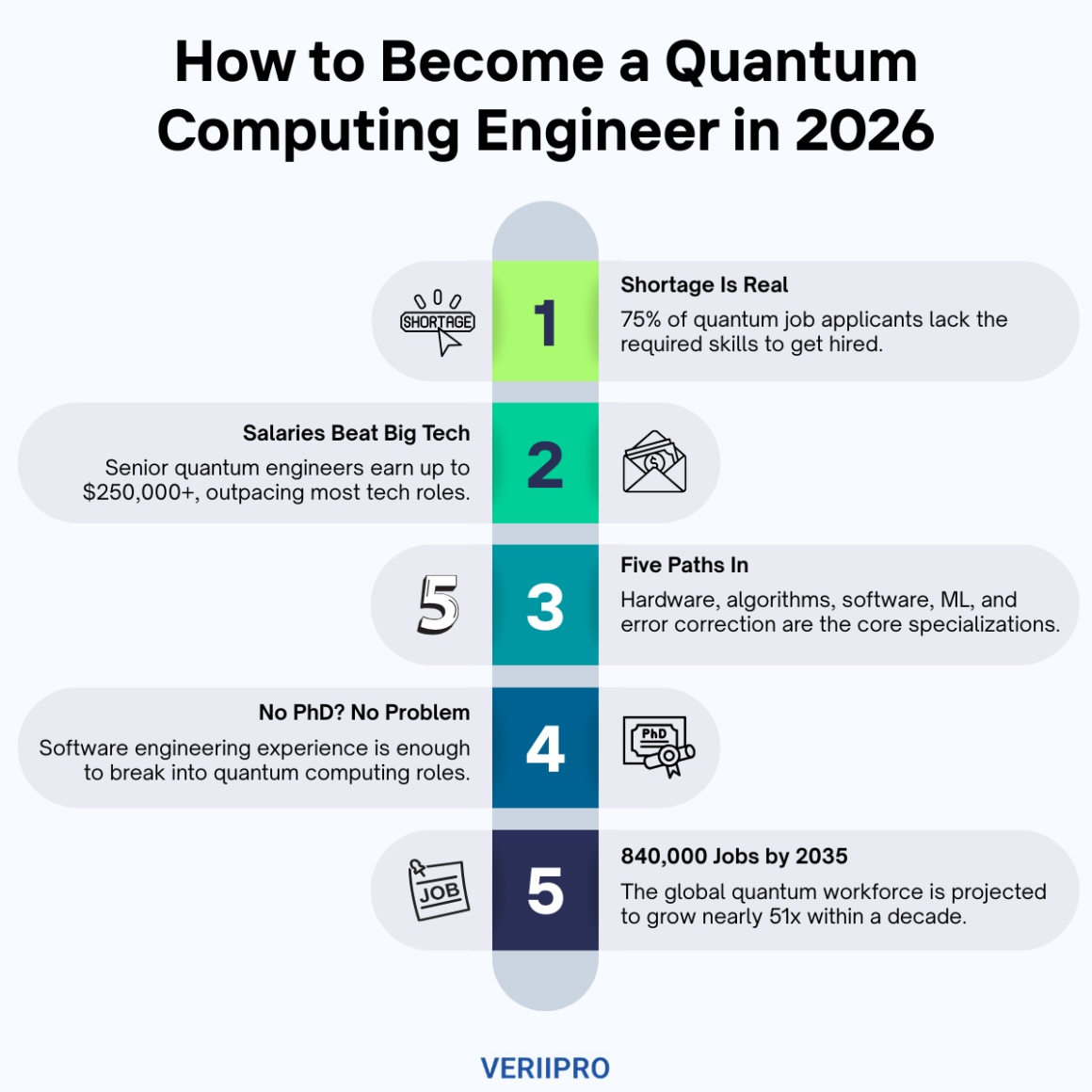
According to the QED-C State of the Global Quantum Industry 2026 report, the global pure-play quantum workforce reached nearly 16,500 professionals in 2025, adding 2,000 new workers in a single year alongside 11% growth in job and internship openings. Meanwhile, the global workforce shortage is projected to exceed 10,000 skilled roles by 2026-27, with McKinsey estimating only half of future quantum jobs may be filled due to the talent gap. Salaries for quantum computing engineers in the US currently range from $130,000 to $250,000 or more depending on role and seniority.
This guide covers every angle: what the role actually involves day-to-day, which specializations pay the most, where the hiring is happening, what education you need, and a concrete roadmap for breaking in no matter where you are starting from.
What Is a Quantum Computing Engineer?
Quantum computing engineers design, build, program, and optimize quantum computing systems. The label sounds clean, but in practice it covers a wide spectrum of work, from tinkering with cryogenic hardware at near-absolute-zero temperatures to writing quantum algorithms in Python and testing them on cloud-connected quantum processors.
How It Differs from a Quantum Scientist or Researcher
A quantum scientist is typically a PhD-level researcher generating new theoretical knowledge. A quantum computing engineer is focused on making things work. That might mean implementing an algorithm a researcher designed, building the control electronics for a qubit system, or optimizing a quantum circuit to run on real hardware with its noise and error constraints. Researchers publish papers. Engineers ship systems. In practice there is significant overlap, especially at smaller companies, but the engineering role is defined by its bias toward implementation and reliability.
What Does a Quantum Computing Engineer Do Day-to-Day?
Depending on specialization, a typical day could involve writing and testing quantum circuits using Qiskit or Cirq, debugging hardware calibration errors, designing classical control software for quantum processors, collaborating with hardware teams on qubit coherence issues, or building simulation environments for algorithm testing. Increasingly, engineers are also being pulled into cross-functional work, explaining quantum capabilities to product teams and business stakeholders. Communication is becoming as important as the technical depth.
Types of Quantum Computing Engineer Roles in 2026
The field has matured enough that distinct specializations have emerged. Here is a breakdown of the five most in-demand tracks, along with what each actually requires.
Quantum Hardware Engineer
Hardware engineers design and optimize the physical systems that make quantum computing possible, working across superconducting qubits, trapped ions, photonic architectures, and neutral atom platforms. Daily work includes fabricating and characterizing quantum devices, testing qubit properties such as coherence times and gate fidelities, and troubleshooting hardware failures. Most positions require a Master’s or PhD in physics, electrical engineering, or materials science. Key skills include quantum device physics, cryogenics, precision electronics, and signal processing.
Quantum Algorithm Developer
Algorithm developers design novel quantum algorithms targeting problems that classical computers cannot efficiently solve, from optimization and cryptography to chemistry simulation and machine learning. This is among the most research-heavy engineering roles, often requiring a PhD in quantum computing, mathematics, or computer science. Salary ranges for this track run $150,000-$250,000 and above, reflecting how rare genuine algorithm expertise is.
Quantum Software Engineer
Quantum software engineers build the frameworks, compilers, and tools that allow quantum algorithms to run on real hardware. They work on programming libraries like Qiskit, Cirq, and Q#, develop compilation pipelines that translate high-level programs into device instructions, and create simulation environments for testing. A Master’s degree or PhD in computer science or physics is typical, combined with strong classical software engineering fundamentals. The crossover nature of this role, requiring both quantum knowledge and software architecture skills, makes it one of the more accessible entry points for experienced software engineers.
Quantum Machine Learning Engineer
Quantum ML engineers sit at the intersection of quantum computing and artificial intelligence, developing hybrid quantum-classical algorithms for classification, optimization, and generative modeling. They build proof-of-concept applications, optimize circuits for quantum hardware, and often publish research as part of the role. Tools like PennyLane and TensorFlow Quantum are standard. The rarity of professionals who are genuinely strong in both fields means compensation at the upper end, with senior roles at companies like IBM, Google, and Microsoft reaching $210,000 and above.
Quantum Error Correction Specialist
Error correction is the central unsolved challenge in scaling quantum computers. These specialists design error correction codes, analyze failure modes, optimize logical qubit implementations, and develop fault-tolerant architectures. According to Riverlane’s QEC Report 2024, 66% of the 29 quantum hardware companies surveyed were actively implementing QEC or had it as a primary focus. Most positions require a PhD in quantum computing, mathematics, or theoretical physics. Salary ranges: $145,000-$240,000 and above.
Role Comparison Table
| Role | Typical Education | Salary Range (US) | Key Skills |
|---|---|---|---|
| Quantum Hardware Engineer | Master’s / PhD Physics or EE | $140K-$220K+ | Cryogenics, device physics, electronics |
| Quantum Algorithm Developer | PhD Quantum/Math/CS | $150K-$250K+ | Algorithm theory, circuit design, math |
| Quantum Software Engineer | Master’s / PhD CS or Physics | $130K-$200K+ | Qiskit, Cirq, compiler design, Python |
| Quantum ML Engineer | Master’s / PhD ML + Quantum | $140K-$210K+ | TensorFlow Quantum, PennyLane, optimization |
| Error Correction Specialist | PhD Quantum/Math/Physics | $145K-$240K+ | QEC codes, fault-tolerant architectures |
Quantum Computing Engineer Salary in 2026
Compensation in this field is consistently among the highest in tech, driven by the scarcity of qualified professionals relative to demand. Here is how salaries break down in practice.
Salary by Experience Level
Entry-level roles, typically requiring a relevant Master’s or a strong Bachelor’s plus research experience, start between $110,000 and $130,000. Mid-level engineers with three to seven years of experience command $150,000 to $190,000, with total compensation often exceeding $200,000 when equity is included. Senior specialists and researchers at major tech companies like IBM, Google, and Microsoft regularly earn $200,000 to $250,000 in base, with top performers significantly above that figure, as reported by Glassdoor’s 2026 quantum engineer salary data.
Salary by Location (US, Remote, Europe)
Geography still moves the needle. Silicon Valley quantum roles average around $175,000, roughly 15-20% above the national average, with Boston and New York around 5-10% above. Remote positions at major quantum companies increasingly match on-site salaries. Internationally, Switzerland and Germany offer competitive compensation but tend to run below US levels. UK and Canada roles generally lag equivalent US positions.
Total Compensation: Base Pay, Equity, and Perks
Base salary is only part of the picture. At well-funded startups and big tech companies, significant equity packages can substantially increase total compensation, particularly for senior hires. Benefits frequently include access to cutting-edge research infrastructure, generous R&D budgets, and comprehensive health coverage. At startups, equity upside can be substantial if the company succeeds, while big tech offers higher base salaries and more structured bonuses.
How Salaries Have Changed from 2023 to 2026
The trajectory is up. Quantum computing compensation has outpaced standard software engineering salary growth over the past three years, driven by the widening gap between available talent and open roles. Industry analysts project salaries will remain at a premium relative to classical software engineering through at least 2030, with quantum roles estimated to pay 30-50% above conventional software engineering positions as the workforce shortage continues.
Salary Overview by Role (2026)
| Role | Entry Level | Mid Level | Senior Level |
|---|---|---|---|
| Quantum Hardware Engineer | $120K-$145K | $155K-$185K | $200K-$220K+ |
| Quantum Algorithm Developer | $140K-$160K | $175K-$210K | $230K-$250K+ |
| Quantum Software Engineer | $115K-$140K | $150K-$180K | $190K-$200K+ |
| Quantum ML Engineer | $120K-$145K | $155K-$185K | $200K-$210K+ |
| Error Correction Specialist | $130K-$150K | $165K-$195K | $220K-$240K+ |
Sources: Glassdoor, The Quantum Insider, ZipRecruiter (2026).
Skills Required to Become a Quantum Computing Engineer
Core Technical Skills
The non-negotiables: linear algebra and probability theory are foundational to almost everything in quantum computing. Quantum mechanics fundamentals, including superposition, entanglement, and measurement, form the physics baseline. On the software side, Python is essential for algorithm development and working with frameworks like Qiskit, Cirq, and Q#. C++ is increasingly important for performance-critical systems work. Classical computer science fundamentals, particularly compilers, optimization, and software architecture, matter more than most job postings let on.
Emerging Skills Employers Want in 2026
Quantum error correction expertise is the single scarcest skill in the field right now, commanding premium compensation wherever it appears. Domain application knowledge is rising fast in importance: a quantum software engineer who also understands computational chemistry is far more valuable to a pharma employer than one who does not. Post-quantum cryptography is another growing area, driven by NIST’s standardization push and enterprise security concerns. Rust is emerging as a language for quantum infrastructure, particularly in performance-sensitive system components.
Soft Skills That Set Candidates Apart
The ability to explain quantum concepts to non-technical business stakeholders is underrated and genuinely valued. As the field moves toward commercialization, engineers who can bridge research and business strategy move into leadership faster. Project management experience, cross-functional collaboration, and written communication are all mentioned increasingly in senior quantum engineering job postings. This is not a field where you can disappear into the lab indefinitely.
Education and Certifications: What Do You Actually Need?
Do You Need a PhD?
For algorithm research and error correction roles, almost always yes. Those positions sit close to the research frontier and a PhD is practically a baseline requirement. For quantum software engineering, hardware engineering, and applications roles, a Master’s degree combined with strong software or hardware engineering experience is sufficient and increasingly common. A PhD accelerates advancement into senior technical and leadership roles, but Master’s holders are building successful careers across the engineering and applications tracks.
Best Degree Programs for Quantum Computing (US, UK, EU)
In the US, MIT, Caltech, UC Berkeley, University of Maryland, and University of Chicago have established quantum computing programs with strong industry connections. MIT’s xPRO also offers an online Quantum Computing Fundamentals certificate program for working professionals. In Europe, ETH Zurich, Delft University of Technology in the Netherlands, and the University of Waterloo in Canada are strong options. Degree fields worth targeting: physics, electrical engineering, computer science, and applied mathematics all provide viable paths.
Top Online Courses and Certifications Worth Taking
IBM’s Qiskit Developer certification is the most recognized industry credential for quantum software engineers. It validates practical ability to design and execute quantum circuits using the Qiskit SDK. MIT xPRO’s Quantum Computing Fundamentals certificate is a strong entry point for professionals without a physics background. Google’s Cirq documentation and tutorials, Amazon Braket’s learning resources, and IBM’s free Qiskit learning platform are all worth working through as hands-on foundations before pursuing formal certification.
Can You Enter Without a Physics Background?
Yes, particularly via the software engineering route. Many companies actively want engineers who are strong on the software side and are willing to train them on quantum-specific concepts. The formula that works: build strong Python and software engineering fundamentals, complete IBM’s Qiskit certification, build a GitHub portfolio of quantum computing projects, and target roles with “quantum software engineer” or “quantum applications” in the title rather than hardware or research positions. The physics-to-industry path also works in reverse: physicists moving from academia need to build software engineering skills to be competitive in most industry roles.
Where Are Quantum Computing Engineers Being Hired?
Quantum computing is not a one-sector story. In 2026, meaningful hiring is happening across at least five distinct industries, each with different priorities and different types of roles.
Finance and Banking
Hedge funds, investment banks, and financial technology companies are using quantum algorithms for portfolio optimization, risk modeling, and derivatives pricing. Goldman Sachs is among the financial institutions that have hired quantum specialists. The appeal for finance is clear: even modest speed advantages in optimization problems can translate to significant market advantages, making compensation in this sector among the highest for quantum engineers.
Pharmaceuticals and Drug Discovery
Quantum simulation of molecular and chemical interactions is one of the most compelling near-term applications of quantum computing. Companies in biotech and pharma are actively exploring how quantum algorithms can accelerate drug discovery by modeling protein folding and molecular binding at scales that are intractable for classical supercomputers. Research partnerships between quantum hardware companies and major pharma firms are generating direct hiring.
Defense and National Security
Government agencies and defense contractors are investing heavily in post-quantum cryptography, quantum sensing, and quantum communications. NIST’s Post-Quantum Cryptography project has created significant demand for cryptography engineers with quantum expertise. National labs including Los Alamos and Sandia are also active quantum employers.
Energy and Logistics
Supply chain optimization, materials science for next-generation batteries, and grid management are all active areas where quantum-enhanced computing offers real potential. Companies in energy and logistics are not yet hiring at the scale of tech or finance, but the applied research work happening now is building toward operational hiring over the next few years.
Cloud Platforms and Big Tech
IBM, Google, Microsoft, and Amazon all operate quantum systems in the cloud and are among the largest employers of quantum engineering talent. AWS Braket, Azure Quantum, Google Quantum AI, and IBM Quantum Network each represent distinct platforms with their own toolchains and hiring pipelines. Working on the platform side, whether in software, hardware, or systems, offers perhaps the broadest career exposure in the field.
Top Employers and Geographic Hubs in 2026
Leading Companies Actively Hiring Quantum Engineers
IBM has the largest quantum computing workforce in the US, followed by Google and Microsoft. Amazon is expanding aggressively through its Braket quantum service. On the startup side, IonQ, Rigetti Computing, PsiQuantum, Quantinuum, and Atom Computing are all actively growing their teams. Defense contractors like Lockheed Martin and government labs round out the employer landscape. Banks like Goldman Sachs and industrial firms like Volkswagen are also building internal quantum practices.
Best US Cities for Quantum Computing Jobs
The San Francisco Bay Area leads for compensation, with quantum computing roles in Silicon Valley averaging around $175,000. Boston and Cambridge are strong for research-adjacent roles, thanks to the MIT and Harvard ecosystem. New York City is growing as a hub, driven by finance sector demand. Colorado, Maryland, and North Carolina are emerging centers with favorable state-level investment in quantum research, often connected to national labs and government contracts.
Are Remote Quantum Engineering Roles Common?
More common than most people expect, but still less prevalent than in classical software engineering. Roughly 20% of quantum job postings include remote options. Hardware-focused roles are the least flexible, since working on physical quantum systems requires being in a lab. Quantum software engineering, algorithm development, and applications roles are more remote-compatible, and major quantum companies including IBM and Google now list remote positions at competitive salaries.
The Talent Gap – and Why It Works in Your Favor
How Big Is the Shortage?
Big. An EPJ Quantum Technology analysis of 3,641 job postings found that 75% of applicants for quantum computing positions lack the required skills. The Quantum Economic Development Consortium projects 250,000 new quantum sector jobs needed by 2030, rising to 840,000 by 2035. With only around 16,500 professionals in the global pure-play quantum workforce today, the math is stark. The market is under-supplied, salaries reflect that, and the window to build early expertise is genuinely open right now.
How Companies Are Adapting Their Hiring
Faced with the shortage, many companies are changing what they look for. Internal upskilling programs have become standard at IBM and Google, offering employees pathways into quantum teams from classical software and hardware backgrounds. Hiring requirements for quantum software roles have loosened, with a growing number of positions targeting strong classical engineers and offering on-the-job quantum training. Academic partnerships and internship pipelines are increasingly formalized.
How to Position Yourself as a Non-Traditional Candidate
The strategy that works: demonstrate quantum-specific skills through projects rather than credentials. A GitHub profile with working Qiskit circuits, a published implementation of a quantum algorithm, or a completed IBM Qiskit certification all carry weight with technical hiring managers. Target applications-track and quantum software roles where classical engineering experience is explicitly valued. Get into the Qiskit community, contribute to open-source quantum projects, and attend events like Q2B and IEEE Quantum Week where hiring happens informally.
Step-by-Step Roadmap to Become a Quantum Computing Engineer
Path 1 – For Students and Recent Graduates
Start with the fundamentals: linear algebra, probability, and quantum mechanics basics. If your undergraduate degree is in physics, math, or computer science, a targeted Master’s program in quantum computing or quantum information is the most direct route. During that time, pursue internships at companies running quantum programs: IBM, Google, IonQ, and Rigetti all have internship pipelines. Build a GitHub portfolio of quantum projects using Qiskit. Complete IBM’s Qiskit Developer certification before your first job application. Join the Qiskit Slack community to build professional connections early.
Path 2 – For Software or Hardware Engineers Switching Careers
This is the most accessible entry point for experienced professionals. If you are already a strong Python developer, you have significant transferable value. Spend two to three months building quantum computing fundamentals through IBM’s free Qiskit learning platform and MIT xPRO’s certificate program. Build three to five quantum projects demonstrating practical implementation skills. Apply specifically for quantum software engineer and quantum applications roles that list classical engineering experience as a positive. Expect the first role to involve a learning curve, but the transition timelines are realistic. Six to twelve months of focused preparation is enough to be competitive for junior quantum software positions at many companies.
Path 3 – For Physicists Moving into Industry
The challenge for physicists is usually on the engineering side, not the quantum mechanics side. Focus on building the software skills that industry roles require: Python proficiency, software architecture fundamentals, version control, and familiarity with at least one quantum SDK. Learning to communicate research in business and product terms is also important. Target companies that explicitly bridge research and commercial application, such as Quantinuum, PsiQuantum, and the quantum divisions of IBM and Google. Your academic publication record and subject matter expertise are genuine differentiators. The adjustment is cultural as much as technical: industry moves faster than academia, and “good enough to ship” is a real constraint.
Quantum Computing vs. AI Engineering – Which Career Is Right for You?
Both fields are growing fast and paying well. But they are different bets, and it is worth being honest about the tradeoffs.
Salary and Job Availability Compared
AI engineering currently offers significantly more job volume. Quantum computing engineering offers higher average salaries for equivalent seniority and dramatically less competition for open roles. An AI engineer at a mid-tier tech company might earn $150,000 to $180,000 at the senior level. A quantum engineer with equivalent seniority can expect $180,000 to $250,000 or more. The tradeoff is access: AI engineering roles are available at thousands of companies. Quantum engineering roles are concentrated at a relatively small number of well-funded employers.
Skill Overlap and Key Differences
There is meaningful overlap: Python, linear algebra, machine learning fundamentals, and research skills transfer between both fields. Quantum ML engineers specifically need competency in both domains. The divergence is in physics knowledge, which is central to quantum and largely irrelevant to AI, and in the hardware side of the work, which has no real AI engineering equivalent. If you have a physics background and enjoy working close to the hardware layer, quantum is the natural fit. If your background is purely in software and data, AI engineering is the faster path to employment right now.
Long-Term Career Outlook
AI engineering is already in a period of rapid commercialization. Quantum computing is two to three years behind on that curve, with widespread commercial deployment expected to begin around 2027-2028. Getting into quantum engineering now, while the talent pool is still small, positions you for the period when commercial demand accelerates. That window is real. It is also worth noting that the two fields are converging: quantum machine learning is an active area, and engineers who can work across both will likely command the highest compensation in the market by 2030.
Final Thoughts
Quantum computing engineering is one of the few places in 2026 where the talent shortage actually works in your favor. The market is growing, the salaries are strong, and the window to build early expertise is still open. The field rewards people who are willing to sit at the intersection of physics, software, and real engineering problems, not just theoretical ones.
Whether you are a student figuring out your graduate school path, a software engineer considering a pivot, or a physicist looking to move into industry, the roadmap exists. The tools are accessible. The hiring is real. If you are serious about exploring quantum computing roles, VeriiPro connects qualified engineers with companies actively building quantum teams.