

Data engineering is one of the highest-paying career paths in tech right now, and the numbers back it up. The average data engineer salary in the USA sits around $136,906 per year as of May 2026, according to Indeed. That is roughly $65 an hour. Factor in bonuses and total compensation, and many engineers are clearing well past $150,000. This article breaks down what you can realistically expect to earn by experience level, location, industry, and skill set, and what you can do to push your number higher.
What Does a Data Engineer Do?
Data engineers build and maintain the systems that move, store, and transform raw data into something usable. Think pipelines, data warehouses, and ETL processes. They are the people making sure that when a data scientist or analyst needs a dataset, it is clean, accessible, and reliable. The role sits at the intersection of software engineering and data infrastructure, and it shows up in nearly every industry today.
Average Data Engineer Salary in the USA
Across major salary platforms in 2026, the average base pay for a data engineer ranges from $123,049 (Salary.com) to $136,906 (Indeed). Glassdoor puts the median at $132,983. The spread reflects real differences in company size, location, and industry. For a monthly breakdown, the national average works out to roughly $10,400 to $11,400 a month before taxes. Total compensation including bonuses and equity can push significantly higher at larger tech companies.
Data Engineer Salary by Experience
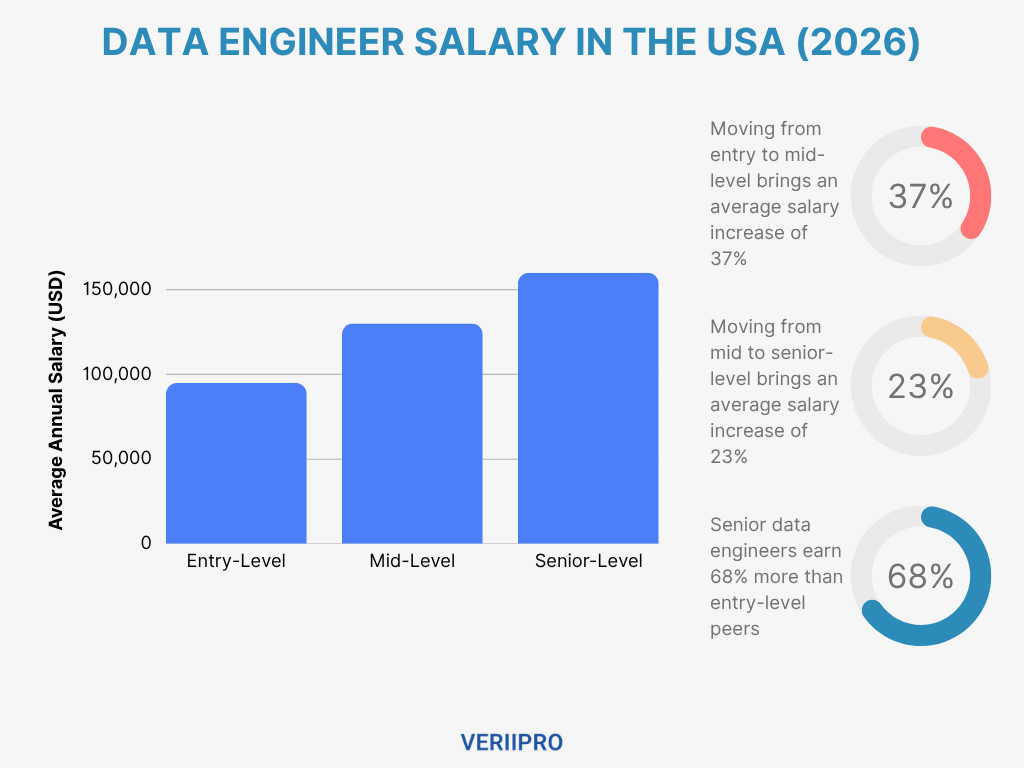
Experience is the single biggest lever on your paycheck in this field. Here is how salaries break down across career stages:
Entry-Level (0-3 Years)
Entry-level data engineers can expect to earn between $80,000 and $105,000 annually. Glassdoor’s 2026 data puts the average for entry-level roles at $94,798. This stage is about proving you can handle real pipelines, not just coursework. Python and SQL are table stakes. Internships, open-source contributions, or a strong portfolio project will help you land at the higher end of this range right out of the gate.
Mid-Level (4-6 Years)
Mid-level engineers are where salaries start to get genuinely competitive. Motion Recruitment’s 2026 Tech Salary Guide pegs the national range at $119,000 to $150,000 for this tier. At this stage, employers expect you to own end-to-end pipelines, work with cloud platforms, and contribute to architecture decisions. This is also where cloud certifications start paying off in real dollar terms.
Senior-Level (7+ Years)
Senior data engineers consistently earn $147,000 to $179,000 in base pay nationally, with staff and principal roles clearing $220,000 or more. Built In reports the average senior data engineer salary at $143,076. At large tech companies, total comp with stock can surpass $250,000. Seniors are expected to lead projects, mentor junior engineers, and make architectural calls on large-scale data systems.
Data Engineer Salary by Location
Where you work still matters a lot, even with remote options. Here is how major markets compare in 2026:
- San Francisco, CA: $183,354 average (Glassdoor), topping the national list
- New York, NY: ~$144,000 (Coursera / Glassdoor data)
- Seattle, WA: ~$146,000, with the added advantage of no state income tax
- Houston, TX: ~$173,000, driven by major energy companies building out large-scale data platforms
- Austin, TX / Chicago, IL / Boston, MA: $125,000-$137,000 range
- Remote: $122,000 to $153,000 for mid-level, competitive but typically below top-metro hybrid roles
Cost of living changes the picture, too. A $146,000 salary in Seattle can net more take-home than $183,000 in San Francisco once you account for state income taxes and rent.
Top Industries Paying Data Engineers
Your industry shapes both your ceiling and your day-to-day work. The highest-paying sectors in 2026 are:
- Technology: Big Tech still leads on total comp. Companies like Apple, Meta, and BlackRock top Glassdoor’s highest-paying employers list for data engineers.
- Finance: Banks, investment firms, and fintech companies pay heavily for engineers who can handle compliance-sensitive pipelines and real-time trading infrastructure.
- Energy: Often overlooked, but energy companies like ExxonMobil and Chevron are paying Bay Area-level salaries to build out AI and predictive maintenance platforms.
- Healthcare: Rising demand for data infrastructure to support clinical analytics, electronic health records, and regulatory reporting.
- E-commerce: Companies like Amazon rely on massive data pipelines for logistics, personalization, and supply chain optimization.
Skills That Impact Data Engineer Salary
Python (70% of job postings) and SQL (69%) are the entry requirements, not the differentiators. The skills that actually push your offer from $120,000 to $160,000+, according to 365 Data Science’s 2026 job posting analysis, are:
- Apache Spark: Still the dominant big data processing framework across industries
- Snowflake and Databricks: Cloud data platform expertise now appears in the majority of senior postings
- Kafka and real-time streaming: Real-time pipelines command a meaningful premium over batch ETL skills
- Cloud platforms (AWS, GCP, Azure): Certifications here have a direct salary impact, especially at mid-to-senior level
- Data governance and MLOps: As AI adoption grows, engineers who can support ML workflows and data governance are increasingly valued
Job Outlook for Data Engineers
The demand for data engineers is not slowing down. 365 Data Science’s 2026 analysis reports the sector now employs over 150,000 professionals in the US, with more than 20,000 new jobs created in the past year alone. The Bureau of Labor Statistics projects data science roles to grow 36% from 2023 to 2033, far outpacing the average for all occupations. The Global Data Engineering Services market is estimated at $105 billion in 2026, growing toward $213 billion by 2031. The biggest driver right now is AI. As companies build out data platforms to support machine learning and analytics, they need engineers who can manage the infrastructure behind those systems.
Data Engineer Salary by Role and Specialization
Beyond experience level, your specific role within data engineering affects your salary:
- Junior / Entry-Level Data Engineer (0-3 years): $80,000-$105,000. Focused on pipeline support and basic data management.
- Mid-Level / Standard Data Engineer (4-6 years): $119,000-$150,000. Responsible for designing scalable data architecture and owning end-to-end pipelines.
- Senior / Big Data Engineer (7+ years): $147,000-$179,000. Leads projects, mentors teams, and makes architectural decisions for large-scale data systems.
- Staff / Principal Data Engineer: $220,000+. Typically found at large tech companies, with equity pushing total comp well past $250,000.
How to Increase Your Data Engineer Salary
Your base salary is a starting point, not a ceiling. Here are the most reliable ways to move it up:
- Get cloud certified. AWS Certified Data Engineer, Google Professional Data Engineer, and Azure Data Engineer certifications consistently appear in high-paying job postings and justify a raise or a stronger offer.
- Learn streaming. Real-time data skills with Kafka and Spark Streaming are in short supply and command a visible premium in most markets.
- Move into the right industry. Energy, finance, and Big Tech pay meaningfully more than average. A sector switch can be the fastest salary jump available if your skills transfer.
- Change companies, not just roles. External offers historically produce larger salary bumps than internal promotions. If you have been in the same role for two or more years, the market may already value you higher than your employer does.
- Build toward staff-level scope. Taking on mentorship, architecture reviews, and cross-team projects positions you for staff or principal titles, where compensation jumps significantly.
Conclusion
Data engineering is one of the strongest career bets in tech right now. Salaries start above $80,000 at entry level and regularly exceed $175,000 for experienced engineers in competitive markets. The job market is growing faster than most tech roles, and AI adoption is only accelerating demand for people who can build and maintain data infrastructure. Whether you are just starting out or already mid-career, there has rarely been a better time to be a data engineer in the United States. VeriiPro can help you find the right role for your experience level and goals. Browse open data engineering jobs today.