

With over 28 million software developers worldwide and demand still outpacing supply in 2026, software engineering remains one of the highest-paying careers in the US. But salaries vary wildly depending on your role, location, and the skills you bring to the table. A backend engineer in Austin and a machine learning engineer in San Francisco are both software engineers. Their paychecks look nothing alike.
This guide breaks down exactly what software engineers earn in 2026 across every experience level, role, city, and industry. Whether you are evaluating a job offer, prepping for a negotiation, or trying to figure out which skills are worth investing in next, you will find real numbers and actionable context here.
Here is what this guide covers:
- Average software engineer salary in 2026 with verified data from BLS, Glassdoor, and Levels.fyi
- Salary breakdowns by experience level, role/specialization, location, and industry
- The key factors that push pay higher (or hold it back)
- Highest-paying programming languages with salary premiums
- Proven strategies to increase your salary and negotiate effectively in 2026
Let’s get into it.
Average Software Engineer Salary in 2026
The answer depends on which number you are looking at. According to the Bureau of Labor Statistics, the median base salary for software developers in the US sits at $133,080 as of the most recent release (May 2024 data). The top 10% of earners clear $211,450. These are base wages only, and they cover engineers across every industry, from regional banks to federal contractors.
Levels.fyi, which tracks total compensation including base salary, bonuses, and equity grants at major tech employers, reports a national median of $192,000 as of mid-2026. Those two numbers are both accurate. They just measure different slices of the market. If you work at a FAANG company or a well-funded startup, Levels.fyi is your benchmark. If you are at a mid-size enterprise, hospital system, or government contractor, BLS is closer to your reality.
| Metric | 2026 Salary (Base) | With Total Comp (Equity + Bonus) |
|---|---|---|
| National Median (BLS) | $133,080 | N/A (base wages only) |
| Glassdoor Average | $138,343 | $155,000-$175,000 |
| Levels.fyi Median | $135,000 (base) | $192,000 |
| Top 10% Earners | $211,450+ | $280,000+ |
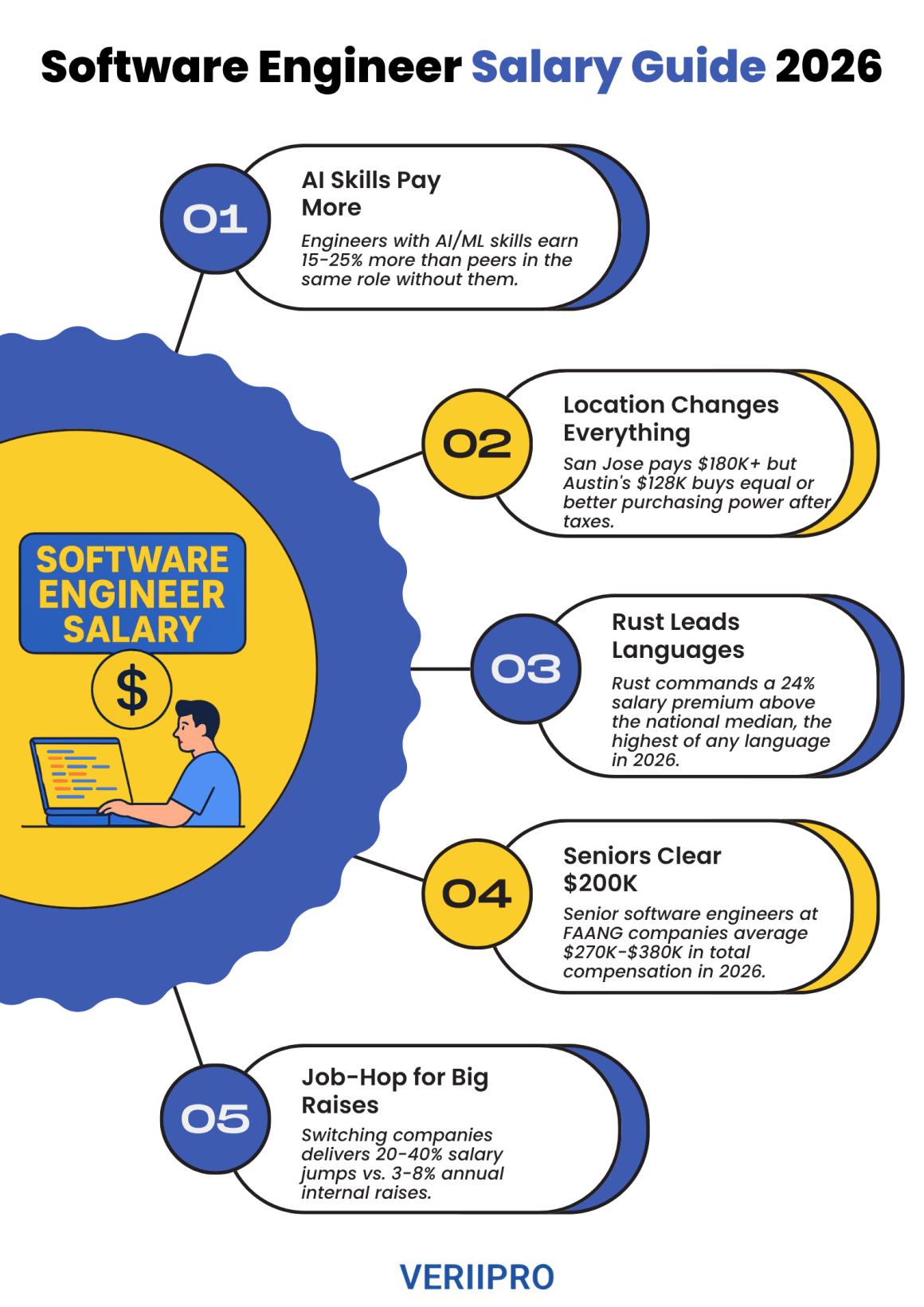
One thing that has shifted noticeably since 2023: AI skills are now a real salary lever, not just a resume talking point. A 2025 PwC study found that roles explicitly requiring AI skills carry a 56% wage premium over comparable roles without them. That premium has moderated slightly as more engineers have upskilled, but AI/ML expertise still adds 15-25% above baseline compensation for most engineers in 2026.
Year-over-year, overall software engineering salaries have grown at 3-5% annually. It is not the explosive growth of 2021-2022, but it is steady. The growth is concentrated at the senior and staff levels, and in specializations tied to AI, cloud infrastructure, and security.
Software Engineer Salary by Experience Level
Experience is the single biggest lever on your pay as a software engineer. Not years of service, but demonstrated capability and scope of ownership. The difference between a senior and a staff engineer is not just three more years on a resume. It is the ability to influence systems, teams, and architecture at a company-wide level.
| Experience Level | Avg. Base Salary | With Total Comp |
|---|---|---|
| Entry Level (0-2 yrs) | $75,000-$100,000 | $95,000-$140,000 |
| Mid Level (3-5 yrs) | $115,000-$155,000 | $140,000-$200,000 |
| Senior (6-10 yrs) | $155,000-$195,000 | $200,000-$320,000 |
| Staff / Principal (10+ yrs) | $200,000-$280,000 | $350,000-$600,000+ |
Entry-level engineers (0-2 years) typically start between $75,000 and $100,000 in base pay nationally. At FAANG companies, new-grad total compensation packages jump considerably higher, often landing in the $140,000-$180,000 range once signing bonuses and initial equity grants are included. Markets like San Francisco and Seattle push the upper end of entry ranges, while Austin or Denver cluster around $85,000-$100,000 base.
Mid-level engineers (3-5 years) see the biggest single salary jump in their careers. This is when the gap between a FAANG and a mid-size employer starts to widen noticeably. Base pay moves into the $115,000-$155,000 range, and total compensation at top companies regularly crosses $200,000 once equity is factored in.
Senior engineers (6-10 years) are where things get interesting. Glassdoor puts the average senior software engineer salary at $202,720 as of early 2026, with a range from $162,535 to $256,993. At FAANG companies, senior engineers at Meta average around $380,000 in total compensation; Google seniors average approximately $302,000, per Levels.fyi data.
Staff and principal engineers (10+ years) operate in a different comp universe entirely. Base salaries often clear $200,000, and the real money is in equity. Median total compensation at staff level at top tech companies frequently exceeds $400,000, with principal engineers at Google and Meta sometimes reaching $1M+ in total comp when equity is marked to current stock prices.
Software Engineer Salary by Role and Specialization
Not all software engineering roles pay the same. The gap between a frontend engineer and an AI/ML engineer can easily be $50,000-$70,000 at the same experience level, and that gap is widening. Specialization in high-demand, low-supply niches is consistently the fastest path to above-average pay in 2026.
| Role | Avg. Salary 2026 | Demand Level |
|---|---|---|
| Frontend Engineer | $110,000-$145,000 | High |
| Backend Engineer | $120,000-$160,000 | Very High |
| Full Stack Engineer | $125,000-$165,000 | Very High |
| DevOps / Platform Engineer | $135,000-$175,000 | High |
| AI / ML Engineer | $155,000-$220,000 | Extremely High |
| Cloud Engineer | $140,000-$185,000 | High |
| Security Engineer | $145,000-$190,000 | High |
| Embedded Systems Engineer | $115,000-$155,000 | Medium |
Which Software Engineering Specialization Pays the Most in 2026?
AI and machine learning engineering leads the field. Machine learning engineers in 2026 earn $128,000-$186,000 in base pay, with senior ML engineers at FAANG companies and frontier AI labs clearing $350,000+ in total compensation once equity and bonuses are included. The production experience gap is where the biggest premiums live: engineers who can deploy PyTorch models in production, build RAG pipelines at scale, or optimize LLM inference infrastructure regularly receive offers $20,000-$40,000 above candidates at the same level without that background.
Security engineering is close behind. The combination of high stakes, specialized knowledge, and a persistent shortage of qualified engineers keeps security compensation well above average. DevOps and platform engineering also commands a consistent premium because these roles sit at the intersection of software and infrastructure, a combination that is hard to hire for and expensive when it walks out the door.
Is AI Engineering Worth the Career Switch for Higher Salary?
For most mid-career engineers, yes. The 12-month payback on building practical AI skills is real and measurable. The skills that move the needle on compensation in 2026 are not necessarily the hardest ones: LLM integration, embeddings, retrieval-augmented generation, and model evaluation are all learnable within a year of focused work. Going from $130,000 to $160,000+ at the same company after upskilling in AI is a realistic outcome, based on AI/ML hiring data showing 88% year-over-year growth in 2025. Becoming a deep learning researcher or ML systems engineer at the frontier-lab level is a different path entirely, one that typically requires a PhD and years of specialized work.
Software Engineer Salary by Location
Location is the second-biggest salary driver after experience, and it cuts in ways that are less intuitive than they look on paper. High nominal salaries in San Francisco or New York do not always translate to higher purchasing power once you factor in taxes, housing, and cost of living.
| City / State | Avg. Base Salary | CoL-Adjusted Reality |
|---|---|---|
| San Jose / Bay Area, CA | $180,000+ | Medium (housing costs are brutal) |
| San Francisco, CA | $161,000+ | Medium (CoL index ~272) |
| Seattle, WA | $165,000+ | High (no state income tax) |
| New York, NY | $148,000-$180,000 | Medium (NYC rents rival SF) |
| Austin, TX | $128,000-$155,000 | High (CoL index ~123, no state tax) |
| Chicago, IL | $130,000-$150,000 | High (strong mid-market) |
| Remote (US) | $130,000-$165,000 | Very High (depends on location) |
Which US City Pays Software Engineers the Most?
In nominal terms, San Jose leads the country. BLS OEWS data shows San Jose reporting a median software engineer salary of $180,320, with San Francisco close behind at $161,000 and Seattle at $165,000. But the real picture shifts when you adjust for cost of living. Using Bureau of Economic Analysis Regional Price Parities data, an Austin salary of $128,000 delivers roughly the same purchasing power as $180,000 in San Jose, once housing, state taxes, and everyday expenses are factored in. Texas has no state income tax, which effectively puts several thousand dollars more in your pocket every year compared to California or New York.
Do Remote Software Engineers Earn Less Than In-Office Engineers?
It depends on the company. About 40% of tech companies apply geographic pay adjustments for remote workers, while around 35% pay location-agnostic salaries, including companies like Airbnb and Spotify. Where a company does apply adjustments, remote workers typically earn 10-20% less than their in-office counterparts in the headquarters city. That said, a remote engineer earning $130,000 in Austin often has more disposable income than someone earning $170,000 in San Francisco. Remote senior software engineers nationally average around $143,000 in base pay, which is only about $2,000 below the national senior median, making remote work a financially strong option for many engineers in 2026.
Software Engineer Salary by Industry and Company Size
Industry matters almost as much as location. The same software engineer role, at the same experience level, can pay $40,000-$80,000 more at a top tech company versus a mid-size healthcare firm. Company size shapes not just base salary but how equity-heavy the compensation package is.
| Industry | Typical Salary Range 2026 |
|---|---|
| Big Tech (FAANG+) | $175,000-$300,000 base; $350,000-$700,000+ total comp |
| Finance / FinTech | $145,000-$200,000 |
| Healthcare / MedTech | $130,000-$175,000 |
| Defense / Government | $120,000-$160,000 |
| Startups (Series A-C) | $110,000-$165,000 + equity |
| Consulting | $125,000-$170,000 |
Do FAANG Companies Still Pay the Most in 2026?
Yes, though the term FAANG is starting to feel dated. Levels.fyi data from May 2026 shows that Stripe and Databricks have actually pulled ahead of legacy FAANG at senior levels. A Stripe L4 package ($766,000 total comp) is roughly equivalent to a Google L6 ($635,000), which is one full level higher. Netflix pays among the highest base salaries in the industry. OpenAI and Anthropic have pushed frontier-model researcher compensation into territory that would have been unthinkable three years ago. For most companies, total compensation at the senior level remains in the $300,000-$500,000 range, with equity making up the majority of that number at companies where stock actually vests.
Are Startups Worth It Financially for Software Engineers?
Sometimes. The honest answer is that most early-stage startup equity is worth less than it looks on paper. CB Insights data suggests more than 80% of seed and Series A startups exit at zero. That said, Series B and beyond, especially at companies with real revenue and a credible IPO path, can deliver life-changing payouts. If you are evaluating a startup offer, look hard at the equity structure, the last valuation, the vesting schedule, and whether the company has a clear path to liquidity. A $140,000 base at a funded Series C with a healthy option grant can end up being worth more than $200,000 at a large enterprise, if the equity plays out.
Key Factors That Affect Software Engineer Salary
Salary is not just a function of how good you are. It is a function of who is hiring for what, where you are located, what you built, and how well you negotiated the last time you had leverage. Here are the eight factors that move the needle most.
Experience and Years in the Industry
Seniority drives the steepest salary increases in software engineering, but it is demonstrated capability that employers pay for, not calendar years. Engineers who advance quickly by taking on larger scope, leading projects, and shipping high-impact work consistently out-earn peers with more years but narrower experience.
Technical Skills and Programming Languages
The specific languages and frameworks you work in affect pay significantly. Depth in high-demand, low-supply areas like Rust, Go, or AI frameworks commands premiums above the market average. More on this in the programming languages section below.
AI and Machine Learning Proficiency (2026 Premium Skill)
This is the single biggest skill premium in the market right now. Roles requiring AI skills paid 56% more than equivalent roles without them in 2025, per PwC data. That premium has narrowed to 15-25% in 2026 as more engineers have upskilled, but the absolute dollar difference is still substantial. Engineers with production experience in LLM integration, RAG systems, or ML infrastructure are consistently at the top of their pay band.
Educational Background and Certifications
A CS degree from a top program still opens doors, particularly at FAANG companies that filter by school in initial screening. That said, the gap between CS degree holders and bootcamp grads narrows within 2-3 years of experience. CS degree graduates typically start at $80,000+, while bootcamp grads average $65,000-$69,000. High-value certifications, particularly AWS, Google Cloud, Azure, and CKA for Kubernetes, directly correlate with higher pay in cloud and DevOps roles.
Geographic Location and Cost of Living
Already covered in detail above. The short version: coastal tech hubs pay higher nominal salaries, but cost-of-living adjustments often close the real gap. Seattle and Austin offer particularly strong value given their state income tax advantages.
Company Size and Industry
Company size affects both base salary and how heavily equity factors into total compensation. Large public tech companies pay higher total comp because equity is liquid and predictable. The industry you work in shapes both the pay ceiling and the base floor, with finance and big tech consistently at the top.
Remote vs. Hybrid vs. In-Office Work Model
Fully remote roles can be excellent financially if you live in a lower cost-of-living area and your employer pays national or SF-rate bands. Companies using geographic adjustment policies will pay you based on where you live, so relocating from San Francisco to Austin at a company with location-based pay can mean a significant pay cut even if your purchasing power stays roughly the same.
H-1B Visa Status and Prevailing Wage Requirements
H-1B sponsored positions are subject to Department of Labor prevailing wage requirements, which set a floor on what employers must pay sponsored engineers. This actually works in favor of visa holders in some cases, since the prevailing wage for a given role and location can be at or above market rate. However, H-1B holders may face less negotiating flexibility than permanent residents or citizens, since switching employers during active sponsorship is more complicated.
Highest Paying Programming Languages for Software Engineers in 2026
The languages that pay the most are rarely the most popular ones. Pay tracks scarcity. Rust commands the largest salary premium at +24% above the median software developer salary, followed by Go at +19%, and Scala at +18%, per Stack Overflow 2025 and Levels.fyi data. Python used for AI and ML sits at a premium too, but generic Python scripting pays much closer to the median.
| Language | 2026 US Avg. Salary | Salary Premium vs. Median |
|---|---|---|
| Rust | $165,000-$195,000 | +24% above median |
| Go (Golang) | $115,000-$155,000 | +19% above median |
| Python (AI/ML) | $130,000-$180,000 | +15-22% (AI-specific roles) |
| Scala | $145,000-$175,000 | +18% above median |
| Kotlin | $130,000-$155,000 | +10% above median |
| TypeScript | $128,000-$165,000 | At or slightly above median |
| JavaScript (generic) | $105,000-$140,000 | At median |
| PHP | $85,000-$115,000 | Below median |
Rust’s premium comes from two places: it is genuinely hard to learn, and the domains it is used in (systems programming, embedded, cryptography, WebAssembly, blockchain infrastructure) are high-value and short on qualified engineers. Rust has been the most-admired language on Stack Overflow for nine consecutive years, with 72% developer approval. In 2026, momentum has real policy backing: CISA and the FBI have urged a halt to new C/C++ development in favor of memory-safe languages, accelerating Rust adoption in critical infrastructure.
Go is the language of cloud infrastructure. Kubernetes, Docker, and a significant chunk of cloud-native tooling across the industry are written in Go. Platform engineering and DevOps teams pay a consistent premium for deep Go expertise because it is genuinely hard to staff. Python’s premium is entirely context-dependent: Python used for AI/ML work at the right company can push total comp well above $200,000, while Python used for basic scripting pays much closer to average.
Languages losing ground: PHP continues to trend below market average. Languages gaining ground: TypeScript has become the dominant language on GitHub by contributors, overtaking JavaScript and Python in 2025, and increasingly commands salaries above the generic JavaScript average.
How to Increase Your Software Engineer Salary in 2026
Generic advice about working harder is not going to move your salary. What does work is being specific about where the market is paying a premium and taking deliberate steps to get there. Here are six strategies that engineers are using right now to push their earnings higher.
Upskill in AI and Machine Learning
The 15-25% AI skills premium is real and accessible. You do not need to become a researcher. Focus on practical skills: LLM integration via APIs, building and evaluating RAG systems, using embedding models, and deploying model outputs in production applications. A year of focused side projects and coursework can shift your entire salary band.
Earn High-Value Certifications
Cloud certifications directly affect pay in cloud and DevOps roles. AWS Solutions Architect, GCP Professional Cloud Architect, Azure Administrator, and the CKA (Certified Kubernetes Administrator) all correlate with meaningfully higher salaries in their respective domains. These are not check-the-box credentials. They signal to hiring managers that you can do specific, high-value work without a long onboarding ramp.
Target High-Paying Industries Strategically
The same skill set earns more at a FAANG company or a fintech firm than at a traditional enterprise. If you are looking for a raise and your current industry has a low salary ceiling, a lateral move to a higher-paying vertical can be worth $20,000-$50,000 without any change in your actual skills.
Master Salary Negotiation Before Your Next Offer
Most engineers leave money on the table. The single biggest leverage point in any negotiation is a competing offer. Without one, you are negotiating against a number the company set before you arrived. With one, you are negotiating between two parties competing for you. Research your market rate using Levels.fyi for tech company data and Glassdoor for broader market benchmarks.
Consider Switching Companies vs. Getting a Promotion
Internal raises at most companies are capped at 3-8% annually. Job-hopping to a new employer can deliver 20-40% jumps, particularly when you bring your experience to a company that values it more. Equity refreshers also slow down after your initial grant vests, so a fresh offer with a new equity package can leapfrog several years of internal pay increases.
Build a Public Portfolio That Commands Premium Rates
Hiring managers at top companies get hundreds of applications. Engineers with active GitHub profiles, technical blog posts, open-source contributions, or speaking credits at meetups and conferences consistently get through screening faster and receive higher initial offers. A portfolio is not just for entry-level engineers. At the senior and staff level, it is what separates candidates who get a recruiter call back from those who do not.
How to Negotiate Your Software Engineer Salary
Negotiation is a skill, and like any skill, having a script for the hard moments makes a real difference. Most engineers either accept the first offer or ask for more without a strategy. Neither approach is optimal.
Time it well. The best moment to negotiate is after you have a formal written offer, not during the interview. Once you have an offer, the company has already invested in selecting you. Their incentive is now to close the deal, not restart the process. Annual reviews are a weaker moment to negotiate because you are not bringing competing leverage to the table.
Research your market rate before any conversation. Pull numbers from Levels.fyi for total compensation at tech companies, Glassdoor for broader market context, and LinkedIn Salary for your specific metro. Have a specific target number in mind. Going into a negotiation with a range suggests you will accept the bottom of that range.
Negotiate the full package, not just base. Recruiters often have more flexibility on signing bonus, equity grant size, and equity cliff timing than they do on base salary, which is usually band-constrained. If they cannot move on base, ask what they can do on the signing bonus or equity grant.
What to Say When Asked “What Is Your Expected Salary?”
Do not anchor yourself. A strong response keeps the conversation open and signals market awareness:
“Based on my research and the scope of this role, I’m looking for a total compensation package in the $X to $Y range. I’d love to understand how your compensation structure works before we get into specifics.”
This avoids locking yourself in below market and signals that you know how to think about total comp, not just base salary.
How to Use Competing Offers as Leverage
A competing offer is the most effective negotiation tool available. You do not need to be bluffing, and you should not be. If you have an offer from Company B, here is a direct script for using it with Company A:
“I’m genuinely excited about this role and this team. I do want to be transparent with you: I have another offer on the table at [Company B] for [amount or range]. Before I make a decision, I wanted to check whether there is any flexibility on your end to get closer to that number. I’d much rather be here if the numbers can work.”
Keep it matter-of-fact. You are not threatening to leave. You are giving the company a chance to compete.
Final Thoughts
Software engineering in 2026 still pays extremely well. But the difference between average and exceptional compensation is not just experience, it is strategy. The engineers who earn the most are the ones who benchmark their pay regularly, invest in the skills the market is actively rewarding, and know how to negotiate when they have leverage. Use the data in this guide as a foundation. Know your number, know your market, and do not leave money on the table the next time you have an offer in hand.
Ready to find a role that matches your skills and your salary expectations? Browse software engineering jobs on VeriiPro and connect with employers who are actively hiring.