



If you’ve been watching tech hiring this year, data center jobs are the bright spot that’s hard to miss. Overall job postings on Indeed sit almost 4% above their pre-pandemic level, while software development postings are still roughly 20% below theirs, according to Indeed Hiring Lab’s October 2026 labor market snapshot.
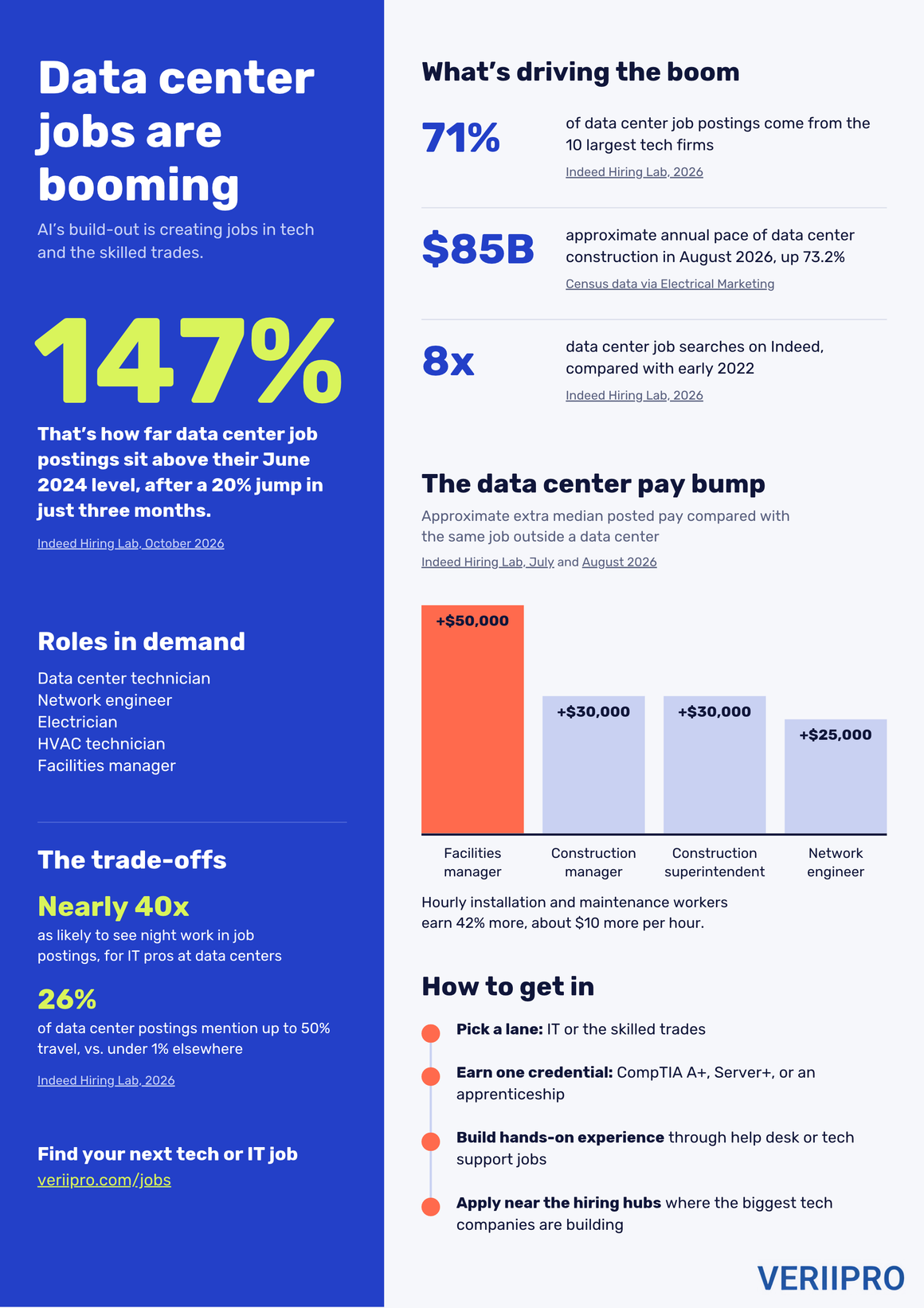
Data center hiring tells a very different story. The same report found that data center-related postings grew another 20% in just three months and are now 147% above where they were in June 2024. That’s not a blip. It’s the hiring side of the AI build-out, and it’s creating work for technicians, network engineers, electricians, HVAC specialists, and construction managers alike.
Quick answer: Data center jobs are booming because the biggest tech companies are racing to build the facilities that power AI. The most common openings are technician, IT support, and installation and maintenance roles, and many of them pay more than the same job outside a data center.
Below, we’ll walk through the roles employers are hiring for, the skills and certifications that help, what the jobs pay, the trade-offs that rarely make the headlines, and how to get your foot in the door.
Why Data Center Jobs Are Booming
Several forces are pushing in the same direction at once.
- Big tech is building at a huge scale. The 10 largest tech firms account for 71% of data center job postings in 2026, and about 6 in every 1,000 US job postings are now tied to data centers, up from 2 per 1,000 in 2023, according to Indeed Hiring Lab.
- Construction spending keeps setting records. Spending on data center construction hit an annual pace of about $85 billion in August 2026, up 73.2% from a year earlier, based on US Census Bureau data reported by Electrical Marketing.
- Hiring is spreading beyond the usual tech hubs. In Columbus, Ohio; Jackson, Mississippi; and Reno, Nevada, the share of job postings from the top 10 tech firms jumped from under 2% in mid-2025 to more than 10%, per Indeed.
- Job seekers have noticed. Searches for data center work on Indeed doubled in the first half of 2026, are 8 times higher than in early 2022, and passed 1 million so far this year, according to Indeed’s follow-up research.
Over the two years through mid-2026, data center postings more than doubled while postings for other tech jobs fell 6%, according to the same Indeed analysis. AI is changing how IT teams work day to day (we covered that in AI-Powered Automation in IT), but the physical side of AI still needs people with tools in their hands.
Key Data Center Roles at a Glance
Data center work splits roughly between tech jobs and hands-on trades. Indeed found that IT infrastructure, operations, and support roles plus installation and maintenance roles make up half of all data center postings, with installation and maintenance alone accounting for about a quarter.
A quick note on the pay column: the US Bureau of Labor Statistics (BLS) doesn’t track “data center technician” or most other data center titles as separate jobs. So the table shows the national median pay for the closest BLS occupation across all industries, using the latest May 2025 data. Many data center roles pay more than these medians, which we’ll get to in the pay section.
| Role | What they do | Key skills | Median pay (closest BLS job) | Typical education |
|---|---|---|---|---|
| Data center technician | Installs, monitors, and repairs servers, storage, and network gear | Hardware troubleshooting, cabling, server components | $76,220 (computer network support specialists) | Associate’s degree, or a diploma plus IT certifications |
| Network engineer | Designs and maintains the networks that connect servers and sites | Routing, switching, network design, cloud networking | $134,050 (computer network architects) | Bachelor’s degree plus 5+ years of IT experience |
| Systems administrator | Keeps servers, operating systems, and core infrastructure running | Linux and Windows servers, scripting, monitoring | $99,130 (network and computer systems administrators) | Bachelor’s degree; some employers accept a certificate or associate’s degree |
| Electrician | Installs and maintains power distribution, backup power, and wiring | Electrical code, power systems, job-site safety | $63,190 (electricians) | High school diploma plus a 4- to 5-year apprenticeship |
| HVAC and cooling technician | Maintains and repairs the cooling systems that keep servers from overheating | HVAC systems, refrigerant handling, preventive maintenance | $61,010 (HVAC mechanics and installers) | Postsecondary certificate plus EPA Section 608 certification |
| Electrical engineer | Designs the power systems for new facilities | Power system design, electrical code, CAD | $120,630 (electrical engineers) | Bachelor’s degree |
| Construction manager | Runs the build from groundbreaking to handover | Scheduling, budgets, safety, contractor management | $114,990 (construction managers) | Bachelor’s degree |
| Facilities manager | Oversees building operations, maintenance teams, and uptime | Critical systems, vendor management, budgeting | $106,660 (facilities managers) | Bachelor’s degree |
A Closer Look at the Main Job Types
IT and Network Roles
The data center technician is what most people picture when they hear “data center job,” and it’s what job seekers search for most. “Technician” shows up in about a quarter of all data center searches on Indeed, well ahead of “engineer” and “electrician,” per Indeed Hiring Lab.
According to CompTIA, a technician’s work usually includes:
- Monitoring server health and performance
- Installing and replacing server components based on diagnostic reports
- Responding to network and server issues before they turn into downtime
- Documenting work and keeping activity logs
Network engineers and systems administrators sit a step up. They design and run the networks and systems that the hardware supports, and they usually need more experience. BLS expects computer network architect jobs to grow 8% from 2025 to 2035, partly because cloud computing keeps expanding. If cloud work interests you, our guide to the impact of cloud computing on tech careers covers the neighboring paths.
Skilled Trades
This is where the build-out looks least like a typical tech job. Data centers use enormous amounts of power and need cooling around the clock, so electricians and HVAC technicians are in demand. BLS specifically notes that AI and data center demand are expected to raise electricity needs and create work for electricians who connect new systems to the grid.
Common trade roles include:
- Electricians who install and maintain power distribution, wiring, and backup power systems
- HVAC and mechanical technicians who keep cooling systems running and catch problems before equipment overheats
- Cabling and fiber installers who run and test the copper and fiber that link servers together
Engineering and Construction
Before a single server goes in, someone has to design and build the facility. Electrical and mechanical engineers plan the power and cooling systems, while construction managers and superintendents run the job site and keep contractors on schedule. Indeed’s researchers point out that much of the new demand is for construction, installation, and maintenance work, not the software roles that have long defined tech.
Operations and Facilities Management
Once a site is live, the job becomes keeping it live. Facilities and operations managers oversee maintenance teams, vendors, budgets, and the critical power and cooling systems that can’t go down. It also comes with the biggest pay premium Indeed found for any data center job title.
What Data Center Jobs Pay
Here’s the honest picture. Data center roles tend to pay less than traditional tech jobs like software engineering, and installation and construction roles pay less still, according to Indeed Hiring Lab. But compared with the same job title outside a data center, the pay is often noticeably better.
| Job | Data center pay premium over the same job elsewhere |
|---|---|
| Facilities manager | About $50,000 more per year (63%) |
| Construction manager | About $30,000 more per year |
| Construction superintendent | About $30,000 more per year |
| Network engineer | About $25,000 more per year |
| Network technician | About $10 more per hour |
| Installation and maintenance worker (hourly) | 42% more, or about $10 more per hour |
| Installation and maintenance worker (salaried) | 12% more |
Figures are median posted pay from Indeed job postings in 2026, reported in Indeed’s July and August research.
Pay is also climbing faster in related fields. Advertised pay for IT systems and solutions jobs rose 4.7% over the past year, and electrical engineering pay rose 5.6%, compared with 2.4% for all postings, per Indeed’s October snapshot.
The benefits are often better too. Indeed found that 90% of data center installation and maintenance postings advertise a 401(k) plan, compared with 48% of similar jobs elsewhere, and 80% of data center IT support postings do, compared with 38%. Parental leave shows up four to eight times more often in the most common data center occupations, and relocation help is more common as well. One thing you won’t see much of: signing bonuses.
In-Demand Skills and Certifications
Many of these skills can be learned without a four-year degree. Here’s what employers look for.
Technical Skills
- Server hardware installation and troubleshooting
- Structured cabling with copper and fiber
- Networking basics such as TCP/IP, switching, and routing
- Linux and Windows server administration
- Monitoring tools and ticketing systems
- Basic scripting to automate routine checks
Trade and Safety Skills
- Electrical systems and the National Electrical Code
- HVAC systems and refrigerant handling
- Reading schematics, blueprints, and equipment manuals
- Job-site safety habits and following procedures exactly
- Staying calm and methodical when something fails in the middle of the night
Certifications Worth Considering
- CompTIA A+ and CompTIA Server+: CompTIA points aspiring data center technicians to these two.
- BICSI cabling credentials: BICSI’s installation path runs from Installer 1 to Installer 2 (Copper or Optical Fiber) and then Technician, per BICSI.
- EPA Section 608: required for nearly all HVAC technicians who handle refrigerants, according to BLS.
- Electrician license: most states require electricians to pass a test and hold a license, per BLS.
- OSHA 10-hour or 30-hour card: job-site safety training from OSHA’s Outreach program. It’s voluntary and not a certification, though some states and localities require it, according to OSHA.
- Uptime Institute Accredited Operations Specialist (AOS): a five-day, 28-hour course for data center managers and operators, from the Uptime Institute.
For a wider look at where IT credentials can take you, see What Kind of IT Jobs Can You Get with IT Certifications?
The Trade-Offs: Nights, On-Call Shifts, and Travel
Data centers never close, and the schedules reflect that. According to Indeed, IT professionals supporting data centers are nearly 40 times as likely to see night work in their job postings as similar roles elsewhere. On-call rotations, weekends, and holidays show up more often too.
Travel is the other big one. About 26% of data center postings mention up to 50% travel, compared with less than 1% for non-data center equivalents.
There’s also a fair question about how long some of these jobs last. On paper, employers are hiring for the long haul: only about 2 in every 1,000 data center postings are labeled temporary, versus roughly 10 in 1,000 elsewhere. But Indeed’s researchers treat that as a hint, not proof, since building a data center takes thousands of workers and running one takes far fewer.
Before you apply, it’s worth asking a recruiter:
- What does the shift schedule look like, and how often does it rotate?
- Is there an on-call rotation, and how is it paid?
- How much travel is expected?
- Is this role tied to construction, or to running the site long term?
Where Data Center Jobs Are Concentrated
Data center hiring clusters around the places where the biggest tech companies are building. Indeed’s research highlights:
- The Washington, D.C. area, where 8% of all postings so far in 2026 have been data center roles
- Columbus, Ohio, and the rural communities around it
- Jackson, Mississippi
- Reno, Nevada
- Hermiston, Oregon, one of the major AWS hubs
Most applicants are already nearby. Overall, 55% of applications to data center postings come from the same metro area, though that ranges from 68% in Washington, D.C. to just 7% in Washington Court House, Ohio, according to Indeed. Remote hubs often have to recruit from out of state, which is one reason relocation help shows up more often in these listings.
How to Get a Data Center Job (Even With No Experience)
Indeed found that data center postings rarely attract career switchers from unrelated fields. Most applicants last worked as network engineers or data center technicians. Still, security officers, project managers, and forklift operators are applying too, so the door isn’t closed. Here’s a practical way in.
- Pick your lane. Decide whether you’re aiming for the IT side (technician, network, systems) or the trades side (electrical, HVAC, cabling). The training paths are different, so it helps to choose early.
- Get one entry-level credential. For IT, that might be CompTIA A+ or Server+. For trades, it usually means an apprenticeship. Electricians, for example, typically train through a 4- or 5-year paid apprenticeship, and military or construction electrical experience can shorten it, according to BLS.
- Build hands-on experience. CompTIA suggests help desk or technical support jobs as stepping stones, since employers usually want a couple of years of hands-on server experience. Construction, warehouse, and military backgrounds are worth highlighting too, because the work is physical and safety-focused.
- Look for employer training programs. Some of the biggest builders now train their own workers. Meta, for example, committed $115 million to a free five-week skilled trades course that leads to an industry credential and a guaranteed job, starting in Indiana, Louisiana, Ohio, and Texas, as reported by CBS News.
- Write your resume for an uptime job. Lead with reliability, safety, documentation, and comfort with shift work. If you’re coming from outside tech, our guide on how to transition into tech shows how to frame transferable skills.
- Search where the work is. Set alerts for titles like data center technician, critical facilities technician, and data center electrician in the hub regions above, and browse open tech and IT roles on VeriiPro.
Will the Data Center Boom Last?
Nobody can say for sure, and the researchers tracking it are upfront about that. Indeed’s team raises the big open question directly: what does data center employment look like once construction wraps up? Communities weighing new projects are also balancing the jobs and wages against strains on local power and water supplies, as Indeed notes.
Still, a finished data center doesn’t run itself. Every new site needs people to maintain, secure, and repair it for years. And the trade skills behind the build-out travel well. BLS projects jobs for electricians to grow 9% and jobs for HVAC technicians to grow 11% from 2025 to 2035, both much faster than average. Compare that with general computer support specialists, whose employment is projected to decline 3% over the same period.
If we had to bet, the safest seats are the ones that keep a finished facility running, plus the skills you can carry from one big project to the next.
Final Takeaway
AI often gets framed as a job killer, but data centers are one place where it’s clearly creating work, and not just for engineers. Technicians, electricians, HVAC specialists, cable installers, and facilities managers are all in demand, and many earn more than they would doing the same job elsewhere. The catch is the schedule and the travel.
If you like hands-on work and can live with odd hours, this is one of the most promising corners of the tech job market right now. Pick a lane, earn one credential, and start applying. You can browse tech and IT jobs on VeriiPro or create a job seeker profile to get started.