

Almost every job posting you’ll ever read asks for a “team player.” It’s become so common that most people skim right past it. But employers aren’t repeating it out of habit. They’re telling you what actually keeps a workplace running.
According to NACE’s Job Outlook 2025 survey, teamwork ranks among the top three skills employers look for in new hires, sitting right alongside problem-solving and communication. That’s not a coincidence. Strong teamwork skills move projects forward faster, spark better ideas, and make the daily grind a lot less painful for everyone involved.
This guide breaks down the ten teamwork skills that matter most, shows you what they look like in real workplaces, and gives you practical ways to sharpen each one. Whether you’re writing your first resume or leading a department, this is the stuff that actually moves your career.
What Are Teamwork Skills?
Teamwork skills are the personal abilities that let you work well with other people toward a shared goal. They cover how you communicate, how you handle disagreement, how reliable you are, and how well you read the people around you. Think of them as the operating system running underneath your technical know-how.
People often use “teamwork” and “collaboration” as if they mean the same thing, and they overlap, but there’s a useful distinction. Teamwork is the broader mindset: showing up, pulling your weight, supporting the group. Collaboration skills are more specific. They’re about actively building something together, like two departments combining efforts on a launch. You can be a decent teammate without collaborating deeply, but you can’t collaborate well without solid team skills underneath.
So what are teamwork skills in the eyes of an employer? They’re what’s known as employability skills, the transferable abilities that apply no matter your industry or title. A brilliant coder who can’t take feedback slows down an entire sprint. A talented nurse who won’t communicate puts patients at risk. That’s why workplace teamwork gets weighted so heavily in hiring. Modern work is interconnected, and almost nothing important gets done by one person alone.
Why Are Teamwork Skills Important?
Companies don’t prioritize teamwork because it sounds nice on a values poster. They do it because the numbers back it up.
Better communication is the obvious starting point. When teams share information openly, fewer things fall through the cracks. A sales rep who loops in the product team early avoids promising a customer something that doesn’t exist yet.
Then there’s productivity. Research from Deloitte found that organizations prioritizing strong communication and collaboration see a 20 to 25 percent jump in team productivity. That’s the difference between hitting a deadline and blowing past it.
Problem-solving speeds up too. A support team that huddles on a tricky customer issue cracks it faster than any one agent stuck alone. Innovation follows the same pattern. When people with different backgrounds throw ideas at a problem, you get solutions nobody would’ve reached solo. Frost & Sullivan research tied stronger collaboration to a 30 percent lift in sales and a 45 percent bump in customer satisfaction.
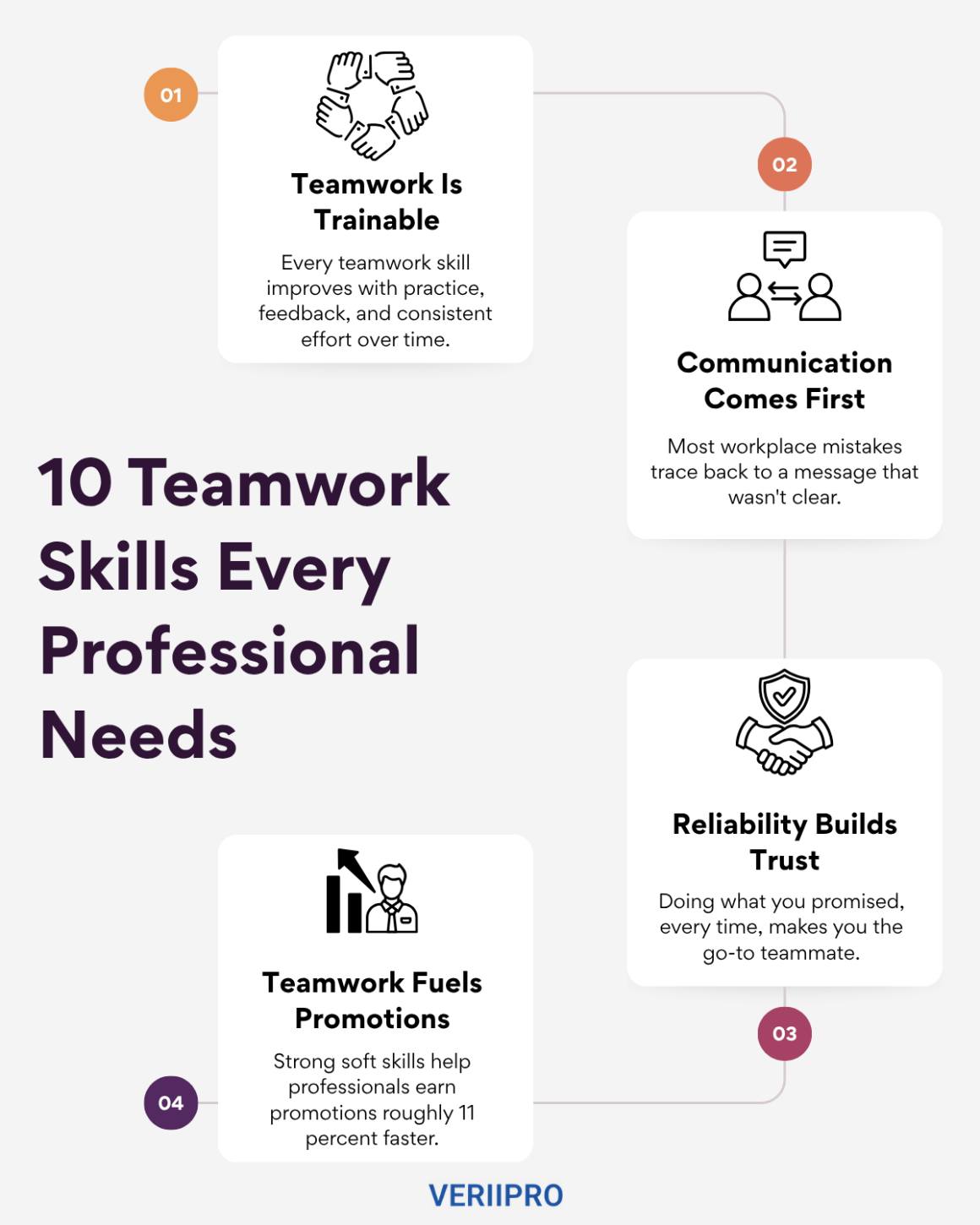
Engagement and retention round it out. SHRM’s State of the Workplace report points to teamwork and collaboration as key drivers of keeping good people around. And here’s the career angle you should care about most: people with strong soft skills like teamwork tend to earn promotions 11 percent faster than their peers. Being easy to work with is quietly one of the best career moves you can make.
10 Essential Teamwork Skills Every Professional Should Develop
Here are the teamwork abilities worth building, with what each one looks like on the job and how to get better at it.
1. Communication Skills
Clear communication is the foundation everything else sits on. It covers what you say, how you write it, and the signals you send without words at all.
Why it matters: most workplace mistakes trace back to a message that wasn’t clear, wasn’t sent, or wasn’t understood.
Workplace example: a project manager sends a short Friday recap listing what got done, what’s stuck, and who owns what next. Nobody starts Monday confused.
How to improve: get to the point faster. Before hitting send, ask whether a teammate could act on your message without a follow-up question. If not, rewrite it.
2. Collaboration
Collaboration is working shoulder to shoulder with others to reach something none of you could build alone. Of all the important teamwork skills, this is the one hiring managers picture when they say “team player.”
Why it matters: nearly every meaningful project crosses roles and departments.
Workplace example: design, engineering, and marketing plan a product launch together, each shaping the timeline instead of getting handed orders.
How to improve: share credit generously and ask others what they need from you before they have to ask you.
3. Active Listening
Active listening means fully understanding what a teammate is saying before you jump in with your own take. It’s the least flashy skill on this list and one of the rarest.
Why it matters: people contribute more when they feel heard, and you catch details you’d otherwise miss.
Workplace example: in a brainstorm, a team lead paraphrases a quiet colleague’s idea back to them before building on it. That colleague speaks up more from then on.
How to improve: stop planning your response while someone’s still talking. Pause a beat before you reply.
4. Accountability
Accountability is owning your responsibilities and your mistakes without needing to be chased.
Why it matters: teams run on trust, and trust comes from people doing what they said they’d do.
Workplace example: a developer misses a bug that reaches production, flags it immediately, and starts on the fix instead of going quiet and hoping nobody notices.
How to improve: when something goes sideways, lead with “here’s what happened and here’s my plan,” not excuses.
5. Adaptability
Adaptability is staying effective when priorities shift, tools change, or a new person joins the team.
Why it matters: work rarely goes to plan, and rigid people become bottlenecks.
Workplace example: a marketer’s campaign gets its budget cut mid-quarter, so they rework the plan around free channels instead of grinding to a halt.
How to improve: treat changes as puzzles rather than personal attacks. Ask “what can I do with this?” first.
6. Problem-Solving
Problem-solving in a team setting means pooling everyone’s thinking to work through a challenge together.
Why it matters: complex problems need more than one brain and one perspective.
Workplace example: a support and engineering team map out a recurring customer complaint on a shared whiteboard until the root cause becomes obvious.
How to improve: define the actual problem clearly before anyone suggests fixes. Half of bad solutions come from solving the wrong thing.
7. Conflict Resolution
Conflict resolution is handling disagreements without letting them damage relationships or derail the work.
Why it matters: friction is inevitable, and how you handle it sets the tone for the whole team.
Workplace example: two teammates clash on an approach, so they lay out the trade-offs side by side and let the goal, not ego, decide.
How to improve: focus on the issue, never the person. Swap “you’re wrong” for “help me understand your thinking.”
8. Emotional Intelligence
Emotional intelligence is reading your own emotions and other people’s, then acting on that awareness.
Why it matters: it’s the glue behind trust, empathy, and smooth working relationships.
Workplace example: a manager notices a normally chatty employee has gone quiet and checks in privately instead of calling them out in a meeting.
How to improve: name what you’re feeling in tense moments before reacting. Self-awareness is where it all starts.
9. Reliability and Dependability
Reliability is being someone your team can count on, every time, without a backup plan for when you flake.
Why it matters: dependable people become the ones others want on every project.
Workplace example: a colleague consistently delivers their piece a day early, so the whole team plans around them with confidence.
How to improve: under-promise and over-deliver. Protect your reputation for follow-through like it’s currency, because it is.
10. Respect and Open-Mindedness
Respect means valuing perspectives that differ from yours and staying genuinely open to being wrong.
Why it matters: diverse input produces better decisions, but only if people feel safe sharing it.
Workplace example: a senior engineer seriously considers a junior teammate’s suggestion and adopts it, signaling that good ideas can come from anyone.
How to improve: when you disagree, get curious before you get defensive. Ask a question instead of shutting the door.
Real-World Examples of Teamwork Skills in Action
Sometimes the clearest way to understand these skills is to see them working together. Here are some teamwork examples pulled from everyday work.
Cross-functional product launches lean on collaboration and communication, with engineering, design, and marketing syncing constantly so nothing ships half-finished. Agile software teams live and die by their daily standups, where accountability and adaptability keep sprints on track. Marketing campaign planning is a running exercise in problem-solving and open-mindedness as the group tests ideas and kills the weak ones.
Customer support collaboration shows up when agents share notes on a tricky account so the next person isn’t starting from zero. Healthcare teams might be the highest-stakes example of all: doctors, nurses, and technicians coordinating in real time, where one dropped message has real consequences. And remote project coordination ties it together, with distributed teammates relying on clear writing and dependability to stay aligned across time zones. These teamwork skills examples all share one thread: no single person carries the outcome alone.
How to Improve Your Teamwork Skills
The good news is that team skills are learnable. Nobody’s born a great collaborator. Here’s where to focus.
Practice active listening by actually pausing before you respond. Sharpen your communication by writing shorter, clearer messages. Ask for feedback directly, because “how could I have handled that better?” is one of the most underused questions at work. Volunteer for group projects even when they’re outside your lane, since reps build the skill faster than any article can.
Support your teammates without being asked, and watch how quickly goodwill comes back around. Learn some basic conflict management so disagreements don’t rattle you. Show up to brainstorming sessions with energy instead of dread. Respect opinions that clash with yours, and build trust the boring way: by keeping small promises over and over. None of this is complicated. It’s just consistent.
Common Mistakes That Affect Teamwork
Knowing what to avoid is half the battle. A few habits quietly wreck team performance.
Poor communication tops the list, followed closely by not really listening. Dodging accountability erodes trust fast, and once trust is gone, everything slows down. Resistance to feedback keeps people stuck, while micromanagement signals you don’t trust anyone else to do their job. Bad time management drags the whole team’s timeline with it.
Working in silos is a sneaky one. Atlassian’s State of Teams research found that one in two knowledge workers say different teams end up duplicating work simply because they weren’t talking to each other. And dominating discussions shuts down the quieter voices who often have the best ideas. The fix for most of these is the same: slow down, loop people in, and assume good intent. Small corrections here pay off big.
How to Showcase Teamwork Skills on Your Resume and During Interviews
Having the skills is one thing. Proving you have them is another.
On your resume, don’t just write “great team player.” Show it with results. Something like “Partnered with a 6-person cross-functional team to launch a product two weeks ahead of schedule” says far more. Sprinkle in ATS-friendly keywords like collaborated, coordinated, partnered, facilitated, and cross-functional, since applicant tracking systems scan for them. Quantify whenever you can. Numbers make teamwork feel real.
In interviews, use the STAR method: Situation, Task, Action, Result. When they ask “tell me about a time you worked on a team,” walk through a specific story with a clear outcome. A behavioral example might be describing a conflict you helped resolve and what changed because of it. Don’t forget your LinkedIn profile either. Recommendations from teammates and a headline that reflects how you work with others both reinforce the story your resume tells.
Jobs That Require Strong Teamwork Skills
Some roles simply don’t function without strong collaboration skills. A few where teamwork is non-negotiable:
Project Managers and Product Managers coordinate people across every department daily. Software Engineers work in tight sprints where one person’s code affects everyone’s. Data Analysts translate findings for teams who need to act on them. Digital Marketing Specialists and Graphic Designers constantly hand work back and forth. QA Testers partner closely with developers to catch what slips through. Customer Success Managers, Operations Managers, and Healthcare Professionals all sit at the center of teams where communication failures carry real costs. If you’re job hunting in any of these, teamwork isn’t a bonus. It’s the job.
Teamwork Skills vs Leadership Skills
People sometimes treat teamwork and leadership as opposites, like one’s for followers and the other’s for the boss. That’s backward.
Teamwork is about contributing well within a group. Leadership is about guiding that group toward a goal. The key difference is direction: teammates support the shared effort, while leaders shape it. But the similarities run deep. Both demand communication, emotional intelligence, and trust. In fact, teamwork is where leadership gets built. You learn to influence people by first learning to work well beside them. Nobody hands you a leadership role because you’re good at giving orders. They hand it to you because you’ve shown you can bring people together. That’s exactly why employers value both, and why strong teamwork abilities so often become the launchpad for a promotion.
Why Teamwork Skills Matter More in Remote and Hybrid Workplaces
When your team is scattered across cities or time zones, teamwork stops being automatic and starts requiring real effort.
Virtual communication carries more weight because you lose the hallway chats and the read-the-room body language. A poorly worded message can sit misunderstood for hours. Cross-functional collaboration takes intention when you can’t just walk over to someone’s desk. Digital collaboration tools like Slack, Asana, and shared docs become the shared office, and knowing how to use them well is a genuine skill now.
Accountability matters even more remotely, since no one’s watching over your shoulder. Doing what you said you’d do is how distributed teams stay functional. And building trust without face-to-face time is the real challenge. It comes from consistency, quick responses, and showing up reliably in every small interaction. Remote teamwork rewards the dependable and quietly exposes the people who were coasting on presence alone.
Conclusion
Teamwork is one of the most valuable skills you can build, and one of the most portable. It follows you across jobs, industries, and titles. Communication, accountability, adaptability, and respect don’t just make you easier to work with. They make you the person teams want and leaders promote.
The best part is that none of this requires talent you were born with. It requires practice. Pick one skill from this list, work on it this week, and highlight it the next time you update your resume or sit down for an interview. Do that consistently, and teamwork stops being a line on a job posting and becomes the thing that quietly carries your career forward.