

Introduction
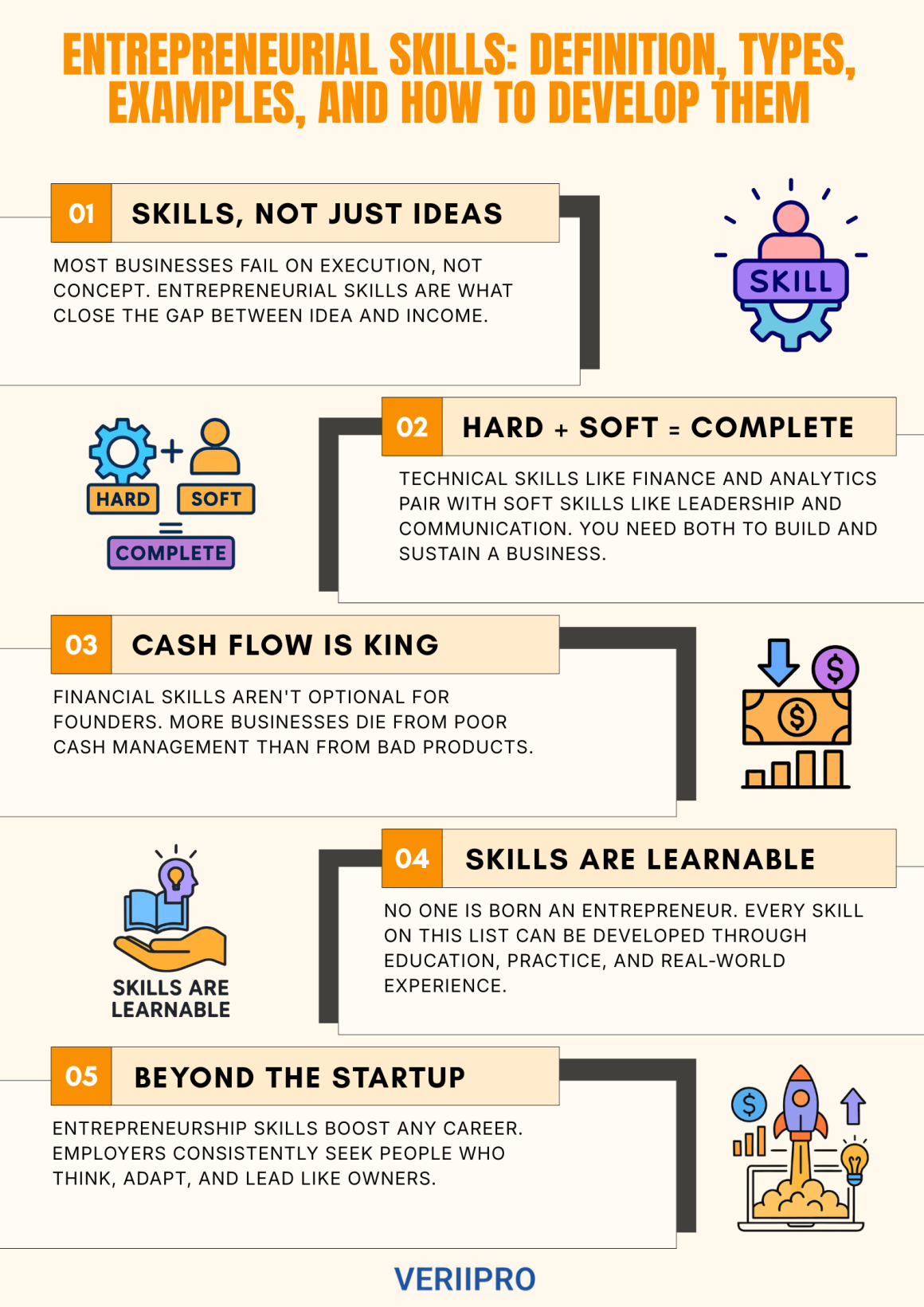
Most people think entrepreneurship is about having a great idea. It’s not. The idea is the easy part. What actually separates someone who builds a lasting business from someone who just has a dream is a specific set of skills – skills that can be learned, practiced, and sharpened over time.
Entrepreneurial skills are the mix of hard and soft abilities that help individuals start, manage, and grow a business. They cover everything from reading a balance sheet to inspiring a team to pivot when things go sideways. In today’s environment, these skills matter whether you’re launching a startup, climbing the corporate ladder, or freelancing on the side.
This guide breaks down the entrepreneurship definition, the key skill types, real examples, and practical steps to develop them – no fluff, no filler.
What Are Entrepreneurial Skills?
The entrepreneurship meaning, at its core, is the process of identifying a problem, building a solution, and creating value around it. Entrepreneurial skills are what make that process actually work.
They split into two broad categories. Hard skills are the technical, learnable ones: financial management, data analysis, marketing strategy, legal basics. Soft skills are the human ones: communication, leadership, resilience, adaptability. Both matter. A founder who can read a P&L but can’t communicate a vision will struggle. One who inspires everyone but can’t manage cash flow will run out of runway.
The entrepreneurial mindset is the foundation. It’s how you approach uncertainty, failure, and opportunity. The skillset is what you build on top of it. Together, they’re what turns an idea into a real business.
Key Types of Entrepreneurial Skills
1. Business Management Skills
This is the operational backbone. Planning, organizing resources, making decisions under pressure – these are what keep the lights on. Without solid management skills, even a great product can fail because the business around it falls apart.
2. Leadership Skills
Entrepreneurs rarely build anything alone. Leadership means articulating a vision that others want to follow, delegating effectively, and creating an environment where people do their best work. It’s less about being in charge and more about being trusted.
3. Communication Skills
You’ll pitch to investors, negotiate with vendors, sell to customers, and manage a team – sometimes in the same week. Clear, confident communication is how you make all of those interactions work. Writing matters just as much as speaking.
4. Financial Skills
Cash flow kills more businesses than bad products do. Understanding budgeting, forecasting, ROI, and basic accounting isn’t optional – it’s how you stay solvent long enough to succeed. You don’t need to be a CPA, but you need to know your numbers.
5. Problem-Solving Skills
Entrepreneurship is essentially a continuous stream of problems. Your ability to stay analytical under pressure, break down complex issues, and find workable solutions faster than competitors is a genuine competitive advantage.
6. Time Management Skills
Solo founders and small teams wear many hats. Knowing what to prioritize, what to defer, and what to cut is critical. Time management isn’t about being busy – it’s about spending your hours on things that actually move the needle.
7. Strategic Thinking Skills
Tactics win battles. Strategy wins wars. Strategic thinking means looking ahead – understanding where your market is going, where you want to be in three years, and what moves get you there. It’s the difference between reactive and intentional growth.
8. Marketing and Networking Skills
Even the best product needs an audience. Marketing and branding skills help you reach the right people with the right message. Networking builds the relationships – with mentors, partners, customers, and peers – that open doors no amount of advertising will.
Essential Entrepreneurial Skills (With Examples)
Beyond the categories above, a few qualities show up again and again in successful founders:
- Creativity and innovation: Airbnb saw unused bedrooms as inventory. That’s creativity solving a real problem.
- Risk-taking ability: Calculated risk – not recklessness. Every business bet involves uncertainty; the skill is knowing which ones to take.
- Adaptability: Companies that survived the 2020 disruptions pivoted fast. Those that couldn’t didn’t.
- Critical thinking: Separating signal from noise, questioning assumptions, and making decisions with incomplete information.
- Customer focus: Obsessing over the actual problem your customer has, not the product you want to build.
- Emotional intelligence: Managing your own reactions and reading others’ emotions – underrated but essential in leadership.
Entrepreneurs often need to combine multiple skills simultaneously – a product launch, for example, requires strategic thinking, marketing, financial planning, and team leadership all at once.
Importance of Entrepreneurial Skills
These skills don’t just help you start a business. They shape how that business grows. Strong entrepreneurship skills improve decision-making quality, speed up problem resolution, and create the kind of culture where innovation actually happens.
Long-term, they support sustainability. A business built on good judgment, solid financials, and strong relationships is one that lasts beyond the initial excitement of launch.
Entrepreneurial Skills vs Managerial Skills
These two skillsets often get confused. Here’s how they differ – and why you need both:
| Aspect | Entrepreneurial Skills | Managerial Skills |
|---|---|---|
| Focus | Innovation and creation | Execution and stability |
| Risk Approach | Embraces calculated risks | Minimizes and controls risk |
| Goal | Launch and grow new ventures | Optimize existing operations |
| Mindset | Opportunity-driven | Process-driven |
| Best For | Startups, new projects, pivots | Scaling, maintaining systems |
| Overlap | Both require leadership, communication, and decision-making |
The short version: entrepreneurial skills build the ship, managerial skills keep it sailing. The best business leaders develop fluency in both.
How to Develop Entrepreneurial Skills
1. Learn Through Education and Courses
Formal education in business, finance, or marketing builds fundamentals. Platforms like Coursera, LinkedIn Learning, and Harvard Business School Online offer targeted courses without a four-year commitment. Pick what’s relevant to your gaps.
2. Gain Practical Experience
Nothing replaces doing. Start a small side project. Freelance. Launch something low-stakes. The problems you’ll run into – pricing, finding customers, managing time – are the same ones you’d face at scale. Learning them small is far less expensive.
3. Build a Network
Find people who’ve done what you’re trying to do. Mentors compress learning curves dramatically. Peers keep you honest. Communities like founder Slack groups, local entrepreneurship meetups, and industry conferences are good starting points.
4. Improve Soft Skills
Communication, leadership, and adaptability are practiced, not studied. Join a public speaking group, take on leadership roles in low-stakes environments, and deliberately put yourself in situations that require flexibility.
5. Use Tools and Technology
Project management tools (Notion, Asana), financial software (QuickBooks, Wave), and analytics platforms reduce the overhead of running a business – freeing up your attention for higher-value decisions.
Real-World Examples of Entrepreneurial Skills
Leadership in action: Satya Nadella took Microsoft from a stagnant giant to a cloud powerhouse largely through a leadership style shift – from know-it-all to learn-it-all culture. That’s a soft skill with hard results.
Problem-solving under pressure: When supply chains collapsed in 2021, founders who’d built supplier relationships and maintained financial buffers recovered faster than those who hadn’t.
Marketing for growth: Dollar Shave Club built a brand with a $4,500 video that went viral. The skill wasn’t budget – it was understanding their customer and communicating with authenticity.
Financial planning for scale: Many startups fail not because they lack revenue but because they can’t manage growth. Financial skills prevent scaling yourself out of business.
Challenges in Developing Entrepreneurial Skills
It’s not easy. Common blockers include:
- Lack of experience: You can’t learn to ride a bike by reading about it. Real exposure takes time.
- Fear of failure: This one quietly kills more entrepreneurial careers than any external obstacle.
- Limited resources: Time, money, and access to mentors aren’t equally distributed.
- Role overload: Being responsible for everything makes it hard to go deep on any one skill.
The answer to most of these is starting smaller and accepting that early efforts will be imperfect. That’s not a bug – it’s the process.
Tips to Master Entrepreneurial Skills
- Commit to continuous learning – the business landscape shifts fast, and standing still means falling behind.
- Reframe failure as data. Every mistake tells you something useful if you’re paying attention.
- Stay adaptable. Markets change, customer needs evolve, and the strategy that worked last year may not work next year.
- Keep customers central. Skill development without customer focus is just theory.
- Practice consistency. Skills compound. Showing up daily – even imperfectly – beats intense bursts followed by nothing.
Conclusion
Entrepreneurial skills aren’t just for people starting companies. They’re for anyone who wants to create value, lead effectively, and navigate uncertainty with confidence. Every skill on this list can be developed with the right mix of education, practice, and real-world experience.
Start where you are. Identify the skill that would make the biggest difference right now – and go build it. The compounding effect of consistent skill development is one of the most reliable paths to long-term success, in business and beyond.