

VeriiPro Blog
  • Homepage
  • Job search
  • Sign up
  • About Us
VeriiPro Blog
VeriiPro Blog
  • Homepage
  • Job search
  • Sign up
  • About Us
Artificial Intelligence
27 Posts
View Posts
Career Advice
59 Posts
View Posts
Employers
5 Posts
View Posts
Expert Advice
37 Posts
View Posts
Immigration Advice
2 Posts
View Posts
Interview Advice
21 Posts
View Posts
Job Seeker
9 Posts
View Posts
Miscellaneous
2 Posts
View Posts
Remote Work
5 Posts
View Posts
Resume Tips
5 Posts
View Posts
Salaries
9 Posts
View Posts
Technology
1 Posts
View Posts
Uncategorized
2 Posts
View Posts
Visa Processing
3 Posts
View Posts
Workplace Culture
5 Posts
View Posts
Home › Blog › Career Advice
Futuristic illustration of AI and business analytics for 2026, representing the growth of AI jobs and careers worldwide.

Table of Contents

  • Top 10 Countries Leading the AI Job Market in 2026
  • Skills Required for AI Careers
  • How to Apply for AI Jobs Globally

Top 10 Countries for AI Jobs and Careers in 2026 (Best Locations)

Updated on May 24, 2026

Artificial intelligence has stopped being a buzzword and become a budget line. The global AI market hit $514.5 billion in 2026, and 88% of organizations now use AI in at least one business function. If you can build or deploy AI systems, somebody is hiring.

But where you build that career matters almost as much as what you build. LinkedIn ranked AI Engineer the fastest-growing job title in the United States for 2026. Germany pays well but moves slow. India hires fast but pays less. Japan keeps quietly leading on robotics. Here is a practical look at the top AI countries in the world, ranked by 2026 investment, hiring intensity, and ecosystem strength.
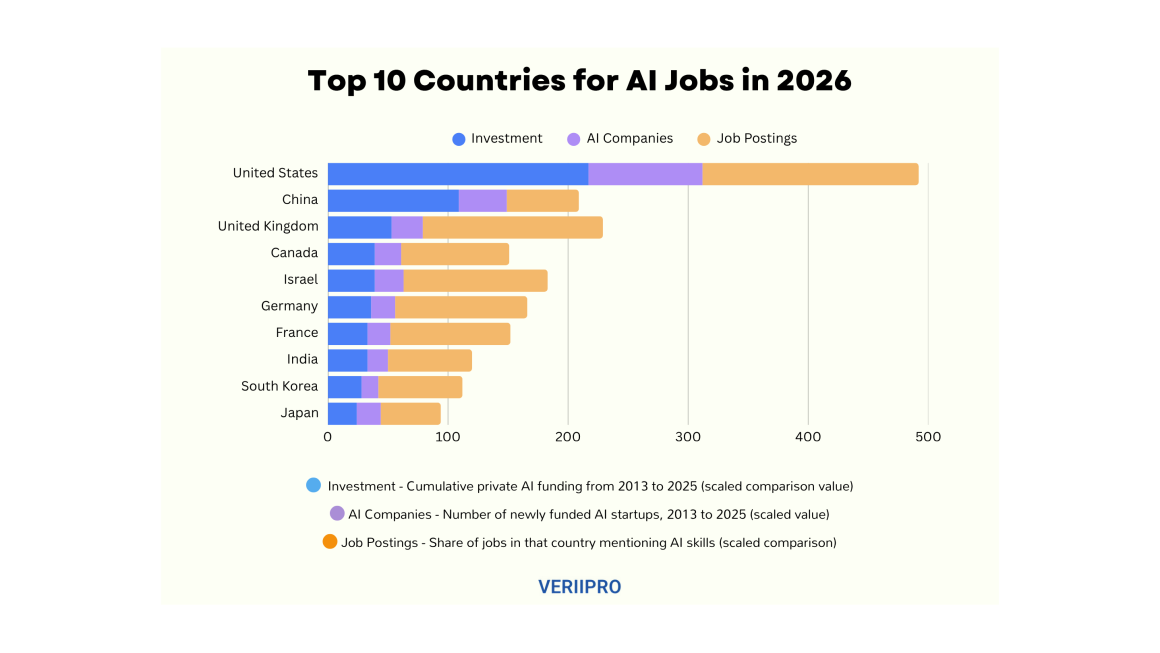
Top 10 countries for AI jobs and careers in 2026, ranked by AI investment, startup growth, and AI job postings share.

Top 10 Countries Leading the AI Job Market in 2026

1. United States

  • Average salary: $147,000 to $200,000+ for mid and senior AI engineers; top firms clear $400,000 total comp
  • Top industries: Big Tech, healthcare AI, fintech, defense, autonomous vehicles
  • Why choose: The US still attracts $285.9 billion in private AI investment annually, more than 23 times the next country. Frontier work at OpenAI, Anthropic, Google, and Meta happens here.

2. China

  • Average salary: ¥400,000 to ¥900,000 (roughly $55,000 to $125,000) at major tech firms like Baidu, Tencent, and Alibaba
  • Top industries: Consumer AI, computer vision, autonomous driving, industrial robotics, e-commerce
  • Why choose: China narrowed the model performance gap with the US to just 2.7% and leads the world in AI patents. Workplace AI usage already tops 80%.

3. United Kingdom

  • Average salary: £55,000 to £110,000 (around $70,000 to $140,000), with London paying a clear premium
  • Top industries: Financial services, healthcare, deep tech research, government, media
  • Why choose: The UK pulled in $28 billion in cumulative AI funding through 2024, the largest in Europe. DeepMind and a strong Oxbridge pipeline keep it competitive.

4. Canada

  • Average salary: CAD 100,000 to CAD 160,000 (about $73,000 to $117,000) in Toronto, Montreal, and Vancouver
  • Top industries: AI research, fintech, gaming, healthcare, natural resources tech
  • Why choose: The spiritual home of deep learning. Hinton and Bengio’s institutions (Vector, Mila, Amii) anchor the ecosystem, and immigration is far friendlier than the US.

5. Israel

  • Average salary: ILS 350,000 to ILS 650,000 (about $93,000 to $173,000) for experienced engineers
  • Top industries: Cybersecurity AI, defense, medical imaging, autonomous systems, enterprise SaaS
  • Why choose: Israel punches far above its weight, with roughly $15 billion in cumulative AI funding and 64 new AI companies funded in 2025 alone. Cybersecurity and defense AI here are unmatched.

6. Germany

  • Average salary: €65,000 to €115,000 for AI engineers; SAP, BMW, and Siemens pay higher at senior levels
  • Top industries: Automotive, industrial automation, manufacturing, enterprise software
  • Why choose: If applied AI in physical systems is your thing (robotics, factory floors, self-driving), Germany is hard to beat. The work tends to be substantive rather than hype-driven.

7. France

  • Average salary: €55,000 to €100,000 for AI engineers; higher at Paris fintech and Mistral-tier startups
  • Top industries: Foundation model research, luxury and retail AI, aerospace, healthcare
  • Why choose: France is Europe’s serious answer to American AI labs. Mistral, Hugging Face’s Paris team, and state-backed compute mean real frontier work, not just enterprise integration.

8. India

  • Average salary: ₹12 to ₹45 lakh per year (roughly $14,500 to $54,000); top product firms pay ₹60+ lakh
  • Top industries: IT services, fintech, e-commerce, generative AI startups, global captive R&D centers
  • Why choose: Bangalore, Hyderabad, and Pune now host AI engineering teams for nearly every major US tech firm. The work is first-class, and cost-of-living math makes salaries stretch.

9. South Korea

  • Average salary: ₩60 to ₩120 million per year (about $44,000 to $88,000) for ML and AI engineers
  • Top industries: Semiconductors, consumer electronics, robotics, gaming, automotive AI
  • Why choose: South Korea leads the world in AI patents per capita, and Samsung, LG, and Kakao pay competitively for engineers working on production AI systems and chip design.

10. Japan

  • Average salary: ¥6 to ¥12 million per year (about $40,000 to $80,000); senior roles in Tokyo go higher
  • Top industries: Robotics, advanced manufacturing, automotive, eldercare tech, gaming
  • Why choose: Japan remains the global benchmark for robotics and applied AI in physical systems. Toyota, Sony, and Panasonic offer rare opportunities to work on AI integrated into hardware at massive scale.

Skills Required for AI Careers

Job titles vary by country, but the skill stack is remarkably consistent.

Technical skills

  • Python (non-negotiable) and R for statistical work
  • Machine learning and deep learning fundamentals
  • Data analysis, statistics, and a real grasp of probability

Tools and technologies

  • TensorFlow and PyTorch (PyTorch dominates research, TensorFlow is strong in production)
  • SQL and at least one major cloud platform (AWS, GCP, or Azure)
  • LLM frameworks, vector databases, and basic MLOps

Soft skills

  • Problem-solving, especially scoping vague business problems into tractable ML tasks
  • Communication, particularly explaining model behavior to non-technical stakeholders
  • Critical thinking. AI outputs look authoritative even when they are wrong.

Workers with advanced AI skills earn a 56% wage premium over peers in the same roles without them.

How to Apply for AI Jobs Globally

Applying for AI roles abroad is mostly the same as applying at home, with a few extra steps.

  1. Build a real portfolio. Two or three solid GitHub projects beat a dozen tutorial clones. Pick problems with messy data and ship end to end.
  2. Tune your resume and LinkedIn. Use the exact phrasing from the job description. Recruiters search for slightly different terms in different markets.
  3. Apply through the right channels. Global boards like LinkedIn work, but company career pages often have roles posted nowhere else. For Europe, try Otta and Honeypot.
  4. Get a credential or two. DeepLearning.AI, Stanford online courses, and Google ML certifications carry weight. They signal seriousness and pass keyword filters.
  5. Network with intent. Most international hires happen through referrals. Engage with AI engineers on LinkedIn, contribute to open source, show up at conferences.
  6. Prepare for the interview gauntlet. Expect coding, ML system design, math fundamentals, and behavioral rounds. Top firms do not lower the bar for international candidates.

Also Read
CAREER ADVICE

10 Essential Teamwork Skills Every Professional Needs to Succeed

Jul 22, 2026
CAREER ADVICE

10 Goal-Setting Techniques That Actually Work in 2026

Jul 14, 2026
Related Topics
  • AI
  • Artificial Intelligence
  • career
  • career advice

Found this helpful? Help others - share it:

0
0
0

Frequently Asked Questions

The United States. Senior AI engineers in San Francisco or New York routinely clear $300,000 in total comp, with top firms paying more. Switzerland comes second by raw number, though cost of living eats much of the difference.

Yes, by almost every measure. The US has the most roles, highest pay, and around 42% of the world's AI researchers. The trade-offs are visa difficulty and intense competition for entry-level roles.

Very much so. AI/ML job postings in the US alone jumped 163% from 2024 to 2025, and the trend looks similar across every major market.

Start with career pages of firms that sponsor visas, then add LinkedIn and country-specific boards. Many countries have tech-specific visas (UK Global Talent, Germany's EU Blue Card, Canada's Express Entry) worth researching first.

Doable but not easy. Visa sponsorship adds friction, and you need to be clearly stronger than local candidates to be worth the paperwork. Strong portfolio, niche specialization, and remote experience all help.

The UK leads on funding, Germany on industrial AI, France on frontier research, and Switzerland on pay and talent density. Ireland and the Netherlands are strong dark horses for English-speaking applicants.

Globally, around $100,000, but the range is huge. Mid-level engineers earn about $147,000 in the US, $92,000 in Germany, $70,000 in the UK, $73,000 in Canada, and roughly $20,000 to $54,000 in India.

It helps a lot. Most AI roles list a bachelor's as a minimum, and research positions often want a PhD. That said, several top hires have come from people with strong portfolios and no formal CS degree, especially in applied LLM work.

India for sheer volume of entry-level roles, Canada for visa-friendly pathways, and Japan for structured training programs at large industrial firms.

Learn Python well, build a foundation in math and statistics, work through a structured ML course, then build projects on real datasets. Contribute to open source, write about what you build, and apply to junior or AI-adjacent roles (data analyst, ML support engineer) to get your foot in.

Related Articles

Career Advice

10 Essential Teamwork Skills Every Professional Needs to Succeed

Jul 22, 2026
Career Advice

10 Goal-Setting Techniques That Actually Work in 2026

Jul 17, 2026
Career Advice

15 Skills of a Good Manager: Qualities Every Successful Leader Should Have

Jul 8, 2026

Explore Top IT & Engineering Jobs

Find roles that match your skills, experience, and career goals - all in one place.

Browse Jobs
You may also like
Diverse team stacking hands together in a circle to show teamwork and collaboration.
CAREER ADVICE

10 Essential Teamwork Skills Every Professional Needs to Succeed

Jul 22, 2026 10 min
Ascending wooden blocks with checkmarks leading to a bullseye, illustrating goal-setting techniques and step-by-step progress.
CAREER ADVICE

10 Goal-Setting Techniques That Actually Work in 2026

Jul 17, 2026 8 min
A confident manager sits at her desk with a tablet and notes, smiling thoughtfully while reflecting on her team's goals.
CAREER ADVICE

15 Skills of a Good Manager: Qualities Every Successful Leader Should Have

Jul 8, 2026 8 min
A job candidate and hiring manager shaking hands across a table during an interview, with a resume document visible in the foreground.
CAREER ADVICE

Resume Summary Examples: How to Write a Strong Professional Summary

Jun 16, 2026 7 min
Accountability vs responsibility concept shown through a puzzle with a missing piece labeled Accountability
CAREER ADVICE

Accountability vs Responsibility: What’s the Difference? (With Examples)

Jun 10, 2026 10 min
10:22 PMClaude responded: A young entrepreneur smiling confidently in a modern office, showcasing strong entrepreneurial skills and a growth mindset.A young entrepreneur smiling confidently in a modern office, showcasing strong entrepreneurial skills and a growth mindset.
CAREER ADVICE

Entrepreneurial Skills: Definition, Types, Examples, and How to Develop Them

Jun 18, 2026 6 min
Agile feedback loop concept with a businessman using a laptop, illustrating iterative cycles and continuous improvement in project management.
CAREER ADVICE

Agile Methodologies: Types, Benefits, and How to Choose the Right One

Jun 18, 2026 5 min
A focused young professional wearing a smartwatch to track time while planning tasks in a notebook
CAREER ADVICE

Time Management Tips to Boost Productivity and Achieve More Every Day

May 13, 2026 9 min
Abstract big data analytics visualization dashboard representing machine learning, data science, and business intelligence technology.
CAREER ADVICE

How to Become a Machine Learning Engineer (Guide)

Jun 18, 2026 5 min
Two professionals collaborating on data analysis and machine learning metrics on a laptop during a business meeting.
CAREER ADVICE

What Does a Data Analyst Do? Complete Career Guide (2026)

May 26, 2026 11 min
Robotics engineering student and teacher working on a robotic arm in a science lab
CAREER ADVICE

How to Become a Robotics Engineer: Education, Skills & Career Path

Apr 27, 2026 5 min
A digital illustration of a human silhouette filled with industrial and technology elements representing big data engineering concepts
CAREER ADVICE

Big Data Engineer: Roles, Skills, Salary, and How to Start Your Career

Jun 18, 2026 7 min
CAREER ADVICE

Professional Communication Skills: Definition, Types, and Tips

Apr 27, 2026 11 min
CAREER ADVICE

What Is Professional Development? Benefits, Goals & Action Plan

Apr 27, 2026 10 min
Platform Engineering: The New Face of DevOps
CAREER ADVICE

Platform Engineering: The New Face of DevOps

May 13, 2026 3 min
VeriiPro Blog

Connect With Us

Linkedin Twitter Facebook

For Candidates

  • Login
  • Sign up
  • Browse Jobs

For Employers

  • Login
  • Post Jobs
  • Register Account
  • Search Candidates

Useful Links

  • Blog
  • Contact Us
  • Terms and Conditions
  • Privacy Policy

Connect With Us

Linkedin Twitter Facebook

© 2026 VeriiPro. All Rights Reserved

Input your search keywords and press Enter.