

Some interview questions are easy. “What’s your name?” “When can you start?” Then there are the ones that make your stomach drop, the ones designed to throw you off balance and see what you do next.
Tough questions are not there to trip you up for fun. Interviewers use them to figure out how you think, how you handle pressure, and whether you’ll fit the team. The way you respond reveals more than your resume ever could. A solid answer to “tell me about a time you failed” tells a hiring manager more about your character than a list of certifications.
That is why preparing strategic answers matters so much. Most people walk into interviews and wing it. You don’t have to. This guide breaks down 12 of the most common job interview questions that catch people off guard, with sample answers, tips, and a clear method for staying calm when the hard ones land. By the end, you’ll know exactly how to answer interview questions that used to make you sweat.
Why Employers Ask Tough Interview Questions
Hiring is expensive and risky. One wrong hire can cost a company months of lost productivity and a fresh recruiting cycle. So interviewers ask harder questions to lower the odds of getting it wrong. Here is what they are really trying to learn.
Assessing Problem-Solving Skills
Employers want to see how you break down a messy situation. Nearly 90% of employers say they look for evidence that a candidate can solve problems, according to NACE’s Job Outlook survey. A tough question forces you to show your thinking, not just your conclusions.
Evaluating Cultural Fit
Skills can be taught. Attitude is harder to fix. Questions about conflict, values, and work style help interviewers picture you in the room with their team. They are checking whether you’ll add to the culture or grind against it.
Testing Communication Abilities
Can you explain something complicated without rambling? Tough questions put your communication under a small spotlight. Clear, organized answers signal that you’ll communicate well with clients and coworkers too.
Measuring Emotional Intelligence
How you talk about a former boss, a failure, or a frustrating coworker says a lot. Interviewers watch for self-awareness, empathy, and the ability to stay composed. Emotional intelligence often matters more than raw talent.
Understanding Professional Experience
Behind every tough question is a simple goal: proof. Saying you’re a strong leader is easy. Describing a time you led a project through a crisis is the part that counts. These questions pull real stories out of your history.
Identifying Growth Potential
Companies hire for the next few years, not just the open seat. Questions about goals, weaknesses, and lessons learned show whether you reflect and improve. Hiring managers love candidates who treat every setback as a lesson.
How to Answer Difficult Interview Questions Effectively
Before we get to specific questions, here is the framework. Master it and you can handle almost any of the job interview questions that come your way, even ones you didn’t prepare for.
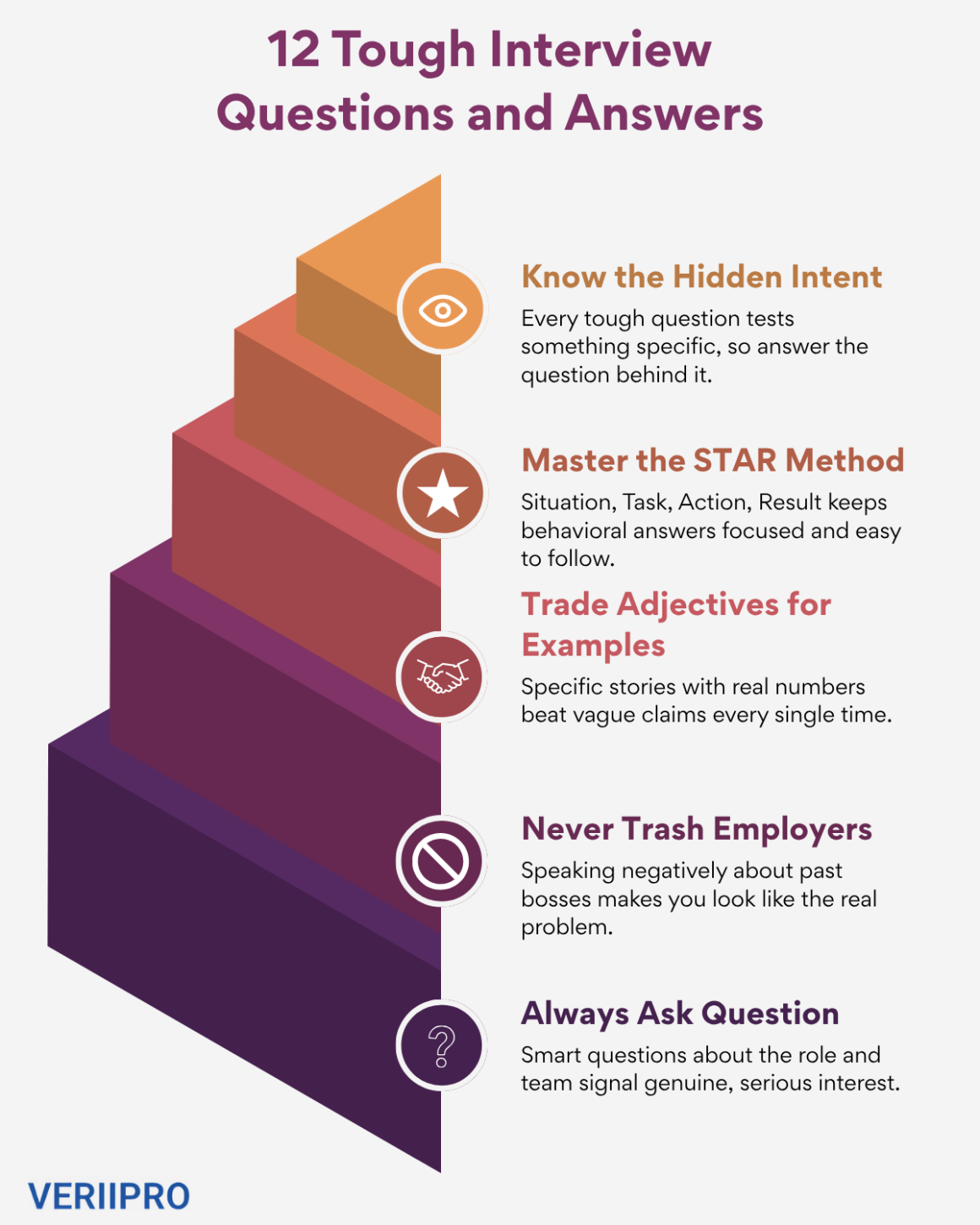
Understand the Intent Behind the Question
Every question has a hidden purpose. “Why are you leaving your job?” is really asking, “Will you badmouth us someday too?” As one career writer puts it, a handful of interview questions quietly decide everything. Once you spot the intent, the right answer becomes obvious.
Use the STAR Method
For behavioral interview questions, the STAR method keeps your answers tight and memorable. Employers increasingly lean on behavior-based questions and skills-based hiring, NACE reports, so this structure pays off. It works in four parts:
- Situation: set the scene briefly.
- Task: explain what you were responsible for.
- Action: describe what you actually did.
- Result: share the outcome, ideally with a number.
Most rambling answers fall apart because they skip the result. Don’t.
Provide Specific Examples
Vague answers are forgettable. “I’m a hard worker” means nothing. “I cut our reporting time from six hours to forty minutes by building a template” sticks. Specifics make you believable, so trade adjectives for examples.
Stay Honest and Professional
You don’t need a perfect record. You need an honest one. Interviewers can smell a rehearsed lie, and the truth, framed well, almost always lands better. Admit the gap, then show what you learned.
Keep Responses Structured and Concise
Aim for answers that run sixty to ninety seconds. Long enough to show substance, short enough to keep attention. If you feel yourself drifting, land the plane. Concise answers feel confident.
12 Tough Interview Questions and Sample Answers
Here are the questions that come up again and again, along with how to handle each one. These are some of the most common interview questions you’ll meet across almost any industry. Treat the sample answers as templates, then swap in your own stories.
1. Tell Me About Yourself
Why interviewers ask this: It is an icebreaker, but it is also a test. They want to see what you choose to highlight and whether you can give a focused answer instead of your life story.
Sample answer: “I’m a marketing coordinator with four years of experience in B2B software. I started in social media, moved into content, and over the last two years I’ve led email campaigns that grew our qualified leads by 30%. I’m drawn to this role because it blends strategy with hands-on creative work, which is exactly where I do my best.”
Tips for answering: Keep it professional, not personal. Use a past, present, future structure. End by connecting yourself to the job.
2. What Is Your Greatest Weakness?
Why interviewers ask this: They want self-awareness, not a confession. This is one of the trickiest common interview questions and answers because honesty and strategy have to coexist.
Sample answer: “I used to take on too much myself instead of delegating, because I wanted things done a certain way. It started to slow my team down. So I built a habit of handing off clearly defined pieces and checking in at milestones. My projects move faster now, and my team has grown.”
Mistakes to avoid: The fake weakness (“I just work too hard”) and the disqualifying one (“I miss deadlines”). Both backfire.
Tips for answering: Pick a real weakness, then show the fix. Growth is the whole point.
3. Why Should We Hire You?
Why interviewers ask this: They are handing you the microphone. This is your chance to connect your strengths directly to their needs.
Sample answer: “You need someone who can run paid campaigns and also write the copy that goes in them. I’ve done both for three years, and at my last job that combination cut our agency costs while improving click-through rates. I can hit the ground running without a long ramp-up.”
Tips for answering: Match two or three of your strengths to the job description. Be confident, not arrogant. Bring a number if you have one.
4. Why Do You Want to Work Here?
Why interviewers ask this: They want to know you did your homework and aren’t just spraying out applications.
Sample answer: “I’ve followed your product since the redesign last year, and the way your team writes about customer research really stands out to me. I want to work somewhere that treats users as collaborators, not just data points, and that shows up in everything you publish.”
Tips for answering: Name something specific about the company. Tie it to your values. Avoid generic praise anyone could copy and paste.
5. Tell Me About a Time You Failed
Why interviewers ask this: They want to see accountability and resilience. How you handle failure predicts how you’ll handle the next one.
Sample answer (STAR method): “We launched a feature that flopped (Situation). I owned the rollout plan (Task). I’d skipped early user testing to hit a deadline, so when adoption stalled, I ran interviews, found the confusion, and shipped a fix in two weeks (Action). Adoption tripled the next month, and we made user testing a required step (Result).”
Tips for answering: Choose a real failure with a real recovery. Own your part. Always end on the lesson.
6. Describe a Conflict You Had at Work
Why interviewers ask this: Conflict is unavoidable. They want to know you can disagree without blowing things up.
Sample answer: “A designer and I clashed over a deadline. Instead of escalating, I asked to grab coffee and hear his side. Turned out he was waiting on assets I hadn’t flagged as urgent. We built a shared tracker, and the friction disappeared.”
Tips for answering: Stay calm and neutral. Focus on resolution, not blame. Never trash the other person.
7. Why Are You Leaving Your Current Job?
Why interviewers ask this: They are checking for red flags. Are you running from a problem, or toward an opportunity?
Sample answer: “I’ve learned a lot in my current role, but I’ve grown past what it can offer. I’m looking for a position with more ownership over strategy, which is exactly what this job involves.”
Mistakes to avoid: Bashing your employer. Even if it was awful, negativity makes you look like the problem.
Tips for answering: Frame it as moving toward something. Keep it short and positive.
8. What Is Your Greatest Professional Achievement?
Why interviewers ask this: They want to see what you value and what “great” looks like to you.
Sample answer: “I rebuilt our onboarding process after noticing new hires were quitting in their first ninety days. I interviewed people who’d left, redesigned the first two weeks, and cut early turnover by half within a year.”
Tips for answering: Pick something relevant to the role. Use numbers. Explain why it mattered, not just what you did.
9. Where Do You See Yourself in Five Years?
Why interviewers ask this: They want to know your ambitions line up with the role and that you’re likely to stick around.
Sample answer: “I want to grow into a senior role where I’m mentoring others and owning bigger projects. This position is a strong step in that direction, especially with the chance to lead campaigns from start to finish.”
Tips for answering: Show ambition that fits the company. Avoid rigid plans. Never say “your job” to the person interviewing you.
10. How Do You Handle Pressure or Stress?
Why interviewers ask this: Every job has stressful stretches. They want proof you won’t crumble.
Sample answer: “I get specific. When everything feels urgent, I list what’s actually due and rank it by impact. During our last product launch, that habit kept me focused while three deadlines hit at once, and we shipped on time.”
Tips for answering: Give a concrete coping strategy. Back it with an example. Stay positive about challenges.
11. Tell Me About a Difficult Decision You Made
Why interviewers ask this: They want to see your judgment and how you weigh trade-offs.
Sample answer: “I had to choose between two vendors, one cheaper and one more reliable. I mapped the long-term costs, made the case for the pricier option, and got buy-in. It saved us from the outages our competitor was dealing with.”
Tips for answering: Walk through your reasoning. Show you considered other angles. Own the outcome.
12. Do You Have Any Questions for Us?
Why interviewers ask this: Saying “no” signals low interest. This is one of the most common questions asked in an interview, and your questions show how seriously you’re thinking about the role.
Sample questions to ask: “What does success look like in the first ninety days?” “What’s the biggest challenge the team is facing right now?” “How would you describe the team’s working style?”
Tips for answering: Always have two or three questions ready. Ask about the role and team, not just perks. Skip anything you could have Googled.
Bonus Tough Interview Questions and Answers
A few more that catch people off guard, with the short version of how to handle each.
Why Is There a Gap in Your Employment History?
Be honest and brief. Whether it was caregiving, layoffs, or a planned break, state it plainly and pivot to what you did or learned during that time.
Why Did You Change Careers?
Frame the switch as intentional. Connect the skills from your old field to the new one, and show genuine enthusiasm for the change.
What Motivates You?
Tie your motivation to the work itself. “Solving hard problems” or “seeing a project ship” beats “money” every time, even if money matters.
What Is Your Management Style?
Give a clear style with an example, something like “I set clear goals, then get out of the way,” followed by how that played out.
What Would Your Colleagues Say About You?
Pick two or three honest traits backed by a quick story. Bonus points if a former coworker actually said it.
How Do You Prioritize Multiple Deadlines?
Describe your system. Ranking by impact, blocking time, and communicating early when something has to slip all show maturity.
Tell Me About a Time You Demonstrated Leadership
Leadership doesn’t require a title. Share a moment you stepped up, organized people, or owned an outcome others avoided.
How Would You Handle an Unhappy Customer?
Show empathy first, then action. Listen, acknowledge, solve, and follow up. A calm, structured answer reassures any customer-facing employer.
Tough Interview Questions by Experience Level
The same question lands differently depending on where you are in your career.
Tough Interview Questions for Freshers
Expect questions about coursework, internships, and potential. Without much work history, lean on projects, volunteering, and how quickly you learn.
Tough Interview Questions for Experienced Professionals
You’ll face deeper questions about results, leadership, and impact. Interviewers expect specific numbers and a track record, not just enthusiasm.
Tough Interview Questions for Managers
These probe how you build teams, handle underperformers, and balance priorities. Be ready to discuss a tough personnel decision you made.
Tough Interview Questions for Leadership Roles
At this level, expect questions about vision, culture, and strategy. You’ll need to show how you’ve moved an entire organization, not just a project.
Tough Interview Questions by Industry
Some of the top job interview questions are specific to the field you’re entering.
IT and Software Development
Expect technical problem-solving, system design, and questions about debugging under pressure. Be ready to explain your thinking out loud.
Marketing and Sales
You’ll get questions about campaigns, metrics, and handling rejection. Numbers and a story about a deal you closed go a long way.
Customer Service
Interviewers focus on patience, conflict, and handling angry customers. Empathy and a calm process are what they’re listening for.
Human Resources
Expect scenarios about confidentiality, mediation, and tough conversations. Discretion and fairness should run through every answer.
Finance and Accounting
Questions lean toward accuracy, ethics, and handling pressure during deadlines like close or audits. Detail and integrity matter most.
Healthcare
You’ll face questions about patient care, stress, and split-second decisions. Compassion paired with composure is the winning combination.
Common Mistakes When Answering Difficult Interview Questions
Even strong candidates lose offers over avoidable slips. Here are the big ones.
Giving Generic Responses
Cookie-cutter answers blend into every other candidate. Specifics make you memorable, so always reach for a real example.
Speaking Negatively About Previous Employers
Trashing an old boss is the fastest way to look like a problem. Stay neutral, even when the story justifies more.
Avoiding Direct Answers
Dodging a question reads as hiding something. If a question is hard, take a breath and answer it head-on.
Providing Excessive Details
Too much detail buries your point. Give enough to be credible, then stop. Watch the interviewer’s body language.
Lack of Preparation
Walking in cold shows. Researching the company and practicing common job interview questions is the bare minimum.
Exaggerating Achievements
Stretching the truth usually unravels under follow-up questions. Confident honesty beats an impressive lie every time.
Interview Preparation Tips for Success
Preparation is the difference between hoping you do well and knowing you will. Here is where to focus.
Research the Company
Read their site, recent news, and reviews. Knowing their products and challenges lets you tailor every answer.
Review the Job Description
The job posting is a cheat sheet. Highlight the skills they repeat, then prepare stories that prove you have them.
Practice Common Interview Questions
Rehearse out loud, not just in your head. Practicing the common interview questions makes your answers smoother and your nerves quieter.
Prepare STAR Method Examples
Have five or six stories ready that you can adapt on the fly. One good story can answer several behavioral questions.
Conduct Mock Interviews
Ask a friend to grill you, or record yourself. Hearing your own rambling answer is humbling and useful.
Improve Body Language and Communication
Sit up, make eye contact, and slow down. How you say something matters almost as much as what you say.
How to Build Confidence Before an Interview
Confidence is mostly preparation plus a few good habits.
Prepare Key Talking Points
Know your three or four strongest selling points cold. When nerves hit, you can fall back on what you’ve practiced.
Practice Active Listening
Confidence isn’t just talking. Listening closely, then responding to what was actually asked, signals composure and respect.
Manage Interview Anxiety
A few slow breaths before you walk in really do help. Reframe the nerves as energy, and remember they want you to succeed.
Focus on Achievements and Strengths
Right before the interview, remind yourself why you’re qualified. Reviewing your wins shifts your mindset from fear to capability.
Questions You Should Ask the Interviewer
Smart questions turn an interview into a conversation. Here are categories worth covering.
About the Role
“What does a typical week look like?” or “What are the first projects I’d take on?” Practical questions show you’re already picturing the work.
About Team Culture
“How would you describe the team?” or “How do you handle disagreements?” These reveal whether you’ll actually enjoy the job.
About Growth Opportunities
“What does advancement look like here?” signals ambition and a desire to stay and grow.
About Performance Expectations
“How is success measured in this role?” tells you exactly what you’ll be judged on.
About Company Goals
“Where is the company headed in the next couple of years?” shows you care about the bigger picture, not just the paycheck.
Conclusion
Tough questions feel intimidating, but they’re really just opportunities in disguise. They give you room to show character, judgment, and the kind of thinking a resume can’t capture. The candidates who do well aren’t the ones with perfect histories. They’re the ones who prepared.
So do the work. Study the role, build your STAR stories, and practice answering questions for a job interview until the hard ones feel routine. Be honest, stay structured, and let a little personality through. Do that, and the next time an interviewer reaches for their toughest question, you’ll be ready to make a strong, lasting impression.