


The Interview Shift: Why Storytelling is Your Most Competitive Skill in 2026
In the tech world, we obsess over “hard” skills. We spend weeks grinding LeetCode, memorizing system design diagrams, and brushing up on the latest frameworks. And to be fair, those skills are the price of admission. They get you into the room.
But in 2026, technical competency is just the baseline. With AI capable of writing decent code and drafting standard emails, companies are no longer just hiring for “what you know.” They are hiring for “how you think” and “how you grow.”
The deciding factor in whether you get the offer isn’t your coding speed; it’s your ability to tell a compelling story about your work. This is the Behavioral Interview, and mastering it is your biggest competitive advantage.
The Problem with “Robot” Answers
We have all been there. The interviewer asks, “Tell me about a time you failed.”
The candidate freezes, or worse, gives a rehearsed, fake answer: “I work too hard and care too much.”
This is an immediate red flag. Modern hiring managers in the US are looking for authenticity, not perfection. They want to know what you are like on a bad day. They want to know if you take ownership or shift blame.
If you sound like a robot reading a script, you are forgettable. To stand out, you need to structure your experience as a narrative that highlights your problem-solving process, not just the result.
The STAR Method Upgrade
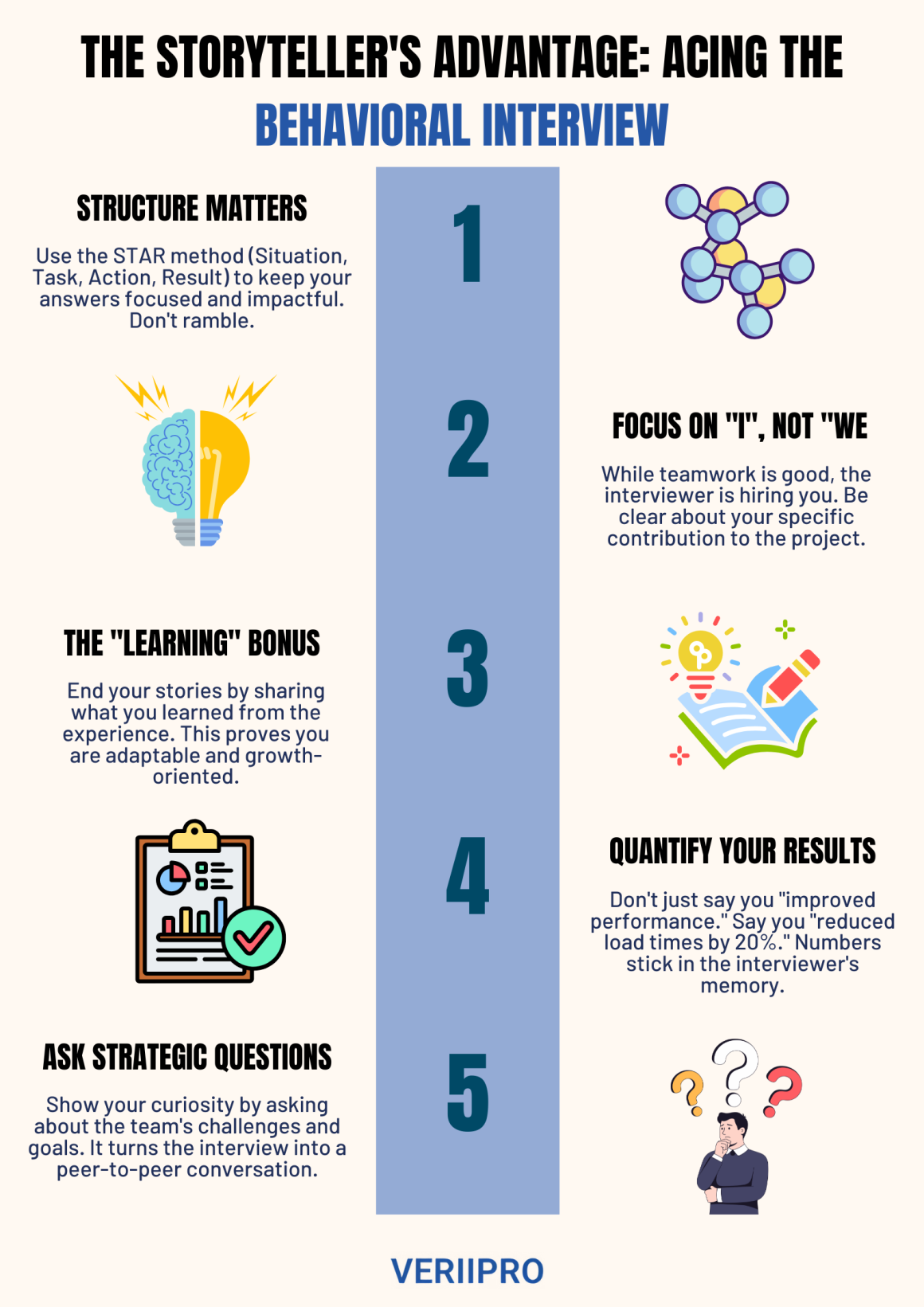
The gold standard for answering these questions remains the STAR Method (Situation, Task, Action, Result). But in 2026, you need to upgrade the “R” (Result) to focus on business impact, not just technical output.
- Situation: Briefly set the scene. “We were missing our Q3 deployment deadline.”
- Task: Define your specific responsibility. “I needed to debug the legacy payment API.”
- Action: This is the meat of the story. Don’t say “We fixed it.” Say “I led a code review, identified the bottleneck in the SQL query, and refactored the schema.” Use “I,” not “We.”
- Result: This is where most people fail. Don’t just say “It worked.” Say “This reduced latency by 30% and saved the client account.”
The “Upgrade” is adding a silent “L” for Learning. “From this, I learned the importance of early load testing.” This shows you are coachable and self-aware.
The “Culture Add” vs. “Culture Fit”
For years, companies hired for “Culture Fit,” basically, “Do I want to have a beer with this person?” This often led to bias and homogeneous teams.
Now, smart companies hire for “Culture Add.” They are looking for people who bring something new to the table. During the interview, don’t try to blend in perfectly. Highlight your unique perspective. If you are a developer with a background in sales, talk about how that helps you empathize with customers. Your difference is your strength.
You Are Interviewing Them, Too
Finally, the biggest power move you can make is asking high-quality questions.
When the interviewer says, “Do you have any questions for us?”, saying “No” is a missed opportunity. It signals a lack of curiosity.
Instead, ask questions that show you are thinking strategically:
- “How does the engineering team balance technical debt with new feature development?”
- “What is the biggest challenge the team is facing in the next six months?”
This shifts the dynamic from an interrogation to a conversation between peers. It shows you care about where you are going, not just that you need a job.
Looking for your next career move?
VeriiPro is here to help! We know that a resume gets you noticed, but the interview gets you hired. VeriiPro connects talented professionals with top US employers who value communication, leadership, and authentic storytelling. Let us help you find a role where your personality and your skills are equally valued.