


Stop Reciting, Start Engaging: Storytelling Techniques for Technical Interviews
The scene is familiar. You are sitting in a technical interview (likely via a Zoom window), and the interviewer asks the dreaded question: “Tell me about a time you handled a difficult technical challenge.” You clear your throat and begin to list facts. You mention the language you used, the specific bug you found, and the fact that you fixed it. It is accurate and factual, and unfortunately, it is incredibly boring.
In 2026, technical proficiency is often viewed as the baseline. With the rise of advanced coding assistants and automated deployment pipelines, companies aren’t just looking for someone who can write syntax. They are looking for someone who can communicate the “why” behind the “how.” They want a teammate, not a human compiler. To stand out, you need to stop reciting your resume and start telling a story.
Why the Brain Craves a Narrative
There is a neurological reason why storytelling works better than a list of bullet points. When we hear facts, only the language processing parts of our brain activate. But when we hear a story, our entire brain lights up, including the areas we would use if we were actually experiencing the events. This phenomenon, known as neural coupling, allows the interviewer to “walk” you through the problem.
When an interviewer is emotionally and mentally invested in your narrative, they are much more likely to remember you at the end of a long day of back-to-back calls.
The “Advanced STAR” Method: Adding the Human Element
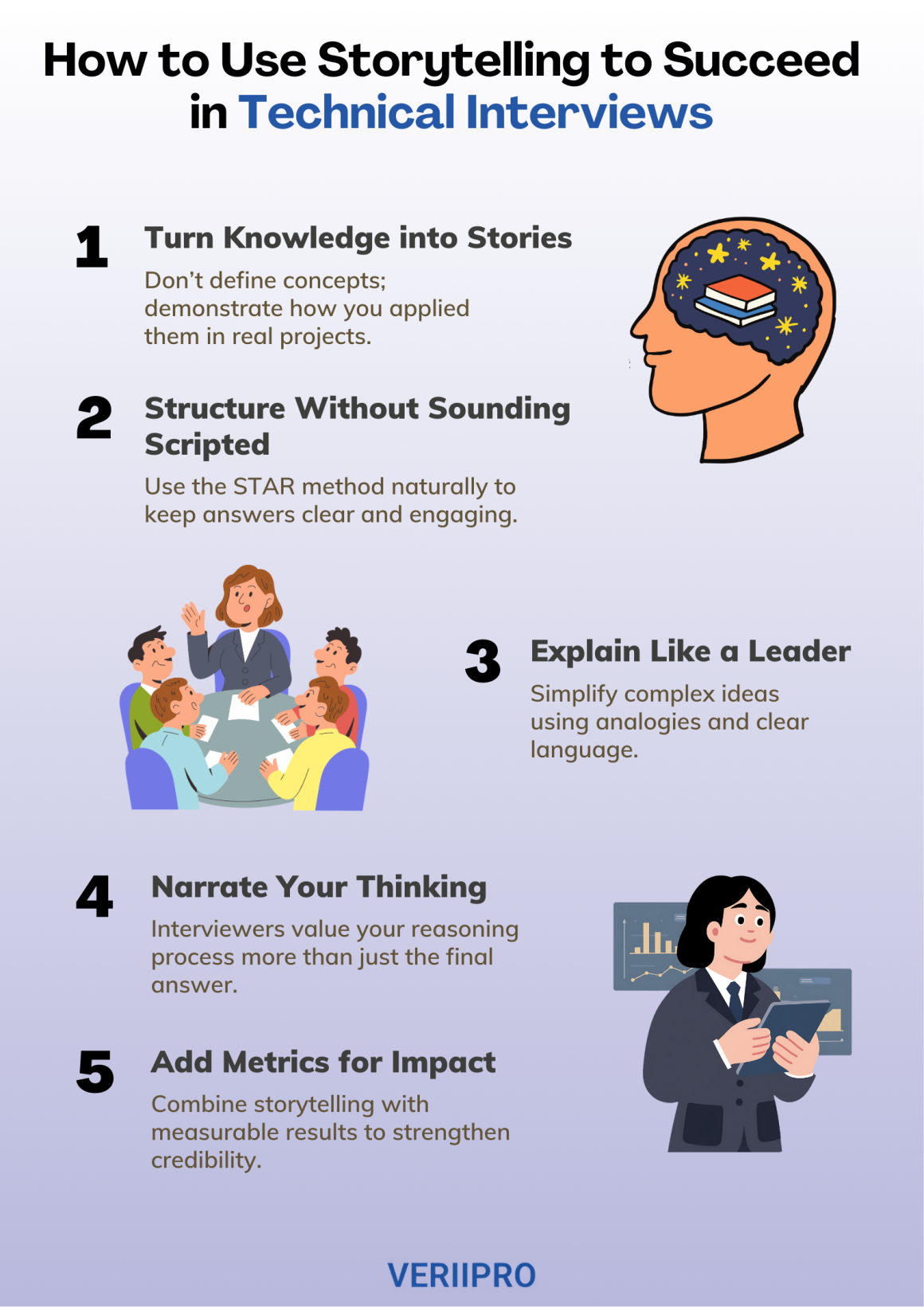
Most job seekers are familiar with the STAR method (Situation, Task, Action, Result). While it is a great structural foundation, it often leads to a dry, clinical delivery. To turn a STAR response into an engaging story, you need to focus on three specific “human” upgrades.
1. Set the Stakes (The “Why” Matters) In the “Situation” phase, don’t just describe the environment. Describe the tension. Was the company losing $10,000 an hour because of a database lag? Was the team’s morale at an all-time low because of a looming deadline? By establishing what was at risk, you give the interviewer a reason to care about the outcome. According to research on workplace communication from Forbes, establishing a clear “conflict” is the most effective way to maintain an audience’s attention.
2. Embrace the “Messy Middle.” This is where most technical candidates fail. They want to appear perfect, so they skip straight from the problem to the solution. But the best stories live in the struggle. Talk about the first solution you tried that didn’t work. Mention the moment you realized you had underestimated the complexity of the migration. Showing how you pivot when things go wrong demonstrates a level of senior-level maturity that a list of successes simply cannot match.
3. Connect the Result to the Big Picture. When you reach the “Result” phase, move beyond the code. Yes, mention that you reduced latency by 30%, but don’t stop there. Explain what that meant for the user. Did it lead to a higher retention rate? Did it allow the sales team to demo the product more effectively? Showing that you understand the business impact of your technical work proves you are a strategic thinker, not just a tactical one.
The Role of “Technical Empathy”
One of the most overlooked storytelling techniques is “Technical Empathy.” This involves tailoring the level of technical detail to your specific audience. If you are speaking to a CTO, you can dive deep into the nuances of Kubernetes orchestration. If you are speaking to a non-technical Product Manager, you should focus on the trade-offs and the user experience.
The ability to translate complex concepts into relatable metaphors is a hallmark of a high-level lead. As highlighted by Indeed’s career guide on communication skills, being able to adapt your story to your listener is a key indicator of leadership potential.
Practice Makes Permanent
Storytelling is a muscle, and like any muscle, it requires consistent training. Don’t wait until the high-stakes interview to try out your narrative. Start by writing down three “anchor stories” from your career. These should be versatile examples that you can adapt to different questions, such as a story of failure, a story of leadership, and a story of a technical win.
Record yourself telling these stories. Listen for “fillers” and notice where the energy in your voice drops. Your goal is to sound like a human talking to a peer, not a student taking an oral exam.
Looking Forward
The technical interview landscape is more competitive than ever. While your skills get you in the door, your stories are what get you the offer. By focusing on the stakes, the pivots, and the broader impact, you transform yourself from a candidate into a memorable professional.
Looking for opportunities in the tech industry? VeriiPro is here to help! Whether you are preparing for your first junior role or a senior leadership position, VeriiPro has the resources and experience to help you land your dream job. We provide personalized career coaching and access to a massive network of hiring managers, helping you refine your storytelling so you can shine in every interview.s the job.