

If you’ve spent years in engineering and are eyeing a leadership role, the title of chief engineer is likely on your radar. It’s one of the most senior positions in any engineering-driven organization and one of the most rewarding. This guide breaks down exactly what a chief engineer does, what it pays, what qualifications you need, and how to get there step by step.
What is a Chief Engineer?
A chief engineer is a senior technical and managerial leader responsible for overseeing engineering operations, guiding teams, and ensuring projects are delivered on time, within budget, and up to standard. The role sits at the intersection of deep technical knowledge and organizational leadership making it both challenging and well-compensated.
What Does a Chief Engineer Do?
The day-to-day varies by industry, but most chief engineers share a core set of functions. Here is a breakdown:
Leadership
- Directing and mentoring engineering teams across multiple projects
- Setting technical standards and holding teams accountable to them
- Acting as the bridge between engineers and executive leadership
Project Management
- Planning, scheduling, and coordinating resources across concurrent projects
- Tracking project progress and adjusting timelines or priorities as needed
- Managing vendor and contractor relationships
Technical Guidance
- Providing expert input on complex engineering problems
- Reviewing designs, specifications, and technical documentation
- Supporting junior engineers with knowledge transfer and problem-solving
Compliance and Quality
- Ensuring all work meets industry regulations and safety standards
- Implementing quality control systems to monitor project performance
- Identifying and mitigating technical and operational risks
Chief Engineer Roles & Responsibilities
While the scope varies by company size and sector, these responsibilities appear in nearly every chief engineer job description:
- Lead and develop engineering teams
- Manage multiple projects simultaneously from planning to delivery
- Ensure compliance with laws, codes, and industry regulations
- Collaborate with stakeholders across departments and at executive level
- Oversee budget planning, resource allocation, and cost control
- Drive continuous improvement in engineering processes and practices
Chief Engineer Salary
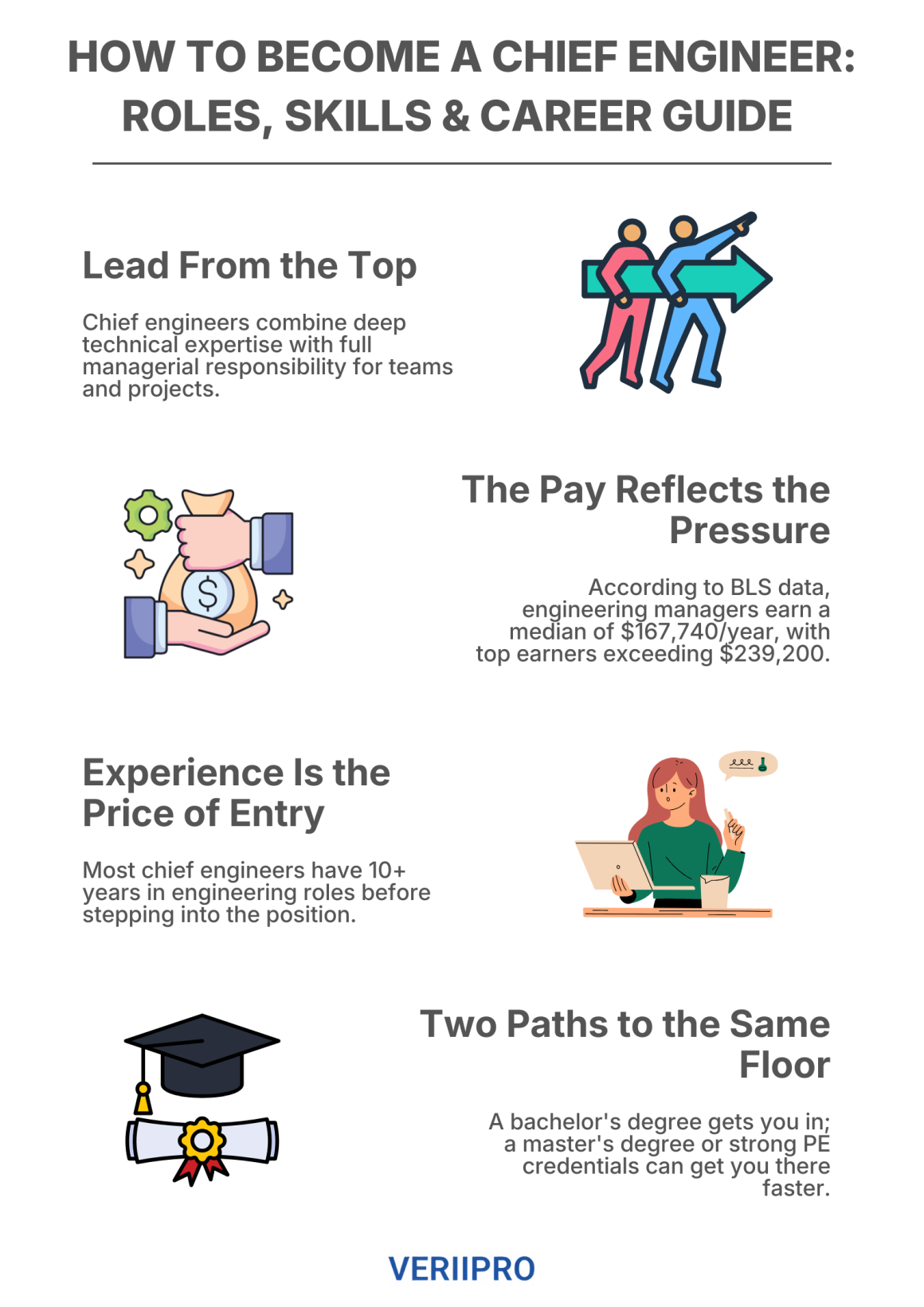
Salary ranges widely depending on the industry, company size, and how broadly the role is defined. According to the BLS Occupational Outlook Handbook, the median annual wage for architectural and engineering managers was $167,740 in May 2024, with the top 10 percent earning above $239,200. Across salary platforms, estimates for chief engineer roles in 2026 range from around $93,000 to $115,000 at the lower end (Indeed, ZipRecruiter, PayScale) to $168,000 to $296,000+ at senior and managerial levels (Salary.com, Glassdoor).
Several factors drive where you land in that range:
- Experience: More years in senior engineering roles = higher comp
- Industry: Aerospace, defense, and energy typically pay more than construction or manufacturing
- Location: California, Texas, and the Northeast consistently pay above the national average
- Company size: Larger organizations with complex projects pay premiums for leadership
How to Become a Chief Engineer (Step-by-Step)
There is no single path, but most chief engineers follow a similar progression:
Step 1: Earn a Degree
A bachelor’s degree in an engineering discipline (mechanical, civil, electrical, industrial, or similar) is the baseline requirement. Many employers prefer candidates with a master’s degree, especially for senior leadership tracks. That said, demonstrated experience can sometimes substitute more on that in the FAQs below.
Step 2: Gain Relevant Experience
You cannot skip this step. Most chief engineers have 10 or more years of hands-on engineering experience behind them. Start in a junior or mid-level role, work on real projects, and progressively take on more responsibility. Exposure to different project types and industries strengthens your profile significantly.
Step 3: Build Technical Expertise
Go deep in your discipline. Chief engineers are expected to be the person in the room who understands the technical details better than anyone else. Pursue specialized training, stay current with tools and standards in your field, and build a track record of solving difficult technical problems.
Step 4: Develop Leadership Skills
Technical expertise alone will not get you to chief engineer. You need to demonstrate that you can manage people, run projects, communicate with non-technical stakeholders, and make decisions under pressure. Volunteer for leadership roles early lead smaller projects, mentor junior engineers, and push yourself into cross-functional work.
Step 5: Get Certifications (Optional but Helpful)
Certifications are not always required, but they can sharpen your competitiveness. A Professional Engineer (PE) license is relevant in civil and structural fields. PMP certification is useful if project management is central to the role. Industry-specific credentials (in energy, aerospace, or manufacturing) can also give you an edge.
Qualifications & Requirements for a Chief Engineer Position
Here is what most employers are actually looking for:
Education A bachelor’s degree in engineering is the minimum. Many organizations prefer a master’s degree or higher, particularly for roles in R&D-heavy industries or large enterprises.
Experience Typically 10+ years in engineering, with at least several years in a supervisory or senior technical role. Employers want to see that you have managed both teams and complex projects not just performed technical work.
Certifications and Licensing A PE license may be required in civil, structural, and some government-sector roles. Project management credentials like PMP are a plus. Specific industries may require additional safety or compliance certifications.
Skills Required to Become a Chief Engineer
Technical Skills
- Engineering design, analysis, and problem-solving in your discipline
- Familiarity with CAD software, simulation tools, and industry standards
- Understanding of regulatory frameworks and compliance requirements
- Knowledge of budgeting and cost-engineering principles
Leadership Skills
- Team management and performance development
- Strategic planning and resource allocation
- Decision-making under uncertainty and pressure
- Mentoring and developing junior engineers
Communication Skills
- Presenting technical concepts clearly to non-technical audiences
- Writing clear reports, proposals, and documentation
- Collaborating effectively across departments and with executive leadership
Problem-Solving Skills
- Structured approaches to diagnosing and resolving complex technical issues
- Risk identification and mitigation planning
- Creative thinking to find solutions within constraints
Industries That Hire Chief Engineers
Chief engineers are needed anywhere engineering projects are complex and teams need experienced technical leadership:
- Construction and infrastructure
- Manufacturing and industrial production
- Information technology and software systems
- Energy (oil, gas, renewables, utilities)
- Aerospace and defense
- Automotive
- Marine and shipbuilding
Where Do Chief Engineers Work?
The work environment depends heavily on the industry. Most chief engineers split their time across:
- Office settings for planning, reporting, stakeholder meetings, and documentation
- Production plants or manufacturing facilities overseeing operations and quality
- Project or construction sites hands-on oversight at critical project phases
Remote and hybrid arrangements are becoming more common, particularly in IT, consulting, and design-heavy roles. Field-intensive industries like construction and energy still expect significant on-site presence.
Chief Engineer vs Chief Technical Engineer
The two titles are sometimes used interchangeably, but in organizations that distinguish them, there are clear differences. A chief technical engineer is primarily focused on the technical side driving R&D, developing methodologies, and solving engineering problems at depth. A chief engineer typically has a broader mandate: managing the people, the budget, the timeline, and the compliance side of engineering operations.
In smaller companies, both functions often sit with a single person. In larger organizations, the roles are separated. The table below summarizes the key distinctions:
| Aspect | Chief Technical Engineer | Chief Engineer |
|---|---|---|
| Focus | Technical design, R&D, and innovation | Project delivery, operations, and team management |
| Responsibilities | Leading R&D, developing technical solutions and methodologies | Overseeing engineering ops, compliance, planning, and budgets |
| Leadership | Guides technical specialists; reports to broader project leadership | Occupies senior leadership; cross-functional decision maker |
| Decision-making | Technical solutions and process improvements | Project scope, resource allocation, and overall delivery |
| In small organizations | Often combined with Chief Engineer role | Often absorbs technical leadership duties as well |
Career Path & Growth Opportunities
Chief engineer is a senior role, but it is not the ceiling. Here is how careers typically progress:
- Entry-level (0-3 years): Graduate/junior engineer, building technical foundations
- Mid-level (4-8 years): Senior or lead engineer, managing small teams or projects
- Senior-level (8-12 years): Principal engineer or engineering manager, overseeing larger scope
- Chief Engineer (10+ years): Full technical and managerial leadership of an engineering function
From chief engineer, the most common growth paths are into Director of Engineering, VP of Engineering, or Chief Technical Officer (CTO). In some industries, chief engineers transition into general management or operations leadership.
Job Outlook for Chief Engineers
The overall outlook is strong. According to the BLS Occupational Outlook Handbook, employment of architectural and engineering managers is projected to grow 4 percent from 2024 to 2034, with approximately 14,500 openings per year on average. Broader BLS engineering employment projections show industrial engineers growing at 11 percent and mechanical engineers at 9 percent over the same period disciplines that commonly produce chief engineer candidates.
Demand is especially strong in energy transition projects, infrastructure, advanced manufacturing, and defense. The combination of technical leadership and project management experience that a chief engineer brings is one of the harder profiles to replace which keeps the role both stable and well-compensated.
Find High-paying Chief Engineer Jobs with VeriiPro
Ready to take the next step? Chief engineer positions are posted across industries daily, but the best roles the ones that actually match your experience and salary expectations can be hard to find through generic job boards.
VeriiPro is a verified platform built for skilled engineering and IT professionals. It gives you access to exclusive job listings that you will not find elsewhere, along with a network of industry experts who can help you position yourself for senior roles.
Join VeriiPro today and start connecting with employers who are actively hiring chief engineers right now.