


Every organization runs on managers, yet most people become one without ever being taught how to do it. You get promoted for being great at your individual job, then handed a team and told to figure out the rest. That gap is exactly why understanding manager skills matters so much right now. Modern management goes well beyond assigning tasks and tracking deadlines. It requires real leadership skills, sharp communication, emotional intelligence, and the strategic thinking to see past this week’s fire drills. This guide breaks down the skills every manager should have, from the technical to the deeply human, along with practical ways to build each one on the job.
What Makes a Good Manager?
There’s a real difference between being a manager and being a leader, even though the two titles often live in the same person. A manager keeps the operational engine running, tracking performance, hitting deadlines, and reporting up the chain. A leader does something less measurable but just as critical: building a team people actually want to be part of. The qualities of a good manager show up in both lanes at once. Specifically, good managers focus on:
- Managing people, not just tasks
- Achieving measurable business goals
- Building high-performing teams
- Supporting employee growth and development
- Driving organizational success
Carrying out these manager responsibilities well, without losing sight of the humans doing the work, is what separates a good manager from someone who merely holds the title.
Why Are Management Skills Important?
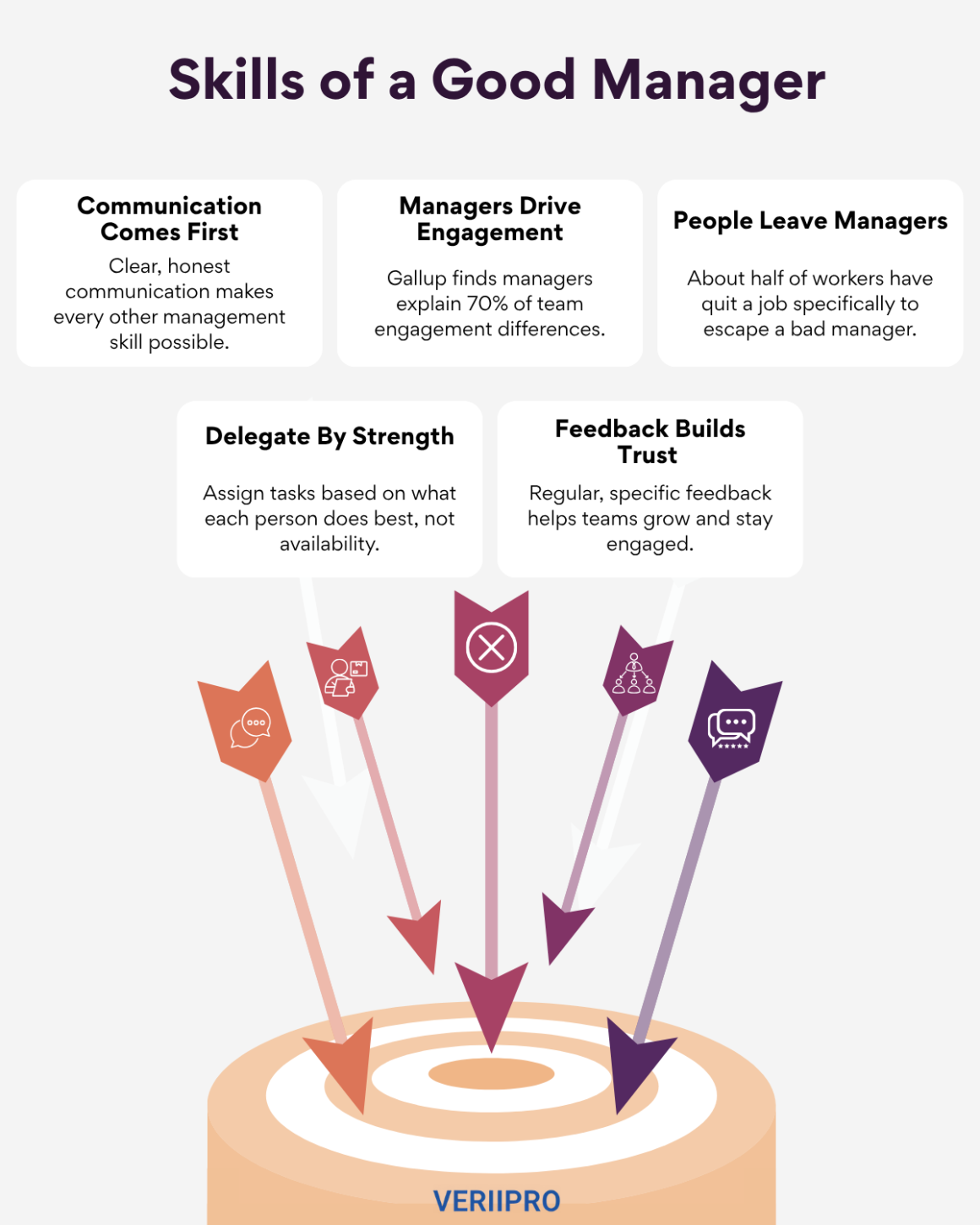
Management skills aren’t a nice-to-have reserved for the corner office. They show up directly in the numbers a business tracks every quarter. Gallup’s research has found that managers account for at least 70 percent of the variance in team engagement scores, meaning who manages a team explains more about its success than almost any other single factor. That same body of research shows that about half of Americans have left a job at some point specifically to get away from a manager, and replacing them isn’t cheap. SHRM estimates that replacing an employee can cost between 50 and 200 percent of their annual salary once recruiting, training, and lost productivity are all factored in. Strong essential management skills change that math directly, through:
- Better team productivity
- Higher employee engagement
- Faster decision-making
- Improved collaboration
- Higher employee retention
- Stronger business performance
15 Essential Skills of a Good Manager
Here are the 15 essential management skills that separate managers who just hold the title from managers people actually want to work for.
1. Leadership Skills
Leadership is the skill every other one on this list supports. It means setting a direction and getting people to follow it, not because they have to, but because they believe in where you’re headed. A manager who explains the reasoning behind a decision, not just the decision itself, builds trust fast. Try this: the next time you assign a task, spend fifteen seconds on the why before the what.
2. Communication Skills
Clear communication keeps everyone rowing in the same direction. That includes active listening, which is harder than it sounds when your inbox is on fire, and constructive feedback that tells someone what went wrong without making them feel small. A simple habit that helps: end every one-on-one by asking what you could have communicated better that week.
3. Decision-Making Skills
Good managers make informed calls using both data and the experience they’ve built up over time. The trap is waiting for perfect information that never arrives. If a project is stalled because you’re still gathering input, set yourself a deadline: decide by Friday with what you have, then adjust if new facts surface.
4. Problem-Solving Skills
Problems show up daily, from missed deadlines to interpersonal friction, and a good manager treats them as puzzles rather than emergencies. Break the issue into its actual parts before reaching for a solution. A supervisor who traces a bottleneck back to one under-staffed shift, rather than blaming the whole team, fixes the real problem instead of a symptom.
5. Delegation Skills
Delegation means matching tasks to people’s actual strengths, not just clearing your own plate. Hand the client presentation to the team member who thinks well on their feet, not whoever happens to be free. Managers who delegate well also let go of exactly how a task gets done, focusing only on the outcome.
6. Time Management
Time management for a manager isn’t about your own calendar so much as your team’s. Protecting focus time, running shorter meetings, and knowing which fires actually need your attention right now versus which can wait a day, all of that adds up to a more productive team. Block off a “no meeting” morning and watch output climb.
7. Emotional Intelligence
Emotional intelligence covers reading the room, managing your own reactions, and understanding what’s driving someone’s frustration before you respond to it. A manager who notices a normally reliable employee slipping and asks what’s going on, instead of writing them up, usually gets a more honest answer and a better outcome.
8. Conflict Resolution
Disagreements between team members are normal; letting them fester isn’t. Good managers address friction early, in private, and focus on specific behavior rather than character. Naming what happened, hearing both sides, and agreeing on a path forward keeps small disputes from turning into reasons people quit.
9. Team Building
A collaborative team doesn’t happen by accident. It comes from managers who create real chances for people to work together and get to know each other, not just forced trust falls at an offsite. Rotating who leads the weekly stand-up, for instance, gives quieter team members a reason to speak up and be seen.
10. Adaptability
Change is constant, whether it’s a reorg, a new tool, or a shift in strategy, and teams take their emotional cue from their manager’s reaction to it. Staying calm and flexible when plans shift, and explaining the reason behind the pivot, keeps a team moving instead of stalling in uncertainty.
11. Strategic Thinking
Strategic thinking means balancing this week’s fires with where the team needs to be a year from now. It’s tempting to stay purely reactive, but managers who carve out even one hour a week to think further ahead make fewer costly short-term decisions.
12. Coaching and Mentoring
Coaching is about helping people get better, not just get things done. That means regular, specific feedback and real investment in someone’s next role, not only their current one. A manager who asks a report where they want to be in two years, then builds it into actual assignments, keeps talent from looking elsewhere.
13. Accountability
Accountability starts with the manager, not the team. Owning a missed deadline instead of pointing at whoever dropped the ball builds far more trust than never admitting fault. It also means following through: if you promised a raise conversation by month’s end, have it by month’s end.
14. Critical Thinking
Critical thinking is about pressure-testing information before acting on it, especially the information that confirms what you already wanted to believe. Before greenlighting a plan, ask what would have to be true for it to fail. That single question catches more bad decisions than most people expect.
15. Negotiation Skills
Negotiation shows up more often than people realize: settling on a deadline, dividing budget between teams, or managing a vendor relationship. The goal in each case is a genuine win-win, not just getting your way. Good managers know their walk-away point before the conversation starts, so they don’t concede more than they meant to.
Technical Skills vs Soft Skills for Managers
Not every skill a manager needs involves people directly. Technical skills keep the operational side of the job running, while soft skills determine whether people actually want to work for you.
Technical Skills
- Budget management
- Project management
- Performance tracking
- Data analysis
- Business planning
Soft Skills
- Leadership
- Communication
- Empathy
- Collaboration
- Emotional intelligence
The strongest managers don’t pick one lane. They pair technical competence with the interpersonal awareness that turns a functional team into one that genuinely performs, and most job descriptions now expect both from the same hire.
How to Improve Your Management Skills
Sharpening your manager skills rarely happens through a single course or book, though both can help. Some habits that make a real difference over time:
- Seek regular feedback, and act on it
- Attend leadership training when it’s offered
- Learn from mentors who’ve solved the problems you’re facing now
- Read a management book every quarter
- Practice delegation deliberately, even when it feels faster to do it yourself
- Improve communication one conversation at a time
- Develop emotional intelligence by naming what you’re feeling before you react
- Take on leadership opportunities before you feel fully ready for them
None of this happens overnight, but consistent small effort compounds faster than most people expect.
Common Mistakes New Managers Should Avoid
Most new-manager mistakes trace back to the same root cause: trying to control too much instead of trusting the team. Watch out for:
- Micromanaging employees
- Poor communication
- Avoiding difficult conversations
- Delegating ineffectively
- Failing to provide regular feedback
- Resisting change
- Ignoring employee development
- Making decisions based on emotion rather than facts
The good news is that most of these are fixable the moment you notice them in yourself.
Careers That Require Strong Management Skills
Strong management skills open doors well beyond a formal management title. Project managers and product managers rely on them daily to keep cross-functional teams moving. So do:
- Operations Manager
- Engineering Manager
- Marketing Manager
- HR Manager
- Sales Manager
- Business Development Manager
- Customer Success Manager
Each of these roles leans on the same foundation: clear communication, sound decision-making, and the ability to get a group of people rowing in the same direction. If you’re eyeing any of them, the fifteen skills above are exactly what hiring managers will be screening for.
How Employers Evaluate Management Skills During Hiring
Recruiters rarely take management skills at face value; they ask for proof. Expect behavioral interview questions that dig into specific leadership examples rather than hypotheticals. Many hiring teams use the STAR method (Situation, Task, Action, Result) to structure your answers and keep them concrete. Be ready to talk through real team management experience, performance achievements you can point to, and at least one conflict resolution example where you handled a hard conversation well. Vague answers about leading by example rarely land. Specific stories with a clear outcome do.
Future Management Skills for 2026 and Beyond
Management is being reshaped in real time by a handful of forces. AI literacy is quickly becoming a baseline expectation rather than a bonus, since managers now need to guide teams through digital transformation instead of just reacting to it. Remote and hybrid team management is here to stay, which puts a premium on data-driven decision-making when hallway conversations aren’t there to catch problems early. Rounding out the list:
- Change management
- Cross-functional collaboration
- Diversity and inclusion leadership
Managers who treat these as optional are likely to find themselves out of step with where the workplace is heading.
Conclusion
Successful managers rarely have just one strength. They combine technical know-how, budgets, timelines, performance data, with the interpersonal skills that make people actually want to follow them. None of the fifteen skills above work in isolation; they reinforce each other, and most managers are naturally stronger in some than others. What matters most is that these are built skills, not fixed traits you either have or don’t. They come from feedback, deliberate practice, and a genuine willingness to keep learning after the title is already on the door. Start with the one skill on this list where you’re weakest, and give it real, focused attention this quarter.