
Introduction
Ask ten managers to explain the difference between accountability and responsibility, and at least eight will use the two words interchangeably. It happens all the time. Both concepts live in the same neighborhood of professional language, both sound serious, and both get invoked during performance reviews, team meetings, and post-project debriefs.
But they are not the same thing. Confusing them creates real problems: unclear role expectations, blame-shifting when things go wrong, and leaders who hand off work and then quietly walk away from the outcome. Getting the distinction right matters for teamwork, leadership, and career growth.
This guide breaks down the accountability definition and the responsibility definition, shows you how they compare, and walks through real-world examples so you can apply both concepts with confidence.
What is Responsibility?
Responsibility Definition
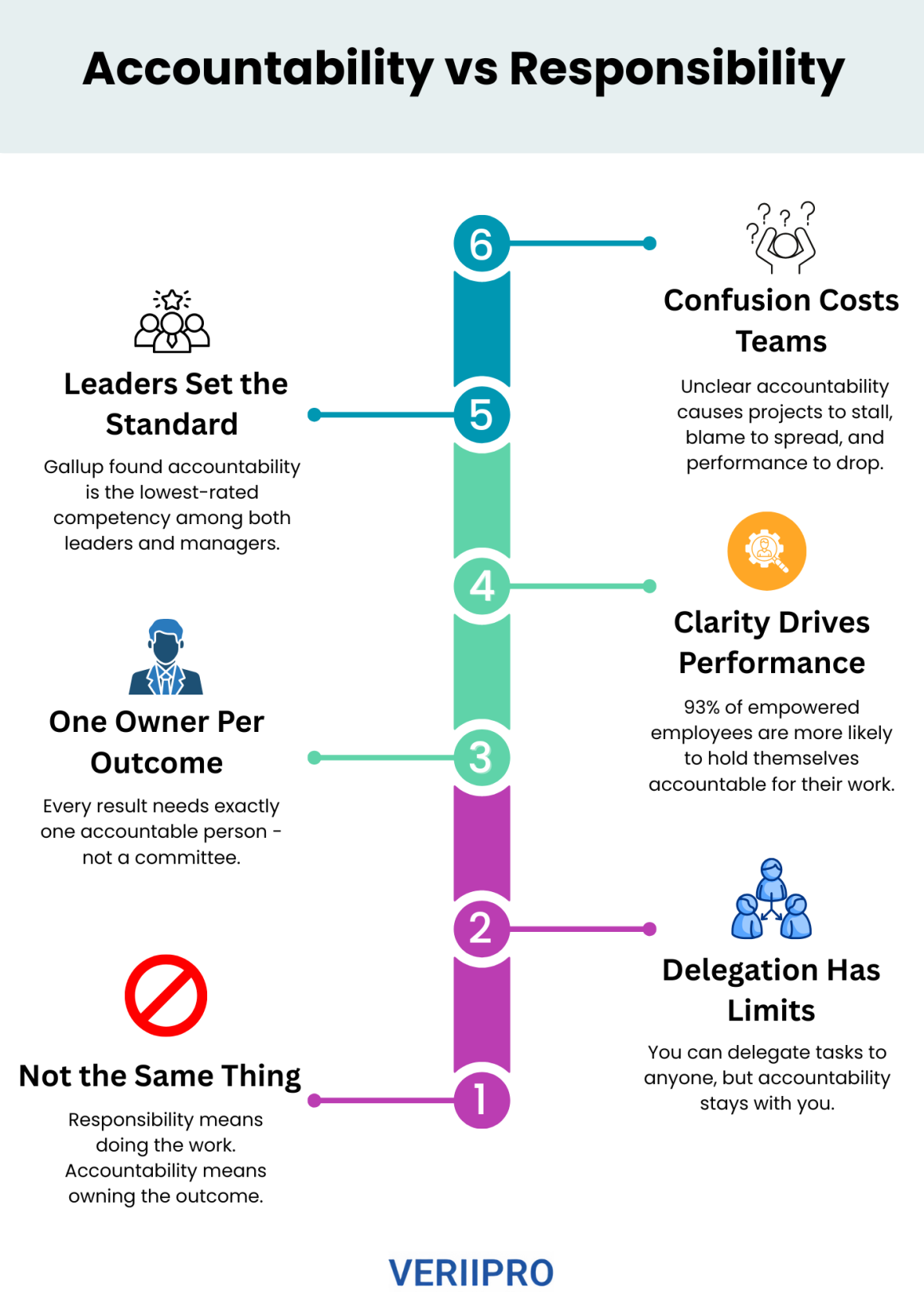
Responsibility refers to the duty to perform a specific task or fulfill a designated obligation. It is assigned, task-focused, and tied to what you are expected to do. What is responsibility, put simply? It is your job to do the work.
Characteristics of Responsibility
- Can be delegated – a manager can hand off a task to a team member
- Task-oriented – it centers on actions, not outcomes
- Shared – multiple people on the same team can all be responsible
- Defined by role – it typically comes from a job description or project assignment
Examples of Responsibility
- A developer writing code for a new product feature
- A customer service rep managing incoming inquiries
- A marketing coordinator scheduling social media posts
- A project coordinator tracking milestones on a timeline
What is Accountability?
Accountability Definition
Accountability is the obligation to own the outcome – good or bad. Where responsibility is about doing, what is accountability really comes down to: answering for the result. The accountability meaning is not just that you showed up and completed tasks. It means you are the person who cannot hand the final answer to someone else.
Characteristics of Accountability
- Cannot be fully delegated – you can share tasks, but you cannot offload ultimate ownership
- Outcome-oriented – it centers on results and consequences
- Usually rests with one individual – even if a team is involved
- Requires transparency – owning success and failure equally
Examples of Accountability
- A marketing manager accountable for campaign ROI
- A sales director accountable for hitting quarterly revenue targets
- A team lead accountable for team performance and morale
- A CFO accountable for the accuracy of financial reporting
Accountability vs Responsibility: Key Differences
Comparison Table
| Factor | Responsibility | Accountability |
|---|---|---|
| Meaning | Duty to perform a specific task | Ownership of the outcome or result |
| Delegation | Can be delegated to others | Cannot be fully delegated |
| Focus | Tasks and activities | Results and consequences |
| Ownership | Multiple people may share it | Usually rests with one person |
| Measurement | Task completion | Goal achievement |
| Reporting | Assigned work done | Final answerability |
Quick Summary
Responsible = doing the work. Accountable = owning what happens because of it.
Think of it this way. If a software team ships a product with a major bug, each developer was responsible for their section of code. But the engineering lead is accountable for the release. That distinction – between who does and who owns – is the heart of the difference between accountability and responsibility.
Why Accountability and Responsibility Are Often Confused
In everyday workplace conversation, both words get used to mean “someone has to handle this.” Organizations routinely blur the two, especially in cultures where hierarchy is flat or where job roles overlap. When everyone is “responsible,” no one ends up truly accountable.
A lack of clarity around roles is also a performance risk. According to a Partners in Leadership study, 85% of employees surveyed said they were not sure what their organization is trying to achieve – a direct byproduct of fuzzy accountability structures. The fix starts with understanding which word you actually mean.
Real-World Examples of Accountability vs Responsibility
Example 1: Marketing Campaign
Responsible: The content writer creates copy. The designer builds ads. The media buyer manages placements.
Accountable: The marketing manager owns the campaign ROI. If the campaign misses its targets, the team may have done their jobs – but the manager answers for the result.
Example 2: Software Development Project
Responsible: Developers write and test code. QA runs functionality checks.
Accountable: The project manager is accountable for on-time delivery and overall quality, regardless of which developer wrote which module.
Example 3: Customer Service Team
Responsible: Agents handle tickets, resolve complaints, and update records.
Accountable: The team supervisor is accountable for customer satisfaction scores and resolution times. If the metrics slip, the supervisor owns that conversation.
Example 4: Hospital Operations
Responsible: Nurses administer treatment, monitor vitals, and update patient charts.
Accountable: The department head is accountable for patient care outcomes. The distinction protects both patients and staff by making clear who makes final calls.
Accountability vs Responsibility in Leadership
Why Leaders Must Be Accountable
Leadership without accountability is just title-holding. Gallup research identifies creating accountability as the lowest-rated competency among leaders and managers alike – meaning most organizations know this is a gap and still struggle to close it. Strong leaders set the tone by owning outcomes, not just assigning work.
Delegating Responsibility Without Losing Accountability
This is where a lot of managers get tripped up. You can delegate responsibility – hand off a task, assign a project, give someone ownership of a deliverable. What you cannot do is delegate away your own accountability. If your team misses a goal, the leader answers for it. That does not mean blame rolls upward on everything, but it does mean the buck stops somewhere specific.
Building a Culture of Ownership
Organizations with strong accountability cultures consistently outperform their peers on productivity, engagement, and profitability. When people know who owns what, things actually get done. When accountability is vague, projects stall and finger-pointing fills the gap.
Common Leadership Mistakes
- Assigning tasks without defining who is accountable for the end result
- Treating accountability as punishment rather than standard practice
- Avoiding the accountability conversation when results fall short
- Confusing being busy (responsible for many tasks) with being accountable for actual outcomes
Accountability vs Responsibility in Project Management
Importance of Role Clarity
Projects fail when everyone thinks someone else is handling the hard part. Clear role definition – who is responsible for what, and who is accountable for the outcome – is the difference between a functional project plan and a shared calendar that nobody trusts.
Using Accountability Matrices
A RACI matrix (Responsible, Accountable, Consulted, Informed) is one of the most effective tools for separating accountable vs responsible roles on a project. Each task has one accountable owner. Multiple people can be responsible. The matrix makes the structure visible, which eliminates most of the confusion before it starts.
Avoiding Role Confusion
When you define accountable roles explicitly at project kickoff, you cut down on mid-project disputes about who should have caught a problem or who gets to make a final call. Less ambiguity means faster decisions.
Improving Team Performance Through Clear Ownership
Teams that understand who owns what work more efficiently. Clear ownership reduces rework, shortens approval cycles, and creates natural feedback loops. When something goes wrong, fixing it is faster because you know exactly who to loop in.
Accountability vs Responsibility in the Workplace
Employee Perspective
For individual contributors, responsibility is the day-to-day work – the tasks, deadlines, and deliverables in your job description. Accountability kicks in when you have ownership of an outcome and need to answer for it, even if others helped. Being accountable vs responsible is not just a senior role distinction. Individual contributors can be accountable for specific results too.
Manager Perspective
Managers live at the intersection. They delegate responsibility constantly – that is the job. But they hold accountability for team output, performance, and morale. A manager who deflects to “the team dropped the ball” has confused their role. The team was responsible. The manager is accountable.
Team Perspective
High-performing teams tend to have shared responsibility and distributed accountability. Everyone carries tasks, and specific individuals own outcomes. That clarity prevents duplication, reduces conflict, and makes collaboration smoother.
Organizational Perspective
At the organizational level, accountability versus responsibility determines how decisions get made, how errors get addressed, and how culture forms. Companies where accountability is modeled at the top – by executives who own results and don’t scapegoat teams – build cultures where honesty and ownership are normal, not exceptional.
Benefits of Accountability in the Workplace
Better Performance
When people know they will answer for outcomes, performance improves. Research shows that 93% of employees who feel empowered are also more likely to be accountable for their work – a feedback loop where clear ownership drives better results.
Improved Productivity
Accountability cuts through ambiguity. When expectations are clear and someone owns each outcome, less time gets spent in limbo waiting for decisions or chasing down who is handling what.
Increased Trust
Trust follows accountability. Teams where leaders own both wins and losses – not just the wins – build stronger internal credibility. People are more likely to speak up, flag problems early, and collaborate honestly.
Stronger Decision-Making
Accountable organizations make decisions faster. When it is clear who owns a decision, it gets made. When ownership is fuzzy, decisions stall in committee.
Enhanced Employee Engagement
Engagement drops sharply when accountability is unclear or selectively applied. Employees who feel that effort is recognized and that outcomes are tied to real ownership tend to stay more engaged and committed.
Better Goal Achievement
Goals need owners. When accountability is built into goal-setting – not just as a feel-good principle but as a structural practice – organizations hit their targets more consistently.
Benefits of Responsibility in the Workplace
Clear Role Expectations
Defined responsibilities remove guesswork. When people know exactly what they are expected to do, they can focus on executing well instead of navigating ambiguity.
Efficient Task Management
Responsibility structures help managers allocate work logically – matching tasks to skills, distributing load fairly, and preventing both overlap and gaps.
Improved Collaboration
When everyone knows their lane, collaboration gets easier. Handoffs are cleaner, dependencies are understood, and teams can coordinate without constant check-ins on who is handling what.
Better Resource Allocation
Clearly assigned responsibilities help organizations deploy people and resources more efficiently, avoiding the waste that comes from duplicated effort or unclear ownership.
Increased Operational Efficiency
At scale, well-defined responsibilities reduce operational noise. Less time in clarification meetings, fewer dropped tasks, and smoother processes across departments.
How to Build Accountability at Work
Set Clear Expectations
Accountability starts with specificity. Vague direction produces vague ownership. Be explicit about what success looks like, by when, and who answers for it.
Define Success Metrics
What gets measured gets owned. When outcomes are tied to clear metrics, accountability has a concrete anchor – not just a feeling or an intention.
Encourage Ownership
Create conditions where taking ownership is rewarded, not punished. When people know that accountability leads to recognition – not just blame – they lean into it.
Provide Regular Feedback
Accountability is a practice, not a policy. Regular feedback keeps people calibrated on whether they are on track and gives them the information needed to course-correct before things go sideways.
Lead by Example
Nothing undermines accountability culture faster than leadership that avoids it. When leaders own their outcomes – including the uncomfortable ones – it signals that accountability is a shared standard, not a downward-facing expectation.
Recognize Results
Acknowledge when accountability leads to wins. Recognizing the people who followed through, owned tough problems, and delivered results reinforces the behavior you want to see more of.
How to Demonstrate Accountability During Job Interviews
What Recruiters Look For
Interviewers want to see that you can own outcomes, not just describe tasks. The difference between a mediocre and strong answer often comes down to whether you use the language of ownership: “I was accountable for…” versus “my team did…”
Sample Interview Answers
Weak: “We had a project that ran over deadline.”
Strong: “I was accountable for a product launch that ran two weeks late. I identified the bottlenecks, communicated the revised timeline to stakeholders, and built a process change to prevent the same issue in the future.”
STAR Method Examples
The STAR method (Situation, Task, Action, Result) naturally builds accountability into your answer structure. The Result step is where accountability lives – not just what happened, but what you owned about it and what you did next.
Accountability vs Responsibility in a RACI Matrix
What Is a RACI Matrix?
A RACI matrix is a project management tool that maps every task to four role types: Responsible, Accountable, Consulted, and Informed. It is one of the clearest visual tools for separating accountability versus responsibility in a team context.
Responsible vs Accountable Roles
In RACI, Responsible refers to the person or people doing the work. Accountable is the single individual who ultimately owns the outcome – typically the decision-maker or the person who signs off. Every task should have exactly one Accountable person. Responsible can be shared.
Example RACI Chart
For a product launch: the developer is Responsible for building the feature. The product manager is Accountable for the feature meeting its goals. The design lead is Consulted. The CEO is Informed. Each role is clear, each boundary is visible, and no one is guessing.
Common Myths About Accountability and Responsibility
Accountability Means Blame
One of the most damaging misconceptions. Accountability is about ownership, not punishment. In healthy cultures, being accountable means you step forward with the answer when things go wrong – and you work on fixing it. Blame culture and accountability culture are opposites, not synonyms.
Managers Are the Only Accountable People
Not true. Individual contributors can be – and often are – accountable for specific outcomes within their domain. Accountability is not reserved for those with direct reports.
Responsibility and Accountability Are Identical
This one is the whole reason this article exists. They are not the same. Responsibility is about doing. Accountability is about owning. You can be highly responsible – completing every task assigned – without being accountable for the result. And vice versa.
Accountability Limits Teamwork
The opposite is usually true. Clear accountability enables better teamwork because roles are understood, decisions have clear owners, and credit and responsibility are distributed fairly. Ambiguity is what actually erodes collaboration.
Accountability vs Responsibility: Which Is More Important?
Neither works without the other. Responsibility without accountability is just activity – people staying busy without anyone owning whether the work actually moves the needle. Accountability without responsibility is hollow – you cannot own an outcome if nobody is actually doing the work.
High-performing teams and organizations need both. Clear task ownership (responsibility) combined with outcome ownership (accountability) creates the structure for real execution. The goal is not to rank them, but to make sure both are visible, assigned, and taken seriously.
Conclusion
Responsibility and accountability are not interchangeable – and treating them as if they are costs organizations real performance. Responsibility is the assignment: the tasks, the duties, the work that needs to get done. Accountability is the ownership: who answers for whether it worked.
Getting this distinction clear has practical value. It makes roles easier to define, decisions faster to reach, and teams easier to build. It also changes how you talk about your own work – both in the day-to-day and in high-stakes conversations like performance reviews or job interviews.
The best organizations build both into how they operate – not as jargon on a values poster, but as actual structural choices. Define who is responsible. Define who is accountable. Make sure those are not always the same person by default. That clarity alone can change how a team performs.