

The standard job interview script is deeply ingrained in our professional culture. You sit down, answer questions about your background, and try to present your best self. Then, usually with about five minutes left on the clock, the hiring manager flips the script. They ask if you have any questions for them. Average candidates treat this as a polite formality. High-performers treat it as the most critical part of the conversation.
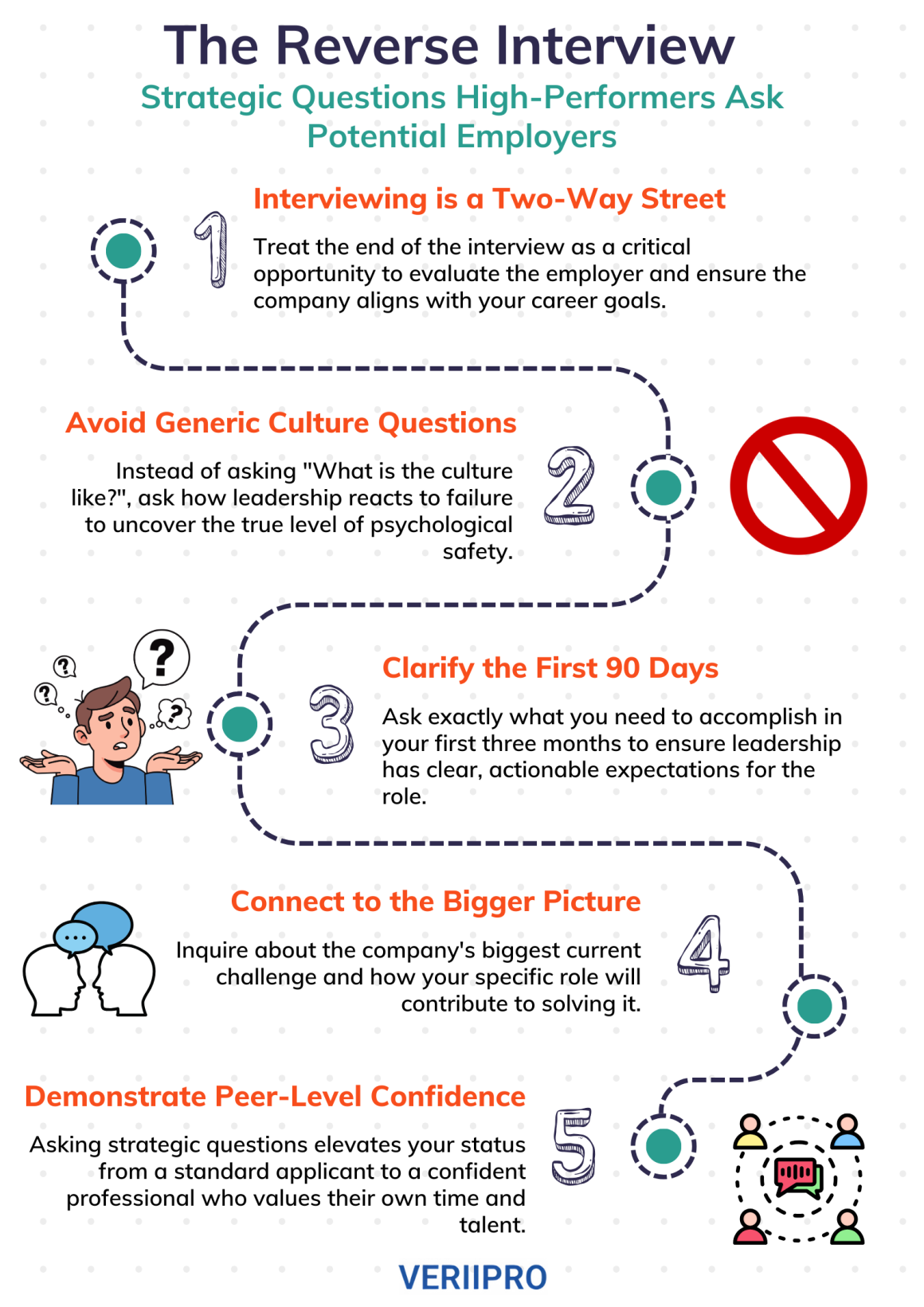
This phase of the meeting is known as the reverse interview. It is your opportunity to look under the hood of the organization and determine if it is truly a place where you can thrive. Interviewing is a two-way street, and top talent understands that an employment contract is a mutual agreement.
The Shift in Interview Dynamics
In recent years, the power dynamic in the hiring process has shifted. Candidates are prioritizing workplace culture, mental health, and long-term career alignment over a simple paycheck. According to Gallup’s research on employee engagement, workers are actively seeking environments that offer a sense of purpose and well-being. If an employer cannot provide that, top talent will simply look elsewhere.
This means you cannot afford to take a job description at face value. You must ask probing, strategic questions that reveal the reality of working at the company. The goal is not to interrogate your interviewer but to start a genuine dialogue about the company’s daily operations, challenges, and values.
Uncovering the True Company Culture
When candidates want to know about the work environment, they usually ask a very generic question: “What is the company culture like?” The problem with this question is that it invites a generic, heavily rehearsed answer. Every hiring manager will tell you that their culture is collaborative, fast-paced, and innovative.
High-performers ask behavioral questions to uncover the truth. For example, you might ask, “Can you tell me about a recent time a project failed, and how the leadership team responded?” This question is incredibly revealing. It tells you whether the company practices psychological safety, a concept highlighted by Google’s Project Aristotle as the number one predictor of team success. If the interviewer describes a culture of blame, you have just uncovered a massive red flag.
Defining Success and Expectations
Another crucial area to explore is how the company defines and measures success. Vague expectations are a recipe for burnout and frustration. You need to know exactly what you are walking into.
Instead of asking about daily responsibilities, try asking: “If you hire me, what would I need to accomplish in the first 90 days for you to consider this a successful hire?” This shows that you are results-oriented and eager to make an immediate impact. It also forces the hiring manager to articulate their expectations clearly. As noted by the Society for Human Resource Management (SHRM), clear goal-setting during the onboarding phase is critical for long-term employee retention. If the interviewer struggles to answer this question, it may indicate that the role is poorly defined.
Assessing the Company’s Trajectory
Top-tier professionals do not just want a job; they want to join a winning team. They want to know that the company is moving in the right direction and that their work will contribute to a larger goal.
To gauge the company’s strategic vision, ask: “What is the biggest challenge the organization is currently facing, and how will this specific role help solve it?” This question accomplishes two things. First, it demonstrates a high level of business acumen. Second, it helps you understand the immediate pressures you will face if you accept the position. Research published by Harvard Business Review emphasizes that employees who understand how their work connects to the company’s broader mission are significantly more engaged and productive.
The Value of the Reverse Interview
Ultimately, the reverse interview is an exercise in risk management. Changing jobs is a major life decision, and you owe it to yourself to gather as much information as possible before signing an offer letter.
When you ask intelligent, strategic questions, you also elevate your status in the eyes of the interviewer. You transition from a subordinate applicant to a confident peer. You show that you are intentional about your career and that you have high standards for the places you choose to work. Next time you find yourself at the end of an interview, remember that it is your turn to take the lead.
Looking Forward
Looking for opportunities in strategic management and career advancement? VeriiPro is here to help! As specialists in connecting top-tier talent with forward-thinking companies, VeriiPro has the resources and experience to help you land a job in your respective field. We understand exactly what hiring managers are looking for and can coach you on how to ask the right questions to secure the perfect role.