



Skills Assessment Tests: Types, Benefits and How Employers Use Them
Introduction
In today’s rapidly evolving job market, traditional hiring methods are being supplemented—and sometimes replaced—by more data-driven approaches. Skills assessment tests have become a cornerstone of modern recruitment and talent development, allowing organizations to verify a candidate’s abilities beyond what is written on a resume. As companies strive for more efficient and fair hiring processes, these tools provide a reliable way to ensure that the person hired has the actual competencies required for the role.
What Are Skills Assessment Tests?
A skills assessment test is a standardized tool designed to measure an individual’s proficiency in specific areas relevant to a job. While a resume outlines past experiences and an interview evaluates social chemistry, these tests provide an objective look at what a person can do in real-time. They differ from traditional interviews by focusing on measurable performance rather than self-reported claims, offering a clearer picture of a candidate’s actual work potential.
Why Employers Use Skills Assessment Tests
Organizations implement these tests to bring precision to their recruitment and talent evaluation strategies. Beyond just hiring, these assessments are integral to workforce development. By identifying the strengths and weaknesses of current employees, companies can better understand their internal talent pool and make more informed decisions about training or restructuring.
Key Benefits of Skills Assessment Tests
Implementing structured assessments offers several advantages to the hiring process:
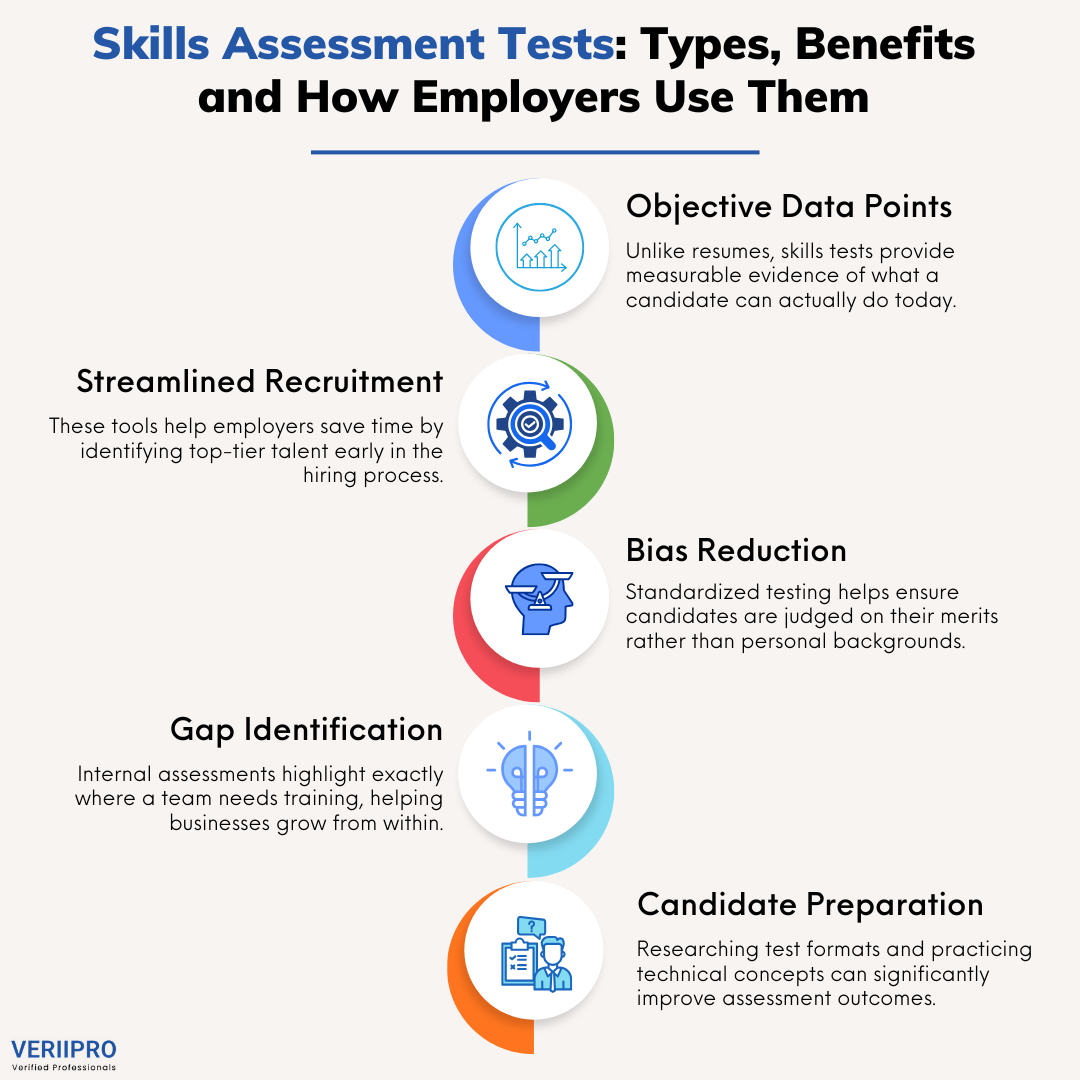
- Objective Evaluation: These tests provide an unbiased measurement of a candidate’s actual skills, moving away from subjective “gut feelings.”
- Filtering Applicants: They help hiring managers efficiently filter out under-qualified applicants early in the recruitment funnel.
- Quality of Hires: By verifying competencies beforehand, companies significantly improve the long-term quality of their hires.
- Internal Development: Assessments support the growth of existing staff by highlighting clear pathways for advancement.
- Identifying Gaps: They help managers pinpoint specific skill gaps that need to be addressed through targeted training programs.
- Reducing Bias: When structured properly, these assessments help reduce unconscious hiring bias by focusing solely on performance metrics.
Types of Skills Assessment Tests
Because different roles require different strengths, employers utilize various testing categories to measure specific competencies.
Hard Skills Assessments
These focus on the technical “know-how” required for a job:
- Technical Skills: Testing specific knowledge like coding, engineering principles, or accounting standards.
- Software Proficiency: Evaluating how well a candidate can navigate tools like Excel, Creative Cloud, or CRM systems.
- Role-Specific Tasks: Measuring the ability to perform core duties, such as medical transcriptions or technical writing.
Work Sample Tests
These provide a “day in the life” look at a candidate’s performance:
- Job Simulations: Candidates perform a task that mirrors actual work they would do on the clock.
- Case Studies: Applicants are given a business problem and asked to propose a strategic solution.
- Task Replicas: Small-scale versions of daily responsibilities are used to gauge speed and accuracy.
Cognitive Ability Tests
These measure how a person thinks and processes information:
- Numerical Reasoning: The ability to work with numbers, charts, and data sets.
- Verbal Reasoning: Assessing how well a person understands and evaluates written information.
- Abstract Reasoning: Measuring logic and the ability to identify patterns.
- Game-Based Tests: Using interactive, digital environments to assess problem-solving skills.
Personality Tests
These look at how a person interacts with others and their environment:
- Behavioral Style: Understanding how a candidate typically reacts to stress or collaboration.
- Culture-Fit Inventories: Determining if a candidate’s values align with the company’s mission.
- Emotional Intelligence: Measuring empathy, self-awareness, and social skills.
Structured and Unstructured Interviews
- Structured: All candidates are asked the exact same set of standardized questions to ensure fairness.
- Unstructured: These are more conversational and fluid, allowing for a deeper personal connection.
Combination / Hybrid Approaches
- Blended Methods: Using a mix of hard skills and personality testing in one session.
- Multistage Assessments: A process where candidates must pass one level (like a cognitive test) to reach the next (a work sample).
How Employers Choose Which Assessment to Use
Selecting the right test requires a strategic approach to ensure the results are actually useful for the specific business needs.
Step 1: Define Hiring Objectives
Employers must first outline the specific roles and responsibilities the new hire will handle. This involves identifying which skills are “deal-breakers” and must be measured immediately.
Step 2: Determine Skill Types (Hard vs Soft)
Managers must decide the balance between technical requirements and behavioral competencies. For example, a developer might need a heavy focus on hard skills, while a manager might need more soft skill testing.
Step 3: Evaluate Assessment Characteristics
The chosen test must be customizable to the company’s needs. It is also critical to ensure the test has high validity and reliability, meaning it actually measures what it claims to. Budgetary time and cost factors are also considered here.
Step 4: Research the Market
Finally, companies look at various assessment vendors and industry standards. They use benchmarking tools to see how their requirements stack up against competitors.
Best Practices for Administering Skills Assessment Tests
To get the most accurate results, employers should follow these guidelines:
- Clear Communication: Candidates should know exactly what is being tested and why.
- Consistent Conditions: Every applicant should take the test under the same environmental and time constraints.
- Fairness: Tests must be audited to avoid culturally biased questions that could unfairly disadvantage certain groups.
- Multi-Method Approach: Combining different assessment types leads to a more accurate overall profile.
- Data Integration: Use the results not just for hiring, but to inform future training and development.
How Candidates Can Prepare for Skills Assessment Tests
If you are facing an assessment, preparation can significantly reduce stress and improve your score. Start by researching common test formats for your industry. You can find practice sample questions online to get a feel for the pacing. It is also helpful to review the core technical concepts mentioned in the job description. During the test, manage your time effectively and try to stay calm and focused.
For many, acing these tests is the first step toward a promotion. If you perform exceptionally well, it provides a great opening for how to ask for a raise. Using your test data as proof of your value makes asking for a raise much easier. When you understand how to ask for a raise at work, you can present your assessment scores as tangible evidence of your growth. If you are unsure of the phrasing, you might draft a salary increase request or look up how to request a salary increase to find the right professional tone. Ultimately, knowing how to negotiate a raise comes down to proving your worth—and assessments are the best way to do that. Mastering how to ask for a pay raise starts with demonstrating that your skills have reached the next level.
Examples of Skills Assessment Test Use Cases
- Technical Roles: Coding bootcamps or software engineering trials.
- Sales/Service: Simulations that test de-escalation or persuasion skills.
- Leadership: Identifying potential managers through behavioral assessments.
- Internal Promotions: Using tests to see if a junior employee is ready for a senior role.
- Onboarding: Establishing a baseline of skills to see where a new hire needs the most help.
Challenges and Limitations of Skills Assessment Tests
While useful, these tests are not perfect:
- Test Anxiety: Some highly qualified people perform poorly under the pressure of a clock.
- Over-reliance: Employers might focus too much on a score and ignore other valuable qualities like grit or passion.
- Bias Concerns: There is always a risk of cultural or language bias if tests aren’t regularly updated.
- Long-term Accuracy: A test is a snapshot; it is not always a standalone measure of long-term performance.
Frequently Asked Questions (FAQs)
What is the difference between skills assessment tests and personality tests?
Skills assessments measure your ability to perform specific tasks, while personality tests look at your character traits and how you interact with others. One measures “can do,” the other measures “how you do it.”
Are skills assessment tests mandatory for all jobs?
No, but they are becoming increasingly common in technical, financial, and administrative sectors where specific proficiencies are required.
How long do skills assessment tests usually take?
It varies widely. A simple software test might take 20 minutes, while a complex coding project or case study could take several hours or even days.
Can candidates fail these tests?
Most assessments don’t have a “pass/fail” grade in the traditional sense. Instead, employers look for a minimum threshold score that indicates the candidate is ready for the role.
How are assessment test results used in hiring decisions?
Results are usually one piece of the puzzle. They are combined with interview performance and reference checks to create a full picture of the applicant.