


Future-Proof Your Paycheck: 5 ‘Human-Only’ Skills Recruiters Want in 2026
For the last twenty years, the highest-paid skills were technical. If you knew Java, Python, or how to configure a Cisco router, you were set. But the value of just “knowing things” is crashing.
Generative AI has commoditized technical knowledge. It can write code, draft legal contracts, and diagnose medical scans faster than any human. So, if the machine can do the technical work, what is left for us?
The answer is humanity.
In 2026, the skills that command the highest premiums are the ones AI cannot replicate: the messy, emotional, intuitive, and complex traits that define our species. These “soft skills” are no longer just nice-to-haves; they are the new “hard skills.”
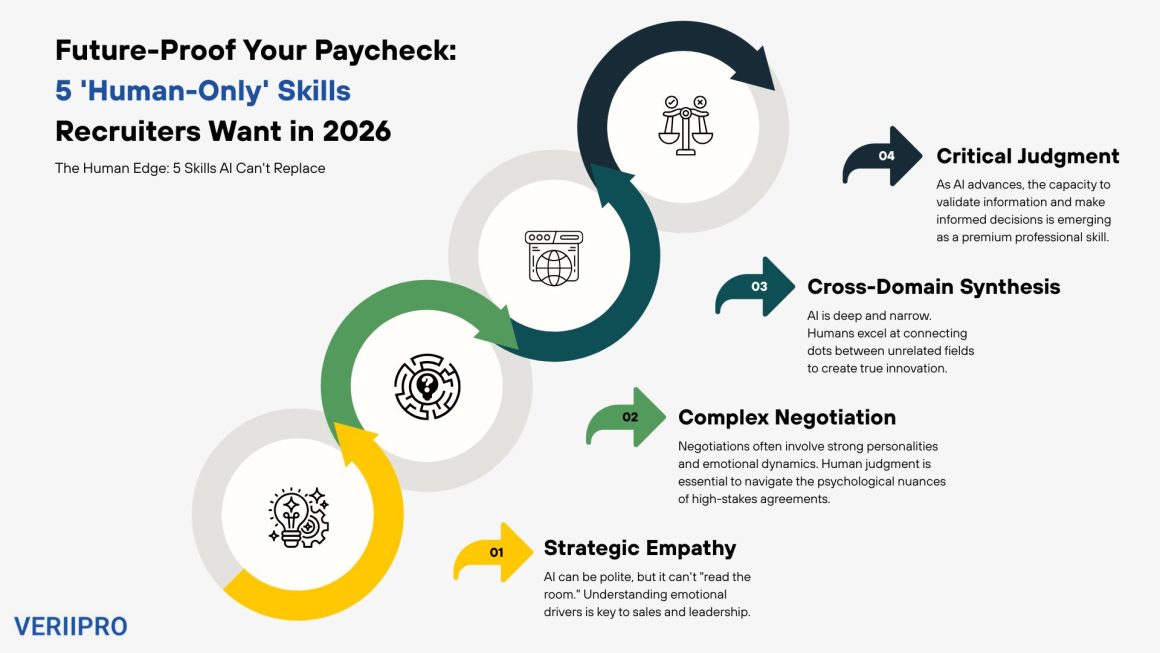
1. Strategic Empathy
We aren’t talking about just being nice. We are talking about Strategic Empathy, the ability to understand the emotional drivers of the people around you to achieve a business outcome.
AI can simulate politeness, but it cannot “read the room.” It doesn’t know that the client is hesitating because they are afraid of losing their job, not because the price is too high. A human who can detect that fear and address it is invaluable. In sales, leadership, and product management, this ability to decode human emotion is the ultimate competitive advantage.
2. Complex Negotiation
Negotiation is an art, not a science. It involves irrationality, ego, and subtle power dynamics.
An AI can calculate the optimal mathematical split of a deal, but it cannot navigate the fragile ego of a CEO who wants to feel like they “won.” It cannot sense when to push and when to pause during a heated union discussion.
Recruiters are looking for people who can bring disparate parties to an agreement in high-stakes environments. This requires a mix of intuition, timing, and psychological insight that algorithms simply don’t possess.
3. Cross-Domain Synthesis
AI is fantastic at deep, narrow tasks. It can tell you everything about biology or everything about computer science. But it struggles to connect the two in novel ways.
The most innovative employees of 2026 are the Synthesizers. These are people who can take an idea from architecture and apply it to software design, or take a concept from jazz music and apply it to team management.
This “dot-connecting” capability is where true creativity lives. It’s not about generating more content (AI does that); it’s about generating new meaning by combining unrelated fields.
4. Critical Judgment
In today’s digital landscape, where AI can generate vast amounts of content in seconds, the real advantage lies in knowing how to identify what is accurate—and what is not.
Companies are drowning in data and automated reports. They need humans who can look at a perfectly formatted AI strategy and say, “This looks right, but it feels wrong because it ignores this specific cultural context.”
This is Critical Judgment. It is the ability to vet, verify, and ultimately make the call when the data is ambiguous. AI provides the options; humans make the decisions.
5. Adaptive Resilience
The only constant in the 2026 economy is speed. Tools change monthly. Strategies change weekly.
AI doesn’t have “grit.” If a model fails, it throws an error. If a human fails, they learn, pivot, and try again.
Recruiters are obsessed with Adaptability Quotient (AQ). They want candidates who don’t panic when the roadmap changes. They want people who view disruption as a challenge rather than a threat. Your ability to stay calm and productive amidst chaos is a skill that cannot be automated.
Looking for your next career move?
VeriiPro is here to help! The job market is shifting from “what you know” to “who you are.” VeriiPro connects professionals with forward-thinking companies that value emotional intelligence, leadership, and adaptability. Let us help you find a role where your unique human traits are your greatest asset.