


Collaborate or Be Automated: Strategies for a Future-Proof Career
For decades, we idealized the “quiet genius.” You know the type: the lone wolf coder hacking away in a basement, or the brilliant writer locked in a cabin, churning out masterpieces in isolation. The message was clear: if your output was high enough, you didn’t need to talk to anyone.
Artificial Intelligence has completely shattered that myth.
Today, generative AI tools can write code, draft emails, create financial models, and summarize reports faster than any human ever could. If your value to a company is defined solely by what you produce in isolation, the “widget” you make at your desk, you are in the danger zone.
The World Economic Forum’s Future of Jobs Report predicts that while administrative and routine tasks will decline, roles emphasizing social influence and collaboration will surge. The harsh reality of the AI age is simple: Collaborate or be automated. The future belongs to the connectors, the negotiators, and the people who act as the “glue” between teams.
The End of the Silo
Why is collaboration the ultimate hedge against automation? Because AI is currently very bad at understanding context, politics, and nuance. It struggles to read the room.
An AI can generate a perfect marketing plan, but it can’t walk over to the sales team, listen to their frustrations about lead quality, negotiate a compromise with the product team about feature timelines, and present a unified strategy to the CEO.
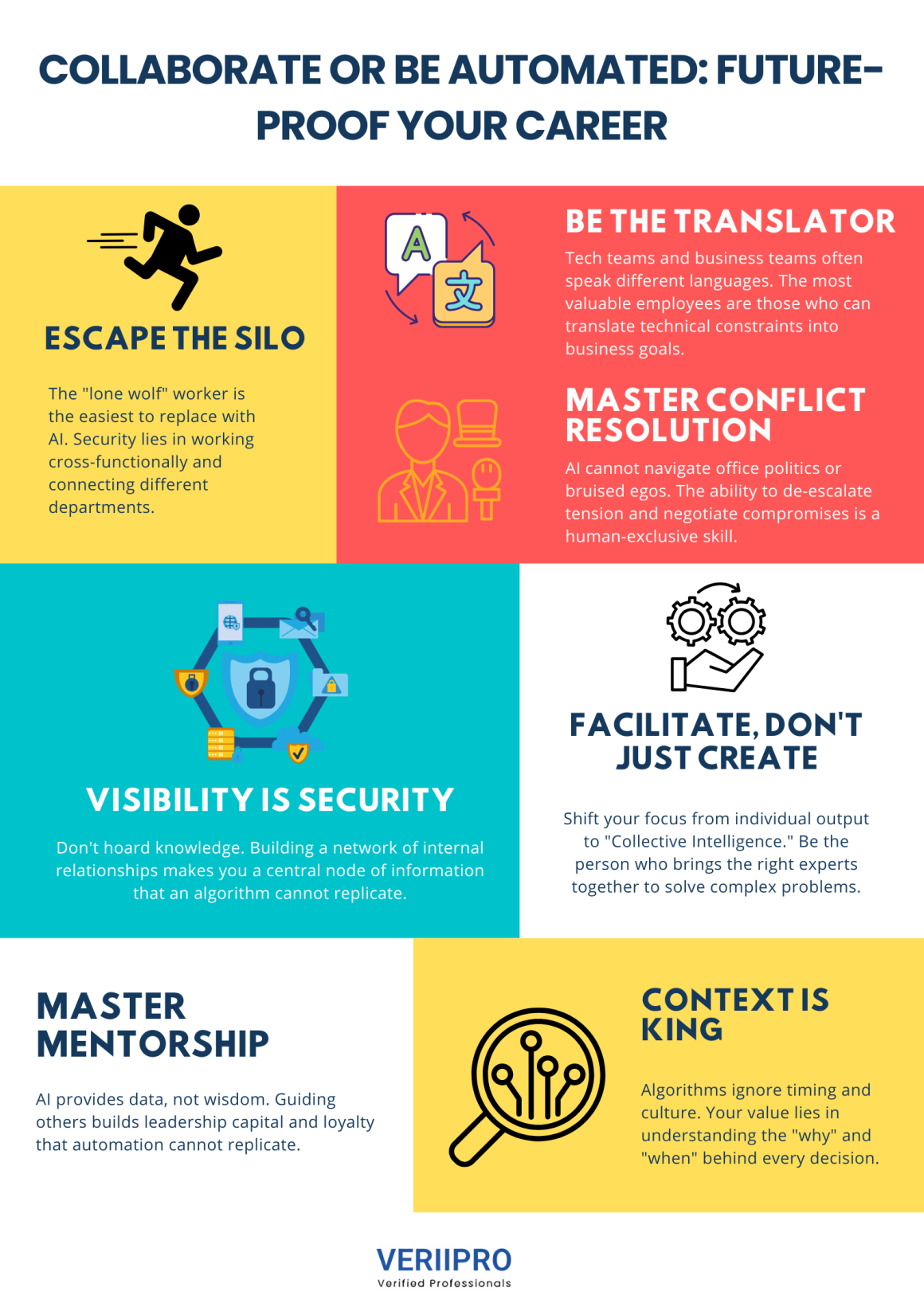
This is where the “silo” mentality dies. In the past, you could stay in your lane. Now, staying in your lane makes you replaceable. The most valuable employees are those who work cross-functionally. They’re the ones who understand how a decision in Engineering impacts Customer Support. By building a network of internal relationships, you make yourself the central node of information, a role that a chatbot simply cannot fill.
Translation Is the New Technical Skill
One of the most critical forms of collaboration is “translation.” This doesn’t mean speaking French or Spanish; it means speaking “Developer” and “Executive” fluently.
We’ve all seen projects fail because the technical team didn’t understand the business goals, or the business team didn’t understand the technical limitations. This gap is expensive. According to a study by Salesforce, 86% of employees and executives cite a lack of collaboration or ineffective communication for workplace failures.
Future-proofing your career means becoming a translator. If you’re a data scientist, don’t just send a spreadsheet. Schedule a meeting with the marketing lead to explain why the data matters for their next campaign. If you’re a project manager, don’t just track dates; help the designers understand the constraints of the developers. AI can translate languages, but it cannot translate intent.
Navigating Conflict: The Human Exclusive
Collaboration isn’t just about high-fives and brainstorming sessions; it’s mostly about conflict resolution. Whenever humans work together, there is friction. Priorities clash. Egos get bruised. Misunderstandings happen.
This is the “messy” human work that algorithms avoid.
Learning to navigate conflict to de-escalate a heated meeting, to give difficult feedback with empathy, or to negotiate a resource budget between two warring departments is a premium skill. Harvard Business Review notes that as technology automates the “hard” skills, “soft” skills like conflict resolution and communication are becoming the primary differentiators for hiring and promotion.
Building “Collective Intelligence”
There’s a concept in psychology called “Collective Intelligence.” It suggests that a group of ordinary people who collaborate well will consistently outperform a single genius who works alone.
AI is the ultimate “single genius.” It has access to all the world’s information, but it works in a vacuum. Your job is to facilitate the group.
To do this, you need to shift your mindset from “How can I solve this?” to “Who do I need to bring together to solve this?” This might mean organizing a hackathon, creating a shared Slack channel for a specific problem, or simply being the person who says, “I think Jane from Finance should be in this meeting.” By fostering an environment where others can succeed, you become the architect of the solution, not just a cog in the machine.
The Verdict: Don’t Hide, Connect
The instinct when fearing job loss is often to hoard knowledge and hide. We think, “If I’m the only one who knows how this system works, they can’t fire me.” In the age of AI, this is backward. If you’re the only one who knows how it works, an AI will eventually learn it, and you’ll be gone.
Security comes from visibility. It comes from being the person everyone wants on their project because you make the work easier, smoother, and more fun. The machines can have isolated tasks. We’ll take the teamwork.
Looking Forward
Looking to pivot into a role that values leadership and strategy? VeriiPro is here to help! As the job market shifts away from solitary tasks and toward collaborative problem-solving, finding the right cultural fit is more important than ever. VeriiPro specializes in connecting professionals with companies that value soft skills, emotional intelligence, and cross-functional leadership. Let us help you find a position where your ability to connect with people is your greatest asset.