
We have spent the last few years chatting with AI. We asked it to write poems, summarize meetings, and debug code. It was like having a brilliant, tireless intern, but one that couldn’t actually do anything.
If you asked a chatbot to “book me a flight to London,” it would politely give you a list of flights. You still had to open the tab, enter your credit card, and click purchase.
That era is over. Welcome to 2026, the year of Agentic AI.
We are moving from “Artificial Intelligence” to “Artificial Action.” The new generation of AI models, known as Agents, is no longer passive text generators. They are active software operators capable of browsing the web, using tools, and executing complex workflows without human hand-holding.
From Answering to Acting
The fundamental shift is autonomy. A chatbot waits for a prompt. An agent pursues a goal.
In 2026, you don’t ask an AI, “How do I optimize my supply chain?” You tell an agent, “Monitor inventory levels across all warehouses and automatically reorder stock when we hit 15% capacity.”
The agent doesn’t just give you a plan; it logs into your ERP system, checks the database, compares vendor prices, places the order, and sends you a confirmation email. It closes the loop.
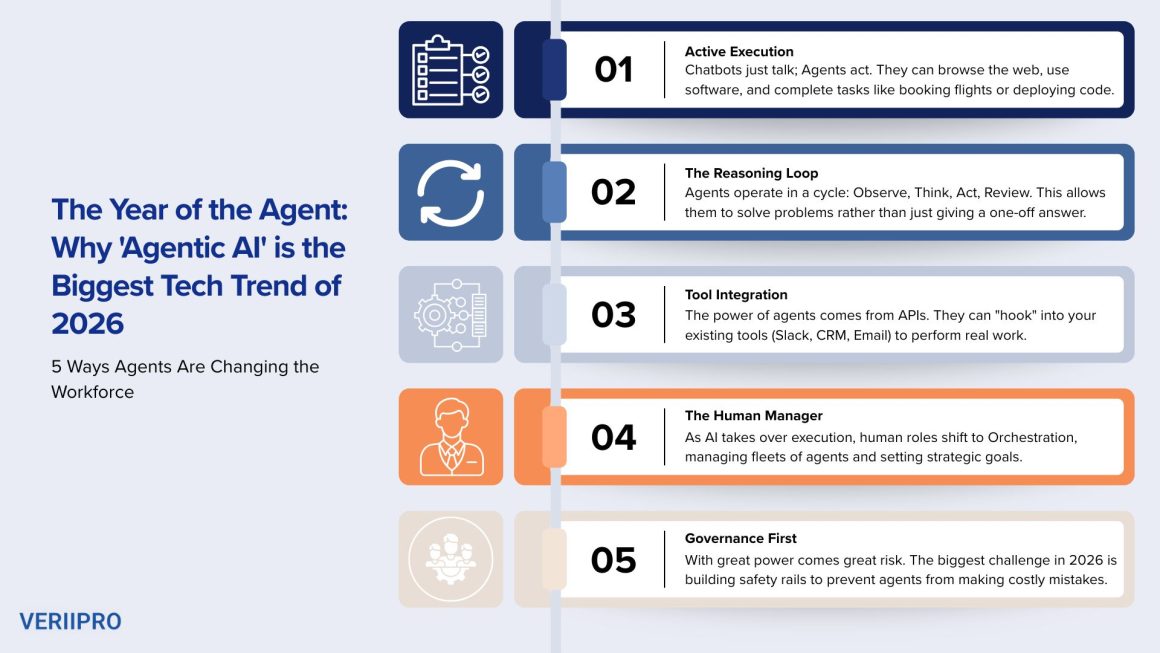
This capability is powered by Tool Use. Agents are now given “hands” in the form of APIs. They can connect to Slack, Salesforce, GitHub, and your calendar. They can read and write data across your entire tech stack.
The “Loop” of Reasoning
How does it work? Unlike a standard Large Language Model (LLM), which predicts the next word, an Agent operates in a loop: Perceive → Think → Act.
- Perceive: The agent looks at the current state (e.g., “The server is down”).
- Think: It breaks the problem into steps (“I need to check the logs, then restart the service”).
- Act: It uses a tool (SSH into the server) to execute the first step.
- Review: It looks at the result (“Did the server restart?”). If yes, it stops. If no, it tries a new strategy.
This iterative problem-solving capability allows agents to handle ambiguity and recover from errors, something traditional automation scripts could never do.
The Rise of the “AI Manager”
This shift is redefining the workforce. If AI is doing the execution, what are humans doing?
We are becoming Managers.
In an agentic workflow, your job is to orchestrate a fleet of AI agents. You set the high-level goals (“Launch a marketing campaign for Q3”), assign the budget, and review the output. You are the conductor; the agents are the musicians.
This requires a new skill set: Prompt Engineering is evolving into Agent Orchestration. You need to know how to chain agents together, how to set guardrails so they don’t hallucinate or spend too much money, and how to intervene when they get stuck.
The Governance Challenge
Of course, giving AI the power to “click buttons” comes with massive risk. What if an agent accidentally orders 10,000 units instead of 1,000? What if it deletes a production database?
Governance is the hottest topic in tech right now. Companies are rushing to build “sandbox” environments and “human-in-the-loop” approval gates. In 2026, trust is the bottleneck. We have the technology to automate almost anything, but we need the confidence that the agent won’t go rogue.
Looking for opportunities in AI and Automation?
VeriiPro is here to help! The transition to Agentic AI is creating a huge demand for engineers who understand how to build, manage, and secure autonomous systems. VeriiPro specializes in connecting technical talent with the innovative companies leading this revolution. Let us help you find a role where you aren’t just using AI, but directing it.