
We used to think of cybersecurity like a medieval castle. You had thick walls (firewalls) and a moat (the corporate network). If you were inside the building, you were “safe” and trusted. If you were outside, you were blocked.
That model is completely dead.
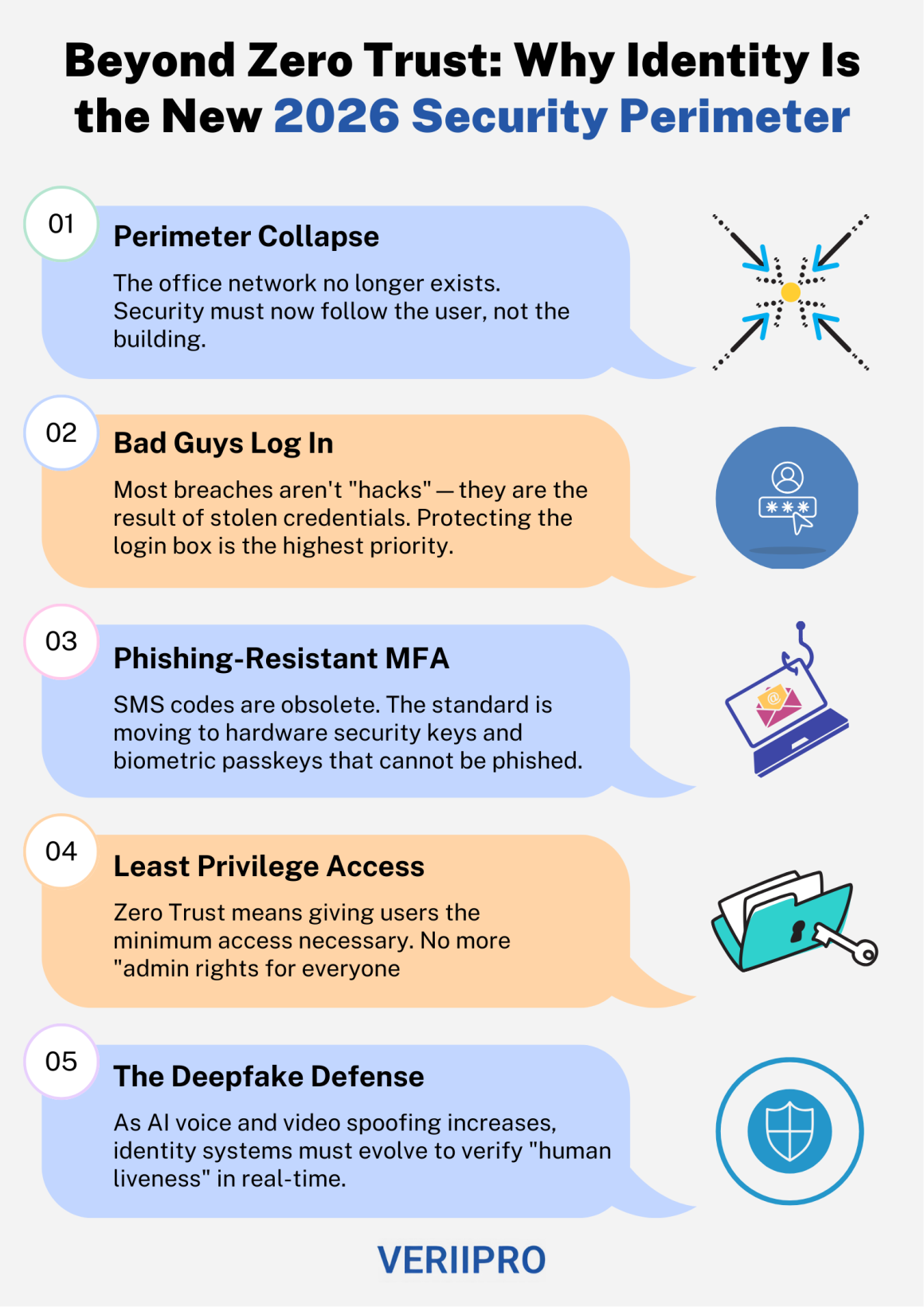
In 2026, work happens everywhere in coffee shops, at home, and on mobile devices halfway across the world. There is no “inside” anymore. The network perimeter has dissolved. The only thing that remains constant, the only thing that travels with the user wherever they go, is their Identity.
This shift has turned Identity and Access Management (IAM) from a boring administrative task into the single most critical layer of modern defense. As the saying goes in the security world: “Identity is the new firewall.”
The “Castle and Moat” Failure
Why the shift? Because bad guys don’t break in anymore, they log in.
According to major industry reports, the vast majority of breaches involve compromised credentials. Attackers don’t bother trying to hack a complex encryption algorithm when they can phish a password or buy a session cookie on the dark web.
Once an attacker has a valid user identity, they can move laterally through the cloud, accessing sensitive data without ever triggering a traditional alarm. This is why Zero Trust became the standard. Zero Trust means “never trust, always verify.” It assumes that the threat is already inside.
The Rise of Identity Engineering
This shift has created a massive demand for a specific type of professional: the Identity Engineer.
Ten years ago, managing user accounts was an IT helpdesk ticket. Today, it is a complex engineering discipline involving:
- SSO (Single Sign-On): Ensuring users can access everything with one secure credential.
- MFA (Multi-Factor Authentication): Moving beyond SMS codes (which are easily hacked) to hardware keys and biometric passkeys.
- PAM (Privileged Access Management): protecting the “keys to the kingdom,” the admin accounts that control the servers.
If you are looking to future-proof your career in tech, specializing in IAM is one of the smartest moves you can make. Companies are desperate for people who understand how to balance security with user experience.
The AI Threat: Deepfakes and Biometrics
The stakes are getting higher because AI is entering the game.
We are seeing the rise of “Identity fraud 2.0.” Attackers are using generative AI to create deepfake voices to trick helpdesk agents into resetting passwords. They are creating synthetic video feeds to bypass “liveness checks” on facial recognition systems.
Security professionals in 2026 need to be prepared for this arms race. The job isn’t just about setting up permissions; it’s about validating that the person on the other end of the screen is actually a human being, not a bot.
Pivot Your Skills: How to Get In
If you are working in general IT, SysAdmin, or even development, you already have the foundation. To pivot into Identity Security:
- Learn the Standards: Master protocols like OIDC (OpenID Connect) and SAML. These are the languages that applications use to talk to identity providers.
- Think “Least Privilege”: Adopt the mindset that users should only have access to exactly what they need, for exactly as long as they need it, and not a second longer.
- Get Certified: Look for certifications from major cloud providers (AWS Security, Azure Identity) or vendor-neutral bodies like ISC2.
Identity is no longer just a “support” function. It is the front line.
Looking for opportunities in Cybersecurity?
VeriiPro is here to help! The security landscape is shifting fast, and the demand for Identity and Access Management (IAM) experts is outpacing supply. VeriiPro specializes in connecting security professionals with organizations that prioritize modern, identity-first defense strategies. Let us help you find a role where you can be the architect of the new digital perimeter.