


We have all spent the last few years marveling at chatbots. We ask ChatGPT to write a poem, and it does. We ask it to summarize a meeting, and it complies. But have you noticed the frustration that creeps in when you ask it to actually do something?
If you say, “Book me a flight to London next Tuesday on British Airways,” the chatbot hits a wall. It politely tells you, “I can’t browse the live internet to perform transactions.” It gives you a list of flights, but you are still the one who has to open the tab, enter your credit card, and click purchase.
This is the fundamental limit of the current AI era. We have built incredibly smart conversationalists, but they are passive. They are brains in a jar disconnected from the world.
This is why the next massive shift in technology isn’t just a smarter chatbot. It is the rise of Agentic AI. By 2026, we won’t just be chatting with AI; we will be assigning it jobs, and it will go off and finish them.
From Answering to Acting
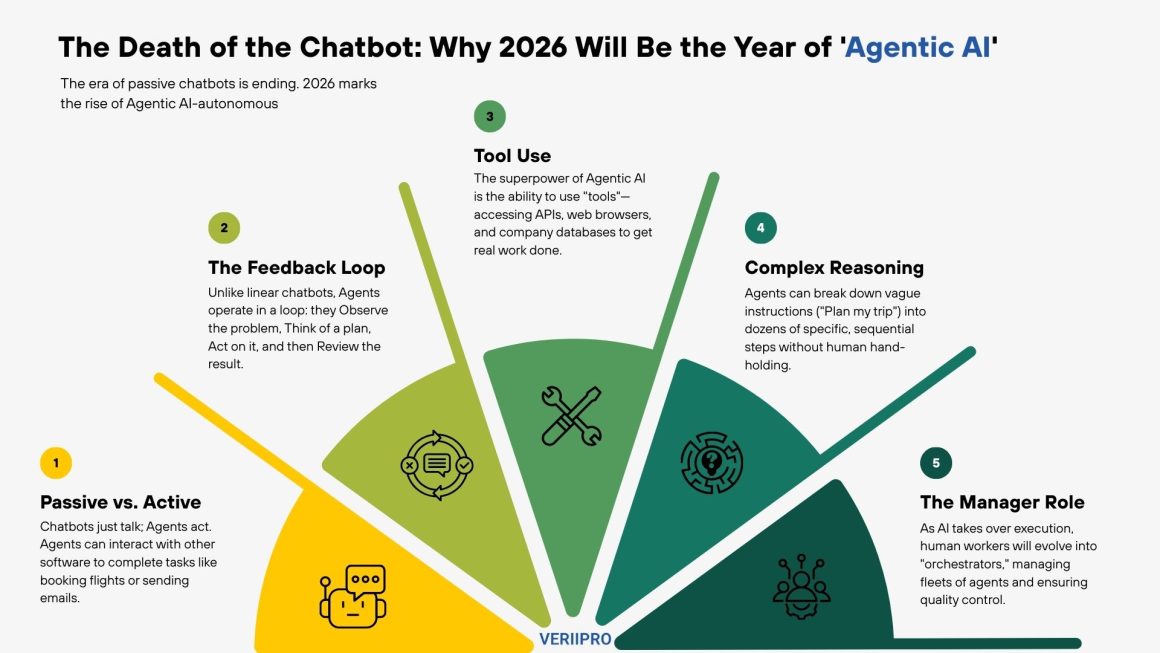
The difference between a chatbot and an AI Agent is the difference between a consultant and an employee. A consultant gives you advice; an employee gets the work done.
In technical terms, an AI Agent is a system that can perceive its environment, reason about how to solve a problem, and crucially use tools to execute actions. As described by Andrew Ng, one of the godfathers of modern AI, agentic workflows allow LLMs to iterate, critique their own work, and use external tools to achieve complex goals.
Instead of just predicting the next word in a sentence, an agent asks: “What steps do I need to take to achieve this goal?”
If you ask an Agent to “Plan a marketing campaign,” it doesn’t just write a generic list. It might:
- Browse the web to research competitor pricing.
- Open your CRM to pull customer data.
- Draft emails in your company’s tone.
- Actually schedule the posts on LinkedIn.
It breaks the big goal into smaller tasks and executes them one by one.
The “Tool-Using” Revolution
The magic behind Agentic AI is “tool use.” Until recently, LLMs were trapped within their own training data. Agents are given “hands” in the form of APIs (Application Programming Interfaces).
Imagine an AI that has access to your calendar, your email, Expedia, and Slack. When you say, “Reschedule my meeting with John,” the agent checks your calendar for conflicts, finds a free slot, emails John to confirm, and updates the invite. You didn’t micromanage it; you just gave the intent.
This shift is already beginning. Microsoft’s recent announcements regarding Copilot focus heavily on “autonomous agents” that can handle complex business processes like supply chain management or IT helpdesk tickets without human intervention.
Why 2026 is the Tipping Point
If the tech exists now, why are we waiting until 2026? Because right now, agents are still a bit… chaotic.
They sometimes get stuck in loops, trying to solve a problem the same way over and over. Or they hallucinate a step in the process. We are currently in the “experimental” phase. But the speed of improvement is blistering.
By 2026, three things will converge:
- Reliability: The underlying models (like GPT-5 or its successors) will be significantly better at logic and reasoning, reducing errors.
- Integration: Software companies (Salesforce, HubSpot, SAP) are currently rewriting their backends to allow AI agents to “hook in” easily.
- Governance: Companies are figuring out the safety rails. You don’t want an AI sending a refund to a customer without checking a policy first.
A report by McKinsey suggests that generative AI’s ability to automate work activities that absorb 60-70% of employees’ time will largely be driven by this transition to agentic workflows.
The Human in the Loop
Does this mean we are all fired? No. But our role changes dramatically.
We stop being the “doers” and start being the “managers.” In an agentic world, your skill set shifts to orchestration. You will oversee a fleet of AI agents, reviewing their work, setting their goals, and stepping in when they get stuck or confused.
The chatbot era was about information retrieval. The agentic era is about outcome delivery. It is the moment AI stops being a novelty and starts becoming a true engine of economic productivity.
Looking for opportunities in AI Development and Engineering?
VeriiPro is here to help! The shift to Agentic AI is creating a massive demand for engineers who understand how to build autonomous systems, chain LLMs, and integrate complex APIs. VeriiPro specializes in connecting top-tier technical talent with the cutting-edge companies building the next generation of AI agents. Let us help you find a role where you aren’t just building chatbots, but creating the digital workforce of the future.