For the last decade, the answer to almost every IT question was “put it in the cloud.” We migrated our servers, our storage, and our software to massive data centers run by Amazon, Microsoft, and Google. We grew accustomed to the idea that computing happens “somewhere else”in a giant, air-conditioned warehouse hundreds of miles away.
But the pendulum is starting to swing back.
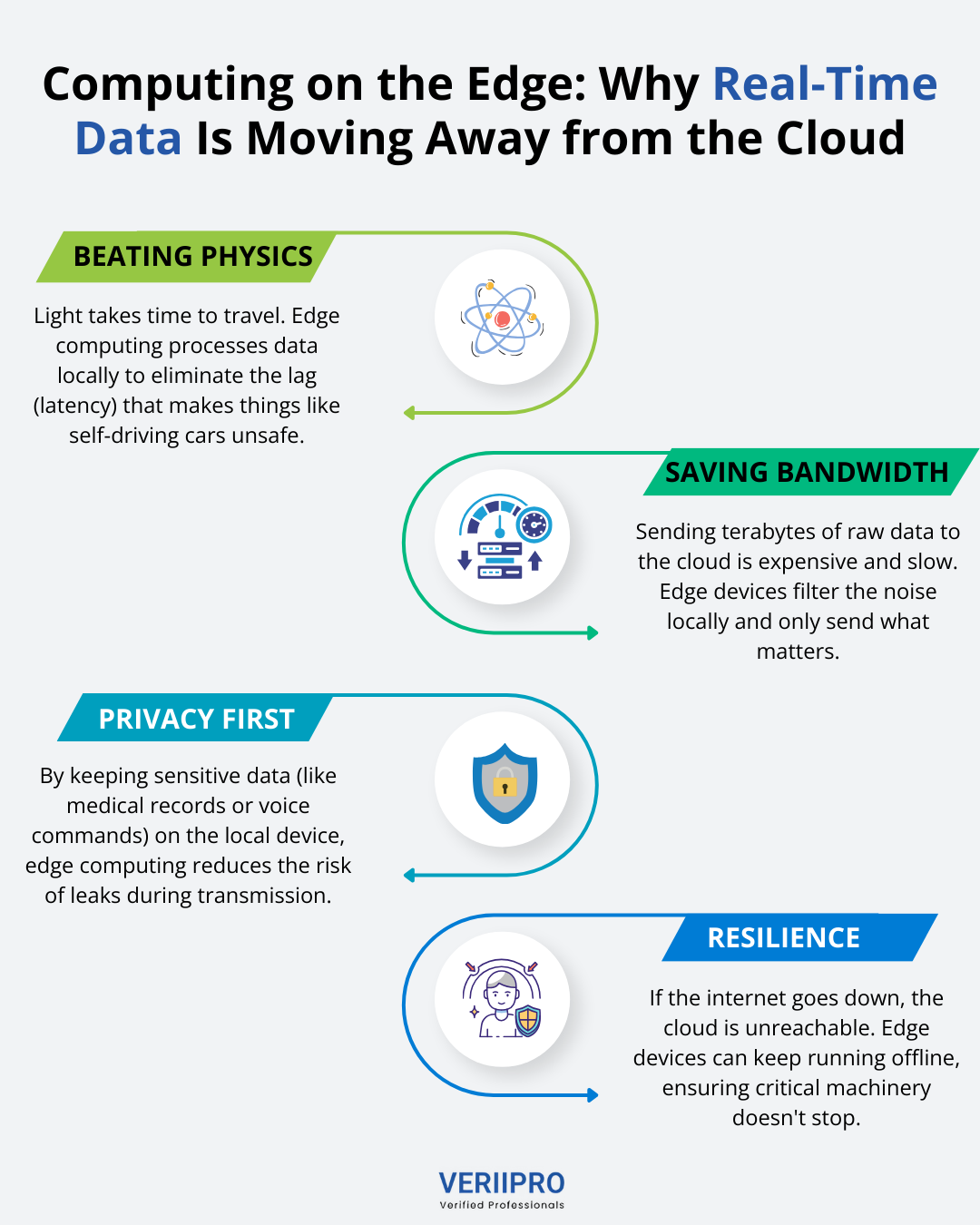
While the cloud is fantastic for storing your vacation photos or hosting a website, it has a major weakness: physics. Data takes time to travel. When you are asking Siri for the weather, a one-second delay is annoying. When a self-driving car sees a pedestrian stepping off the curb, a one-second delay is fatal.
This need for instant speed is driving the rise of Edge Computing. It’s a shift from processing data in a centralized cloud to processing it right where it’s created at the “edge” of the network, whether that’s on a factory floor, inside a hospital room, or in the dashboard of your car.
The Speed of Light Is Too Slow
The primary driver for edge computing is latency. Latency is the time it takes for a signal to travel from point A to point B and back. Even though data travels at light speed through fiber optic cables, distance matters.
If a manufacturing robot detects a vibration that indicates a part is about to snap, it needs to shut down immediately. If that data has to travel from a factory in Ohio to a data center in Virginia, undergo processing, and then send a “stop” command back, the machine might have already destroyed itself.
By moving the “brain” closer to the machine, literally onto a small computer attached to the robot, decisions happen in milliseconds, not seconds. As Accenture explains, this near-zero latency is non-negotiable for mission-critical applications like autonomous vehicles and remote surgery.
The Data Tsunami: Bandwidth Is Expensive
The second problem is volume. The Internet of Things (IoT) is exploding. We have smart cameras, sensors, thermostats, and wearables generating mountains of data every second.
Imagine a security system with 100 4K cameras. Streaming all that high-definition video to the cloud 24/7 requires massive bandwidth and costs a fortune in storage fees. And 99% of that footage is just an empty hallway.
Edge computing solves this by filtering the data before it leaves the building. The camera itself (the “edge” device) analyzes the video. It ignores the empty hallway. It only sends a clip to the cloud when it detects a person. This drastically reduces bandwidth costs and congestion. According to predictions by IDC, by 2025, nearly 60% of the world’s data will be created and processed outside of traditional data centers.
Privacy and Security: Keeping It Local
There is also a growing concern about data privacy. In highly regulated industries like healthcare and finance, sending sensitive patient data or trade secrets across the open internet to a public cloud adds risk.
Edge computing allows sensitive data to stay within the local network. For example, a smart speaker could process your voice command locally without ever sending a recording of your voice to the company’s servers. A hospital monitor can analyze patient vitals right at the bedside. This makes compliance with regulations like HIPAA or GDPR much easier because the personal data never technically “leaves the room.”
Real-World Applications Are Already Here
This isn’t sci-fi, it’s happening now.
- Retail: Amazon Go stores use edge computing to track what you pick off the shelf in real-time, allowing you to walk out without checking out. The cameras have to process your movement instantly; they can’t wait for the cloud.
- Energy: Wind turbines use edge sensors to adjust the angle of their blades in real-time based on sudden wind gusts, maximizing efficiency and preventing damage.
- Gaming: Cloud gaming services are moving servers closer to users (the “edge” of the ISP network) to ensure that when a gamer presses a button, the character on screen moves instantly.
The Future is Hybrid
Does this mean the cloud is dead? Absolutely not. The cloud is still the best place for “heavy lifting,” analyzing long-term trends, training massive AI models, and storing archival data.
The future is a partnership. The Edge handles the “now,” the instant reactions, and filtering. The Cloud handles the “later”, the deep learning, and long-term storage. But make no mistake: the era of sending everything to the cloud is over. The intelligence is moving out to the edge, making our devices smarter, faster, and more independent.
Looking Forward
Looking for opportunities in IoT, Network Engineering, or Edge Computing? VeriiPro is here to help! As the tech infrastructure shifts closer to the user, companies are scrambling for engineers who understand both hardware and software. VeriiPro specializes in connecting technical talent with the innovative companies building the next generation of connected devices. Whether you are a systems architect or a network security pro, we have the resources to help you find your place in the edge computing revolution.