With the EU AI Act’s high-risk rules taking full effect on August 2, 2026, and noncompliance fines reaching up to €35 million or 7 percent of global turnover, companies everywhere are scrambling to hire AI Governance Specialists. The problem is that there are far more open roles than qualified candidates to fill them.
Whether you come from a legal, technical, or policy background, this guide covers every role, salary, skill, certification, and step-by-step roadmap you need to build a career in AI governance in 2026.
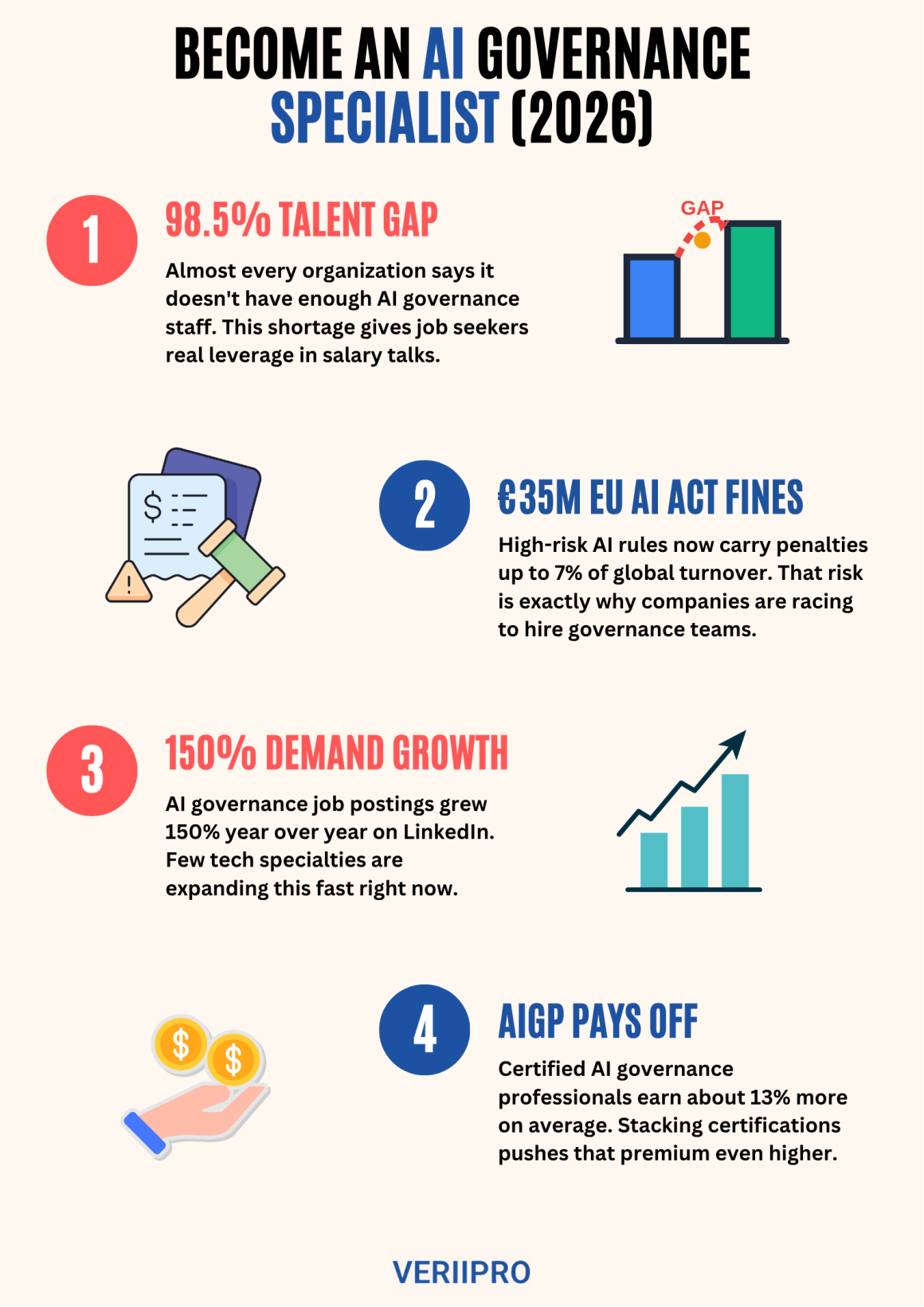
2026 is shaping up to be the inflection point for this field. The EU AI Act’s high-risk obligations under Annex III are now live, US states are layering on their own AI laws, and 98.5 percent of organizations report they don’t have enough AI governance staff to keep pace. At the same time, demand for AI governance roles is up 150 percent year over year, making it one of the fastest-growing specialties LinkedIn tracks.
This guide is written for anyone curious about this career path: lawyers and compliance officers looking for a pivot, data scientists and ML engineers who want to move into oversight, and recent graduates trying to figure out where to point their job search. By the end, you’ll know:
- What an AI Governance Specialist actually does day to day
- How much these roles pay across experience levels, industries, and locations
- Which certifications and skills actually get you hired
- A concrete, step-by-step roadmap based on your current background
Let’s start with the basics: what is this job, really?
What Is an AI Governance Specialist?
Strip away the jargon and an AI Governance Specialist is someone whose job is to make sure a company’s AI systems do what they’re supposed to do, don’t break the law, and don’t blow up in the news. That means writing policies for how AI gets built and deployed, auditing models for bias or safety issues, keeping documentation that regulators can review, and translating legal requirements into rules that engineering teams can actually follow.
It’s easy to confuse this role with a few related titles, so here’s the quick breakdown. An AI Ethics Officer focuses more narrowly on fairness, bias, and the moral dimensions of AI use, often sitting closer to HR or corporate responsibility teams. A Data Privacy Officer is concerned with personal data protection under laws like GDPR and CCPA, a job that existed before AI governance became its own discipline and now frequently overlaps with it. An AI Compliance Manager leans heavily into regulatory checklists: making sure the company’s AI use cases match what GDPR, HIPAA, or the EU AI Act actually require. The AI Governance Specialist often sits above or alongside these roles, coordinating the overall framework that ties legal, technical, and ethical work together.
Inside an organization, you’ll typically find this role reporting into legal, risk, or a dedicated Responsible AI team, sometimes under a Chief AI Officer if the company has one. Forrester predicts that 60 percent of Fortune 100 companies will appoint a head of AI governance by the end of 2026, which tells you how quickly this function is moving from “nice to have” to standard org chart fixture.
The role became mission-critical after 2024 because that’s when the regulatory floodgates opened. The EU AI Act entered into force in August 2024, GDPR enforcement kept tightening, and a wave of US state AI laws started passing. Suddenly, “we’ll figure out AI governance later” stopped being a viable strategy for any company doing business in regulated markets.
AI Governance Specialist Roles and Career Tracks in 2026
“AI Governance Specialist” is really an umbrella term. Underneath it sits a handful of distinct roles, each with its own focus and salary band. Here’s how they break down in 2026.
| Role | Avg. Salary (US) | Key Focus | Top Hirers |
|---|---|---|---|
| AI Ethics Officer | $120K-$180K | Bias, fairness, ethical policy | Google, Microsoft, Meta |
| AI Compliance Manager | $120K-$200K | GDPR, EU AI Act, HIPAA compliance | Finance, healthcare |
| Responsible AI Lead | $150K-$210K | RAI ops, model auditing | Accenture, Deloitte |
| AI Risk Analyst | $115K-$155K | Risk frameworks, audits | Banks, insurers |
| AI Policy Specialist | $110K-$150K | Government and public-sector regulation | Public sector, NGOs |
The AI Ethics Officer is probably the most recognizable title on this list. They build the frameworks that prevent discriminatory outcomes, run bias audits on models before and after deployment, and act as the internal conscience for how AI gets used. Salaries for this role typically land between $120,000 and $180,000, with senior practitioners at large tech companies pushing past $200,000.
The AI Compliance Manager is the person who keeps the regulatory paperwork straight. If your company operates in the EU, this person is making sure your high-risk AI systems have the technical documentation, conformity assessments, and post-market monitoring the AI Act demands. Finance and healthcare companies hire aggressively for this role because the compliance burden in those sectors is heaviest.
A Responsible AI Lead is more operational. Think of this as the person who builds and runs the actual pipelines: automated bias testing in CI/CD, model monitoring dashboards, audit trails. Consulting firms like Accenture and Deloitte have built entire practices around helping clients stand up these RAI ops functions, and they hire heavily for this skill set.
AI Risk Analysts apply traditional risk management thinking to AI systems, which makes this a natural landing spot for people coming from banking or insurance risk teams. And AI Policy Specialists work more on the regulatory side itself, often for government agencies, think tanks, or NGOs shaping the rules everyone else has to follow.
The good news for career changers: these roles draw from genuinely different backgrounds, so there’s an entry point regardless of where you’re starting from.
AI Governance Specialist Salary in 2026
Salary data for this field is still a little messy because the job titles haven’t fully standardized yet, but a clear picture emerges once you look across multiple sources.
ZipRecruiter puts the US average for AI governance roles at around $141,000 per year as of mid-2026, with the middle 50 percent earning between $140,000 and $167,500. The IAPP’s 2025-2026 salary survey reports a median around $151,800 for AI-only governance practitioners, rising to $169,700 for professionals whose roles blend AI governance with data privacy work.
Here’s how compensation typically breaks down by experience level:
| Experience Level | Average Salary (US) |
|---|---|
| Entry (0-2 yrs) | $95K-$120K |
| Mid (3-5 yrs) | $130K-$165K |
| Senior (6-10 yrs) | $170K-$210K |
| Director/VP Level | $220K-$280K |
Industry matters quite a bit. Healthcare and financial services tend to pay a premium over general tech because the regulatory stakes are higher and the compliance teams are larger. A Director, AI Governance role in a hospital system or major bank often commands more than an equivalent title at a mid-size tech company, simply because the cost of getting it wrong (think FDA scrutiny or banking regulators) is so much steeper.
Location plays a role too. US salaries generally lead, with major hubs like New York pushing averages up to roughly $154,000 annually. UK and EU salaries tend to run lower in raw dollar terms but often come with stronger benefits and, in some EU countries, mandatory bonus structures tied to compliance milestones. Remote roles exist and are growing, though they sometimes land closer to the lower end of the range compared to in-office positions at major hubs.
One detail worth knowing if you’re negotiating: certifications genuinely move the needle. The IAPP found that holding one IAPP certification correlates with 13 percent higher pay than non-certified peers, and holding multiple certifications lifts that to roughly 27 percent. Total compensation for senior roles often includes a meaningful bonus tied to audit outcomes or compliance deadlines, and at the director level and above, equity becomes a standard part of the package, especially at venture-backed AI companies.
Skills Required to Become an AI Governance Specialist
The skill set for this role is genuinely multidisciplinary, which is part of why it attracts people from such different backgrounds. Here’s what actually gets used on the job.
Regulatory knowledge is the foundation. You need working familiarity with the EU AI Act, GDPR, California’s CPRA, HIPAA if you’re in healthcare, and the NIST AI Risk Management Framework, which has become the de facto US standard even though it’s voluntary. You don’t need to memorize every article number, but you need to know what triggers high-risk classification and what documentation that requires.
Technical fluency doesn’t mean you need to be able to build a transformer model from scratch, but you do need to understand how ML pipelines work well enough to ask the right questions. That includes basic familiarity with model auditing tools, enough CI/CD knowledge to understand where governance checks get inserted into a deployment pipeline, and exposure to RAIops platforms that automate bias testing and monitoring.
Ethical frameworks cover the practical side of fairness: bias detection methods, fairness metrics like demographic parity and equalized odds, and how to run an algorithmic impact assessment from start to finish.
Communication skills end up mattering more than people expect. A huge part of this job is translating dense policy language into something an engineering team can actually implement, and then turning around and explaining technical risk to a board that doesn’t know what a confusion matrix is. People who can do both sides of that translation are rare and valuable.
Looking ahead, a few emerging 2026 skills are starting to separate strong candidates from average ones. Agentic AI governance is becoming its own subdiscipline as companies deploy autonomous agents that take real actions, not just generate text. Sovereign data mandates are forcing companies to think about where AI training and inference data physically lives. AI sustainability reporting is gaining traction as energy consumption from large models draws regulatory and investor attention. And generative AI risk frameworks, covering everything from hallucination risk to IP exposure, are quickly becoming standard parts of the governance toolkit.
Certifications and Education That Get You Hired
Here’s the honest answer to the degree question: you don’t strictly need a law degree or a computer science degree, but you need depth in at least one of those areas plus working knowledge of the other. People with JDs who add technical literacy, and people with CS or data science backgrounds who add regulatory fluency, both do well. Pure generalists without depth in either area tend to struggle to get past the first interview.
Certifications matter more in this field than in most tech roles, largely because the regulatory landscape changes so fast that employers want proof you’re keeping up. Here’s how the major ones stack up by employer recognition.
AIGP (AI Governance Professional), from IAPP, is the closest thing this field has to a gold standard. The IAPP updated the AIGP Body of Knowledge to version 2.1 in February 2026, restructuring it around four domains and heavily incorporating the EU AI Act, NIST AI RMF, and ISO/IEC 42001. There are no formal prerequisites, though the IAPP recommends one to two years of relevant experience before sitting the exam.
CIPP/E (Certified Information Privacy Professional/Europe), also from IAPP, focuses on European privacy law and pairs extremely well with AIGP. As mentioned above, stacking these two certifications is one of the clearest salary levers in the field.
ISO 42001 (AI Management Systems) is an international standard for AI management systems, and familiarity with it is increasingly expected for roles involving formal AI governance program implementation, especially at companies pursuing certification.
Google’s Responsible AI Practices certificate and AWS’s AI and ML governance training are useful supplements, particularly if you’re coming from a technical background and want to demonstrate you understand governance from inside the major cloud ecosystems your employer likely uses.
On the university side, dedicated “AI governance” degrees are still rare, but a growing number of programs offer relevant specializations: law schools with technology law tracks, policy schools with AI and emerging tech concentrations, and a handful of computer science programs now offering responsible AI electives or certificates.
Can you get in without a technical background? Yes, with caveats. Several entry points, including AI Ethics Officer, AI Policy Analyst, and AI Governance Administrator roles, are explicitly accessible to people coming from ethics, policy, project management, or general compliance backgrounds. The caveat is that you’ll need to build technical literacy on the job or through self-study fairly quickly, because the conversations you’ll be part of involve engineers and data scientists daily.
Industries Actively Hiring AI Governance Specialists in 2026
Some industries are hiring for this role out of genuine necessity, not just trend-chasing. Here’s where the demand is concentrated.
Healthcare faces some of the steepest requirements, between FDA guidance on AI-based medical devices, clinical AI compliance standards, and the governance demands that come with AI systems touching electronic health records. Hospital systems and health tech companies are building out governance teams specifically to manage AI-driven diagnostic tools and clinical decision support systems.
Finance and banking have long had model risk management functions, and AI governance has essentially absorbed and expanded that mandate. Algorithmic trading oversight and credit scoring fairness audits are now standard parts of the job, particularly as regulators scrutinize AI-driven lending decisions for disparate impact.
Big Tech companies, Google, Meta, and Amazon among them, have built internal Responsible AI teams that have grown from small advisory groups into substantial departments with dedicated governance, ethics, and policy staff working across product lines.
Government and the public sector are hiring for national AI policy roles and defense AI ethics positions, areas where the stakes around fairness, transparency, and accountability are especially high given the power these institutions hold.
Consulting firms, Accenture, Deloitte, PwC, and McKinsey among them, have all built dedicated Responsible AI practices to help client companies stand up their own governance functions. This is often a good entry point because consulting firms hire across a wider range of experience levels and backgrounds than corporate in-house teams.
Top Employers and Where the Jobs Are Geographically
The roster of companies actively hiring for AI governance roles spans both Big Tech and traditional enterprises adapting to new regulatory demands. Google, Microsoft, Meta, and Amazon all maintain sizable Responsible AI teams. Consulting firms like Accenture, Deloitte, and PwC are scaling their RAI practices to meet client demand. Major banks and insurers are building out AI risk teams, and healthcare systems and health tech companies are standing up dedicated AI compliance functions as clinical AI tools proliferate.
Within the US, certain cities have become hubs for this work. Washington, DC leads for government and policy-focused roles, given its proximity to regulators and federal agencies. New York remains strong for finance-sector governance roles. San Francisco and the broader Bay Area dominate for Big Tech and AI-native company roles. Chicago and Boston round out the list, driven by financial services and healthcare and biotech employers respectively.
Globally, Brussels has become something of an epicenter simply because it’s where EU AI Act enforcement activity concentrates, making it a magnet for both regulators and the compliance teams that work with them. London remains a major hub for financial services governance roles. Singapore is emerging as a key location for companies managing AI governance across Asia-Pacific operations, and Toronto has built a strong cluster of AI ethics talent tied to its academic AI research community.
As for remote work, AI governance roles are increasingly remote-friendly compared to many tech jobs, though fully remote postings still tend to skew toward mid-level individual contributor roles rather than senior leadership positions, which more often require at least occasional in-person presence for board and regulator interactions.
The AI Governance Talent Gap: Why Now Is the Best Time to Enter
The numbers here are genuinely striking. The IAPP reports that 98.5 percent of organizations say they need more AI governance professionals than they currently have, and LinkedIn’s 2026 Skills on the Rise report puts demand growth for AI governance roles at 150 percent year over year, with AI ethics specifically up 125 percent.
Regulated industries face the worst of this shortage because they can’t simply ignore compliance requirements while they wait for talent to materialize. Healthcare and financial services companies are often competing for the same small pool of candidates who have both regulatory depth and technical literacy, which drives up both salaries and time-to-hire. Average time to hire for AI ethics-related roles currently runs four to six months, an unusually long cycle for tech-adjacent positions.
In response, larger enterprises are building internal “AI governance academies,” essentially structured upskilling programs that take existing employees from privacy, compliance, or technical teams and train them into governance roles over a matter of months. This is partly a recruiting strategy and partly an admission that the external candidate pool simply isn’t deep enough yet.
For job seekers, this shortage translates directly into negotiation leverage. When 98.5 percent of organizations say they’re understaffed, candidates with even moderate AI governance credentials are often fielding multiple offers, and counteroffers on salary and title are common. This also explains why career changers from law, policy, and tech are being fast-tracked into these roles rather than asked to start at the bottom: employers genuinely cannot afford to wait for the “ideal” candidate to show up.
Step-by-Step Roadmap to Become an AI Governance Specialist
The path into this field looks different depending on where you’re starting from. Here are three realistic tracks.
Path 1: For Legal or Compliance Professionals
If you’re coming from a legal or compliance background, your regulatory instincts transfer directly, but you’ll need to build technical literacy. Start by getting comfortable with how ML systems actually work at a conceptual level: what training data is, how models get deployed, and where governance checkpoints fit into that lifecycle. The AIGP certification is a natural first target since it’s built around exactly this kind of cross-disciplinary knowledge. From there, look for first roles like AI Compliance Manager, AI Policy Specialist, or a governance-focused role within an existing legal or compliance team, where your existing expertise is the primary qualification and the AI-specific knowledge can grow on the job.
Path 2: For Tech or Data Professionals
If you’re coming from ML engineering, data science, or a related technical role, you already have the hardest part. What you need to add is regulatory and ethical framework knowledge. Position your existing skills by reframing past projects in governance terms: did you work on model monitoring, bias testing, or documentation practices, even informally? Those experiences are directly relevant. Build portfolio projects that demonstrate governance thinking explicitly: a bias audit of a public dataset, a mock algorithmic impact assessment, or a writeup applying the NIST AI RMF to a hypothetical system. AIGP or ISO 42001 familiarity rounds out the picture and signals to employers that you can speak the compliance language as well as the technical one.
Path 3: For Fresh Graduates or Career Changers
If you’re starting from scratch, focus your degree or coursework on a combination of policy, ethics, or law alongside at least foundational technical literacy, even if that just means a couple of solid courses in statistics, machine learning fundamentals, or data science. Target entry-level titles like AI Governance Administrator, AI Policy Analyst, or Junior AI Ethics Analyst, all of which are explicitly accessible without years of experience. Join communities where this field’s practitioners gather: the IAPP has active local chapters and online forums, and there are growing numbers of AI governance-focused groups on LinkedIn where job postings and informal mentorship both happen.
AI Governance Specialist vs. Other AI Careers
It’s worth understanding how this role compares to other AI careers you might be considering, since the lines can blur.
AI Governance vs. AI Engineer: AI Engineers build and deploy the models; AI Governance Specialists make sure those models meet legal and ethical standards before and after deployment. Salaries are broadly comparable at the mid-level, though senior AI Engineers at top AI labs can out-earn senior governance roles significantly. Day to day, AI Engineers spend their time in code and infrastructure, while governance specialists split time between policy documents, audits, and cross-functional meetings.
AI Governance vs. Data Privacy Officer: These roles overlap heavily, especially around data protection law, but Data Privacy Officers focus specifically on personal data handling under laws like GDPR and CCPA, while AI Governance Specialists take a broader view that includes model fairness, safety, and AI-specific regulation. Many professionals end up doing both, and as noted earlier, that combination commands a real salary premium.
AI Governance vs. AI Product Manager: AI Product Managers own the roadmap and user experience for AI-powered products, while AI Governance Specialists are more often consulted as a check on that roadmap, flagging risks before launch. In 2026, AI Product Manager salaries at the senior level tend to run somewhat higher at product-led tech companies, but AI Governance roles offer more stability and less exposure to product cancellation risk.
So which path should you choose? If you’re drawn to building things and want governance to be one part of a broader technical career, AI Engineer or AI Product Manager with a governance specialization might fit better. If you want governance, risk, and compliance to be the core of your job rather than a side concern, the dedicated AI Governance Specialist track is the clearer choice, especially given the talent shortage working in your favor.
Final Thoughts
AI governance has gone from a niche compliance function to one of the fastest-growing, best-paying career paths in tech, driven by a regulatory wave that shows no sign of receding. Whether you’re coming from law, technology, or policy, there’s a realistic entry point, and the current talent shortage means employers are often more flexible about backgrounds than job postings might suggest.
If you’re serious about this path, pick one concrete next step this week: register for the AIGP exam, start a small bias-audit portfolio project, or set up a job alert for AI governance roles in your target industry. The demand isn’t slowing down, and the people who move now will have a real head start.
Ready to take the next step? Browse AI governance job listings on VeriiPro and find roles that match your background and goals.