

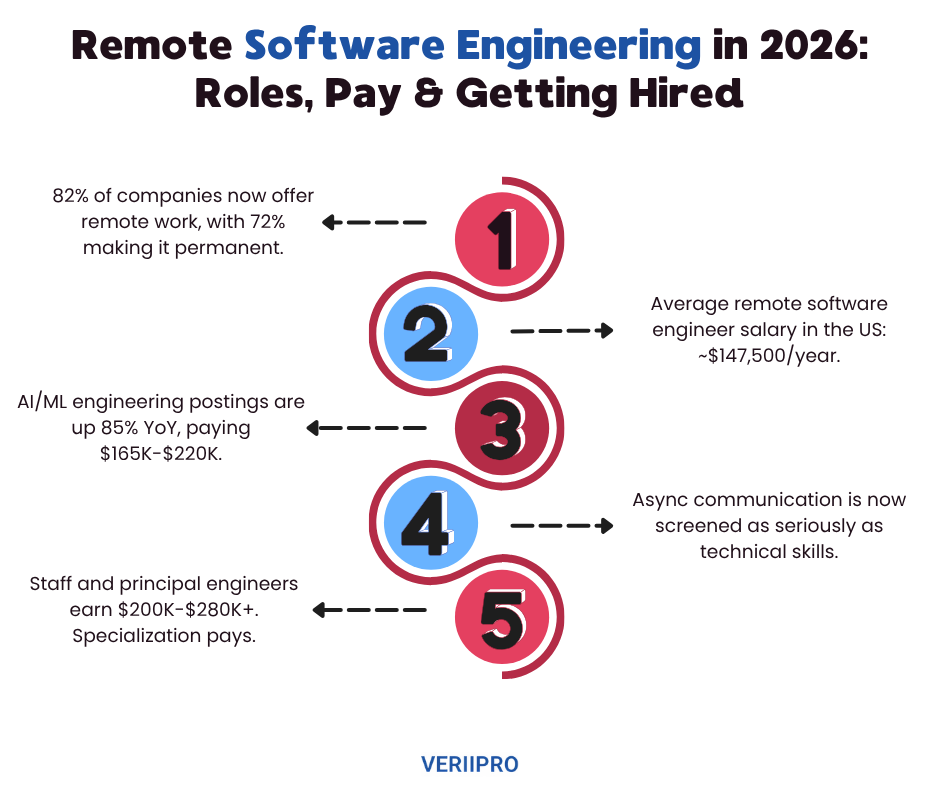
Remote software engineering is no longer a perk. In 2026, nearly 40% of software engineers apply exclusively to remote roles, and companies across every industry are competing to hire distributed tech talent. Meanwhile, 82% of companies now offer some form of remote work, with 72% making those policies permanent. That shift did not happen by accident.
Whether you are an experienced engineer looking to go fully remote or a junior developer targeting your first work-from-home role, this guide covers the top remote software engineering jobs available right now, what they pay, what skills you need, and exactly how to land one in 2026.
Why Remote Software Engineering Jobs Are Booming in 2026
A few years ago, remote-first hiring felt like an experiment. Now it is standard operating procedure for a huge chunk of the tech industry. The numbers back this up: software developer job postings have risen 15% since mid-2025, and remote roles have grown disproportionately within that recovery. Companies have realized they do not need everyone in the same building to build great software.
Tech leads all industries in remote hiring for one simple reason: the work is digital. Pull requests, code reviews, async standups, cloud deployments. None of it requires a physical office. That reality, combined with access to 340% larger candidate pools through remote hiring, has pushed companies to embrace distributed teams as a permanent strategy rather than a pandemic holdover.
Entry-level remote software engineering job postings are still down from their 2022 peak, but senior and specialized roles are strong. AI/ML engineering postings are up 85% year over year. DevOps and cloud are consistently in demand. The market has matured, and it is rewarding engineers who have matured with it.
Benefits of Remote Software Engineering Jobs
There are real, concrete reasons why so many engineers are chasing remote roles. Here is what actually moves the needle.
Higher Salary Potential Regardless of Location
Remote work opens access to salaries that your local market probably cannot match. The average remote software engineer in the US earns around $147,500 per year, with senior roles frequently clearing $200K. At remote-first companies like GitLab, Zapier, and Automattic, engineers are paid the same regardless of where they live. That means an engineer in Austin can pull a San Francisco salary with a fraction of the cost of living.
Better Work-Life Balance and Flexibility
Remote work gives you your schedule back. You can structure your day around deep work blocks instead of back-to-back meetings. A third of developers say they would quit their job if remote work were taken away. That is not just preference. It is about being able to work in a way that actually produces results.
Access to Global Job Opportunities
Geographic constraints used to limit what jobs you could realistically apply for. Remote work removed that ceiling. Today you can apply to companies in New York, London, or Singapore without ever leaving home. The talent pool is global, and so is the opportunity.
Elimination of Daily Commute
Long commutes are productivity killers. Remote work hands that time back to you. Many engineers find they get back one to three hours per day, which adds up fast over a year. Less commuting also means less stress, lower transportation costs, and more mental bandwidth for actual work.
Increased Productivity and Focus
The data on this is consistent. Remote workers complete 94% of tasks compared to 89% in-office, and spend an average of 6.2 hours per day on deep work versus 4.8 hours in an office environment. Open-plan offices are not built for focused software development. A quiet home setup often is.
Top Remote Software Engineering Jobs in 2026
Here is a snapshot of the remote roles commanding the strongest demand and salaries right now:
| Role | Avg. Remote Salary (US) | Remote Availability |
|---|---|---|
| Senior Software Engineer | $145K-$185K | Very High |
| Full Stack Engineer | $130K-$170K | Very High |
| Backend Engineer | $125K-$165K | High |
| Frontend Engineer | $115K-$150K | High |
| DevOps / Platform Engineer | $140K-$180K | High |
| AI / ML Engineer | $165K-$220K | Medium-High |
| Junior Software Developer | $75K-$100K | Medium |
Senior Software Engineer (Remote)
Senior engineers are in high demand across every industry that runs software, which is effectively all of them. You will own architecture decisions, mentor junior engineers, and be responsible for the quality and reliability of production systems. Remote senior engineers typically earn $145K to $185K, with total comp at top tech companies reaching well above that.
Full Stack Engineer (Remote)
Full stack engineers can move between frontend and backend, which makes them valuable at startups and mid-size companies that need versatility. Remote availability for this role is very high. Salary typically ranges from $130K to $170K, and engineers proficient in TypeScript, React, Node.js, and Python are especially sought after.
Backend Engineer (Remote)
Backend engineers design and maintain the server-side logic that powers applications. The role requires strong fundamentals in data structures, algorithms, and at least one or two backend languages such as Python, Go, or Java. Remote backend roles are widely available, with salaries typically in the $125K to $165K range depending on stack and experience.
Frontend Engineer (Remote)
Frontend engineers handle everything the user sees and interacts with. The job requires attention to detail, solid UI instincts, and deep proficiency in JavaScript frameworks, primarily React. Senior frontend engineers who can also work with design systems and accessibility standards command the upper end of the $115K to $150K salary band.
DevOps and Platform Engineer (Remote)
DevOps and platform engineers keep the development pipeline running. That means CI/CD, infrastructure as code, Kubernetes, and cloud platforms. The Robert Half 2026 Salary Guide puts DevOps engineers at $118K to $174K, and demand has grown consistently because every engineering team needs someone who can manage scale and reliability.
AI and ML Engineer (Remote)
This is the fastest-growing category in tech right now. AI and ML engineer job postings are up 85% year over year, and salaries reflect that demand: $165K to $220K is standard, with senior specialists at top companies earning significantly more. These roles require real depth in ML frameworks like TensorFlow or PyTorch, not just surface-level familiarity with AI tools.
Junior Software Developer (Remote)
Entry-level remote roles are competitive in 2026, but they exist, especially at startups and mid-size companies. Junior developers typically earn $75K to $100K remotely. The candidates landing these roles are demonstrating strong fundamentals, have project portfolios, and show they can work independently with minimal hand-holding.
Remote Software Engineer Salary in 2026
Salary is one of the first things engineers want to know. Here is a breakdown by experience level:
| Experience Level | Remote Salary Range |
|---|---|
| Junior (0-2 yrs) | $75K-$100K |
| Mid Level (3-5 yrs) | $110K-$145K |
| Senior (6-10 yrs) | $150K-$190K |
| Staff / Principal | $200K-$280K+ |
Do Remote Software Engineers Earn More Than In-Office Engineers?
It depends on the company’s pay policy. About 35% of companies pay location-agnostic salaries, meaning remote engineers earn the same as their in-office counterparts regardless of where they live. Another 40% apply geographic pay adjustments, which can mean earning 10% to 20% less if you move to a lower-cost city. However, that reduction is often offset by lower living costs. An engineer earning $130K remotely in Austin frequently has more disposable income than one earning $170K in San Francisco. The key question to ask any employer upfront: what is your remote pay policy?
Which Remote Engineering Role Has the Highest Salary in 2026?
AI and ML engineers command the highest salaries, with median total compensation for AI/ML engineers ranging from $134K to $193K+ in base salary, and significantly more in total comp at top tech companies. Security engineers and staff-level platform engineers are close behind. The clear pattern: specialization pays.
Skills That Make You Competitive for Remote Software Engineering Jobs
Landing a remote role requires more than technical chops. Companies have gotten specific about what they want.
What Technical Skills Do Remote Employers Look for Most?
The most requested technical skills in 2026 remote engineering job postings are:
- Core programming languages: Python, JavaScript/TypeScript, Go, and Rust
- Cloud platforms: AWS, GCP, and Azure. Multi-cloud experience is a plus
- Version control and CI/CD pipelines: Git, GitHub Actions, Jenkins, or similar
- AI/ML frameworks for engineers pivoting into higher-paid specializations: TensorFlow, PyTorch
- Containerization and orchestration: Docker and Kubernetes
According to LinkedIn’s 2025 Workforce Report, AI skills now appear in 42% of software engineering job descriptions, up from just 8% in 2022. You do not need to be an ML researcher. But being able to integrate AI tooling into a production environment is increasingly expected.
What Soft Skills Do You Need for Remote Engineering Roles?
This is where a lot of candidates miss. Remote work has its own skill set, and companies screen for it:
- Async communication: Can you write a Slack message or pull request description that actually gives someone everything they need? This matters more than most engineers realize
- Documentation habits: Remote teams rely on written context. Engineers who document their work clearly are far easier to manage across time zones
- Self-management and independent delivery: No one is going to tap you on the shoulder. You need to own your tasks and communicate blockers proactively
- Tool proficiency: Slack, Jira, Notion, Linear, Figma. Familiarity with how distributed teams collaborate is expected, not optional
- Time zone awareness: Many remote teams span multiple continents. Being organized about overlap hours and response expectations is part of the job
How to Get a Remote Software Engineering Job in 2026
A targeted approach works far better than blasting out applications. Here is what actually moves the needle:
Step 1: Build a Remote-Ready Resume and Portfolio
Your resume needs to demonstrate two things: technical competence and the ability to work independently. Highlight any remote experience you have, including freelance work or open source contributions. Your portfolio should include projects with real documentation. A GitHub repo full of well-commented, well-structured code tells a hiring manager more than a list of technologies.
Step 2: Optimize Your LinkedIn Profile for Remote Roles
Add “Open to remote opportunities” to your profile and make sure your headline and skills section reflect the keywords recruiters are searching for. Endorsements and recommendations from past colleagues carry weight. If you have done async or distributed work before, mention it explicitly in your experience section.
Step 3: Target the Right Companies and Job Boards
Not all companies are equally remote-friendly. Startups and mid-size companies that went remote during the pandemic and never went back are often the best bet for fully remote roles. Job boards worth bookmarking include VeriiPro, We Work Remotely, Arc.dev, Wellfound, and Dice for tech-specific listings. Search with filters like “remote only” or “fully distributed” to cut through the noise.
Step 4: Prepare for Remote-Specific Interview Questions
Expect questions like: How do you manage your time when working independently? How do you communicate blockers to a remote team? What tools do you use to stay organized? These are not throwaway questions. Companies are genuinely trying to assess whether you can function without the structure of an office. Have specific examples ready.
Step 5: Negotiate Your Remote Compensation Package
Understand the company’s pay policy before naming a number. If they use location-based pay, know your market and make a case based on your skills and output, not your zip code. Also negotiate beyond base salary: equipment stipends, home office budgets, internet allowances, and async work flexibility all have real dollar value.
Red Flags to Watch for in Remote Software Engineering Job Listings
Not every “remote” job is actually remote. Watch for these warning signs before you apply:
- Vague job descriptions with no tech stack listed. Legitimate engineering roles describe what you will actually work with. No stack mentioned usually means the posting is low-effort or outdated
- No mention of timezone requirements or async culture. A company serious about remote work tells you upfront how the team operates. Silence here is a yellow flag worth probing in the interview
- Unrealistic salary ranges for the role. A senior engineer role posted at $60K to $80K is either not what it claims to be, or the company does not understand the market
- No remote culture infrastructure. Ask what tools the team uses and how they collaborate. If the answer is vague or centers on in-person meetings, it is probably a company doing remote reluctantly
- “Remote” with a location restriction. Watch for listings that say “remote” but then list a specific city or state requirement, or include language like “must be within commuting distance.” That is hybrid or in-office work dressed up as remote
Final Thoughts
Remote software engineering is one of the strongest career paths in tech right now. The opportunities are real, the salaries are competitive, and companies are actively building the infrastructure to support distributed teams long-term. What has changed is the standard of what it takes to land these roles. Employers expect engineers who can communicate clearly, manage themselves, and deliver without daily supervision. Build those habits alongside your technical skills, and the remote roles you want will come. Start your search on VeriiPro and browse fully remote software engineering opportunities today.