
If you are researching an AI engineering career or trying to benchmark your current pay, the first thing you need to know is this: the average AI engineer salary in the US sits between $140,000 and $185,000 in base pay in 2026, with total compensation regularly clearing $200,000 for mid-career professionals once equity and bonuses enter the picture. According to the Bureau of Labor Statistics, the median annual wage for related AI and computer research roles is $145,080. Glassdoor currently puts the average AI engineer salary at $142,589, while Built In’s 2026 data shows the figure closer to $184,757 for tech-company respondents. The spread between sources is wide, and that gap matters when you are negotiating.
This guide breaks down the AI engineer salary picture by experience level, city, skills, and industry. It also covers what the job market looks like right now and the practical steps you can take to earn more.
What Is the Average AI Engineer Salary in the USA?
The honest answer is: it depends on which data source you trust, and all of them are technically correct. Glassdoor reports a national average of $142,589 based on self-reported salaries as of May 2026. Built In shows $184,757, pulling heavily from coastal tech employers. Levels.fyi puts median total compensation at $211,000 when equity is included.
Why the gap? Glassdoor captures a broader, more geographically diverse pool of self-reports. Built In over-indexes on respondents at larger tech companies in high-cost cities. Levels.fyi reflects total comp at well-funded employers, not base alone. None of these numbers is wrong. They are measuring different slices of the same market.
What you can say with confidence: AI engineers earn well above the US national median for all occupations, which the BLS places at around $65,470. That premium reflects genuine scarcity. According to Coursera’s 2026 salary guide, the BLS projects 26% job growth for AI-related roles between 2023 and 2033, roughly six times faster than the average for all occupations. The demand is structural, not speculative.
AI Engineer Salaries by Experience Level
Experience is the single biggest variable in your paycheck as an AI engineer. The jump from entry-level to senior can be $100,000 or more in base salary alone. Here is what each stage typically looks like in 2026.
[INFOGRAPHIC: AI Engineer Salary by Experience Level – updated 2026 stats to be placed here]
Experience Level Years of Experience Avg. Monthly Salary Avg. Annual Salary Entry-Level 0-2 years $8,300 – $10,800 $100,000 – $130,000 Mid-Level 3-5 years $12,500 – $16,700 $150,000 – $200,000 Senior-Level 5+ years $18,300 – $29,200+ $220,000 – $350,000+
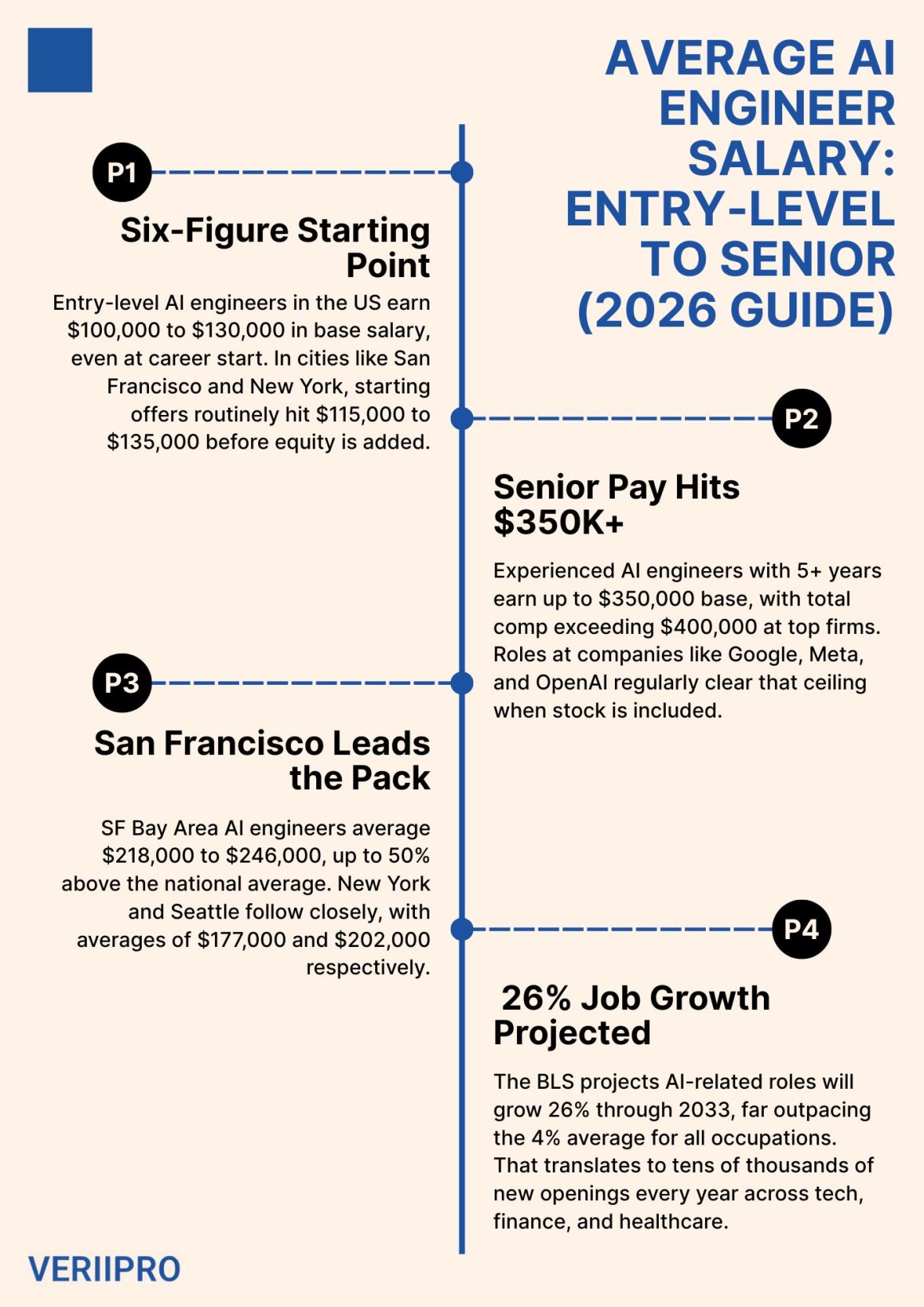
Entry-Level (0-2 years): Expect a base salary in the $100,000 to $130,000 range. Entry-level in AI is not a true beginner role. Most candidates entering at this level have at least a bachelor’s in computer science, often a master’s, and real project experience. In major tech hubs like San Francisco and New York, entry-level offers routinely start at $115,000 to $135,000 in base pay alone, before equity.
Mid-Level (3-5 years): This is where salaries accelerate fast. Mid-level engineers are expected to work independently on production AI systems, integrate large language models into real applications, and collaborate across teams. According to MRJ Recruitment’s 2026 benchmarks, engineers in this bracket have seen roughly 9% year-over-year salary growth.
Senior-Level (5+ years): Senior AI engineers make architectural decisions, lead projects, and mentor teams. Base salaries commonly reach $220,000 to $350,000 at this level, with total compensation at major tech companies pushing past $400,000 when stock and bonuses are included.
AI Engineer Salaries by Location
Where you work still shapes your paycheck significantly, even as remote work becomes more common. Here is how major US markets stack up in 2026.
[INFOGRAPHIC: AI Engineer Salary by Location – updated 2026 stats to be placed here]
City / Region Avg. Annual Salary vs. National Average San Francisco, CA $218,600 – $246,250 +40-50% New York City, NY $177,109 +24% Seattle, WA $202,294 +30% Austin, TX $147,000 – $165,000 Near average Boston, MA $153,892 +5-8% US National Average $142,589 – $184,757 Baseline
San Francisco Bay Area: Consistently the top-paying market in the country. Built In reports average AI engineer salaries of $246,250 in San Francisco. Senior engineers at major tech companies frequently see total compensation exceed $300,000 to $400,000 when equity is factored in.
New York City: A strong second-tier market, particularly for engineers in fintech and media. Glassdoor data places the average at $177,109 in NYC as of May 2026, around 24% above the national figure.
Austin and Emerging Hubs: Cities like Austin, Denver, and Boston are growing fast as AI talent centers. Salaries here run slightly below the Bay Area and NYC but come with a meaningfully lower cost of living. Austin offers a real middle ground for candidates who want competitive pay without the SF price tag.
Remote work has largely eliminated the old practice of geographic pay cuts. Companies hiring remotely now compete nationally for talent, which means a strong candidate in Raleigh or Phoenix can realistically command a salary close to what their Bay Area counterparts earn.
Skills That Impact AI Engineer Salary
Not all AI engineers are paid equally, and skills are a big reason why. Engineers with expertise in high-demand areas command a premium over those with generalist backgrounds. According to Coursera, these are the skills most likely to push your salary above the baseline:
- Python and ML frameworks: Python remains the core language of AI engineering. Proficiency with TensorFlow, PyTorch, and Keras is expected. Engineers who can train, evaluate, and deploy models in production environments earn more than those who only know the theory.
- Large Language Models (LLMs) and Generative AI: This is where the premium is largest right now. Engineers who can build and deploy LLM-powered applications, work with retrieval-augmented generation (RAG), or fine-tune foundation models are seeing the fastest salary growth in 2026.
- Natural Language Processing (NLP): NLP expertise remains highly valued, especially in industries like healthcare and legal tech where text processing is central to the product.
- Cloud platforms (AWS, GCP, Azure): Most production AI systems live in the cloud. Engineers who can architect and manage cloud-based ML pipelines, not just write models, earn significantly more.
- MLOps and Data Engineering: Knowing how to build, monitor, and maintain AI systems in production is increasingly rare and increasingly paid. MLOps skills bridge the gap between research and real-world deployment.
- Deep Learning: Strong fundamentals in neural networks, computer vision, and sequence modeling remain relevant and well-compensated across most industries.
Top Industries Hiring AI Engineers
The industry you work in affects your salary almost as much as your experience level. Some sectors simply pay more for AI talent than others.
Technology: Big Tech remains the top payer. Companies like Google, Meta, Microsoft, and OpenAI offer the highest total compensation packages in the market, often combining strong base salaries with substantial equity grants. Glassdoor’s industry data shows Information Technology as the second highest-paying sector for AI engineers, with a median total pay of $167,322.
Finance and Fintech: Banks, trading firms, and fintech companies have invested heavily in AI for fraud detection, algorithmic trading, and customer personalization. Financial services typically offer competitive base salaries and strong bonuses. According to Glassdoor, Media and Communication, which includes financial media, tops the industry pay list for AI engineers at a median of $190,921.
Healthcare: Healthcare is one of the fastest-growing sectors for AI hiring, driven by applications in diagnostics, drug discovery, and patient data analysis. Salaries here are competitive and growing, and the work carries real-world impact that attracts engineers looking for more than just a paycheck.
Management consulting, aerospace and defense, and retail are also paying well above average for AI talent in 2026.
Job Outlook for AI Engineers
The demand for AI engineers is not slowing down. The BLS projects 26% job growth for computer and information research scientists between 2023 and 2033, roughly six times faster than the 4% average growth projected for all occupations. For data scientist roles, which overlap heavily with AI engineering, the projected growth is even higher at 34%.
According to Stanford’s 2025 AI Index Report, the share of US job postings requiring AI skills climbed to 1.8% in 2025, up from 1.4% in 2023. That covers every job posting across every industry in the country.
The World Economic Forum, citing LinkedIn data, reports that AI has already created 1.3 million new roles globally since 2022. An additional 600,000 AI-enabled jobs are projected to follow.
The supply side has not caught up. Graduate programs are producing more ML candidates every year, but the gap between completing a course and being ready to deploy production AI systems remains wide. For engineers with real-world experience, the leverage is real for the foreseeable future.
How to Increase Your AI Engineer Salary
Your current salary is not your ceiling. These are the most reliable levers for pushing your pay higher.
Get certified in high-demand specializations: Certifications in cloud platforms (AWS Certified Machine Learning, Google Professional ML Engineer) or specialized AI frameworks signal verified competency to employers. They are particularly useful for career changers or engineers looking to move into a higher-paying specialty like LLM development or MLOps.
Switch companies: The data is consistent on this point. Engineers who stay at one company typically see 3-5% annual raises. Engineers who change employers, especially to a company in a higher-paying tier, often see 15-30% salary jumps in a single move. If you have not benchmarked your salary against the market in the last 12 months, do it now.
Specialize in emerging areas: Engineers with LLM, RAG, and agentic AI skills are the ones seeing the fastest salary growth in 2026. Investing time in these areas, through personal projects, open-source contributions, or additional training, directly improves your negotiating position.
Pursue a graduate degree if the timing works: A master’s degree is not required to build a strong AI career, but roughly 17% of AI engineers hold one, and it can meaningfully strengthen your ability to negotiate a higher starting salary.
Negotiate on total compensation, not just base: Equity, signing bonuses, performance bonuses, and professional development budgets all add up. Engineers who negotiate total compensation packages rather than just base salary consistently come out ahead.
Find Your Dream AI Job with VeriiPro
AI engineering is one of the most well-compensated career paths in tech, with salaries ranging from $100,000 at entry level to $350,000 and beyond at the senior level. The market is growing faster than most fields, the skill premium is real, and the right role can change your earning trajectory significantly.
VeriiPro connects AI professionals with top employers across tech, finance, healthcare, and beyond. Whether you are looking for your first AI role or ready to make a move that reflects your current market value, our platform puts the right opportunities in front of you. Browse AI jobs on VeriiPro and take the next step in your AI career today.